
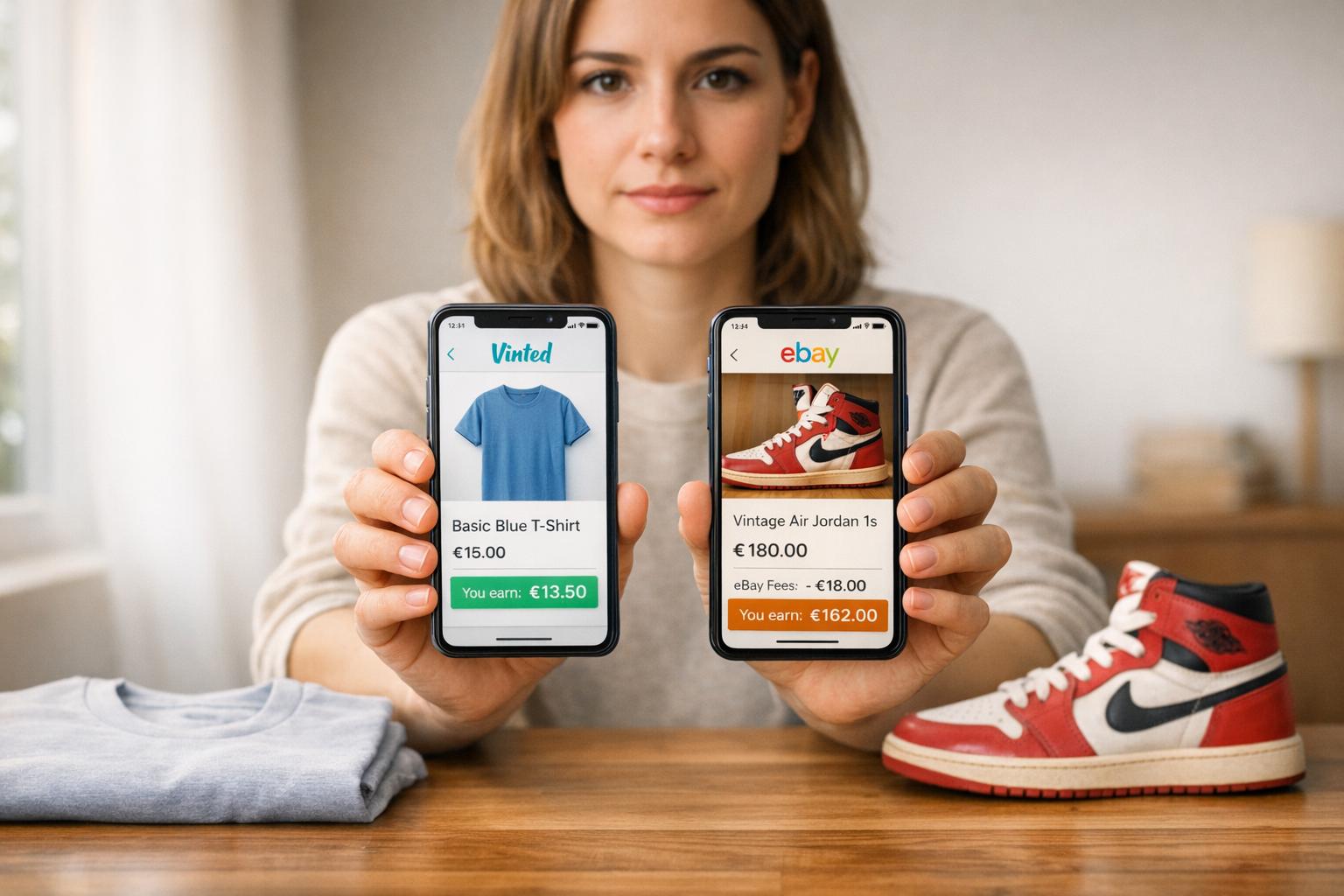
Selling vintage items? Choosing the right platform can make or break your profits. Here’s the key takeaway:
- Vinted: Zero seller fees. You keep 100% of your sale price. Perfect for fashion items priced €5-€50. Buyers often negotiate, so price 10-15% higher to hit your target.
- eBay: Charges 13-15% in fees but has a global audience, ideal for rare or high-value items (€200+). Auctions can drive prices higher, especially for collectibles.
Quick Comparison
| Feature | Vinted | eBay |
|---|---|---|
| Seller Fees | 0% | 13-15% + €0.30-€0.40 |
| Best For | Affordable fashion | Rare, high-value items |
| Buyer Behavior | Negotiates prices | Willing to pay premiums |
| Listing Options | Fixed-price only | Fixed-price & Auctions |
Bottom line: Use Vinted for everyday fashion to maximize profit and eBay for rare or collectible items where higher fees can be offset by premium prices. Let’s dive deeper into how these platforms shape your reselling strategy. For more expert advice, check out our reselling blog.
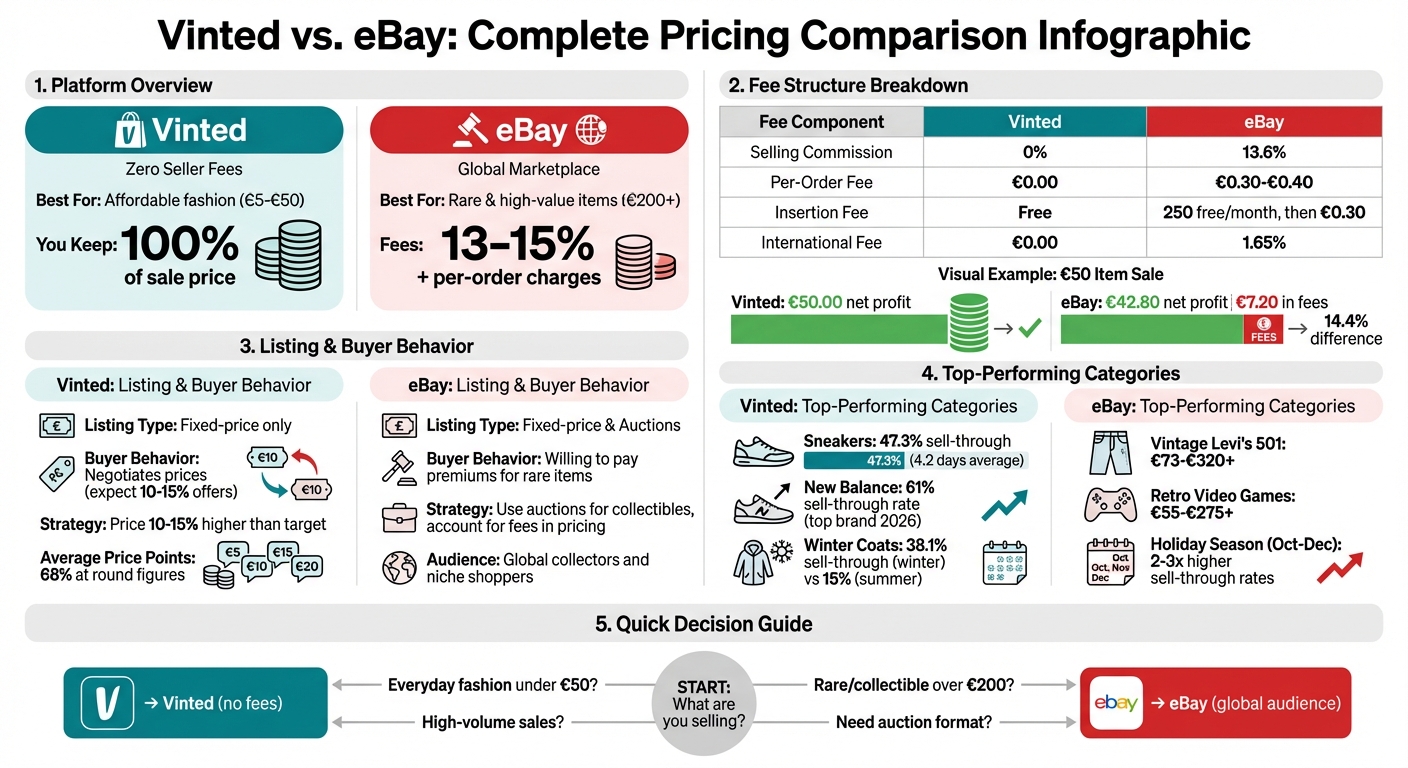
Vinted vs eBay Fee Comparison and Pricing Strategy Guide
Fee Structures: How Platform Costs Affect Your Pricing
Vinted's Zero Seller Fee Model
Vinted stands out with its seller-friendly approach: you keep 100% of your listing price. There are no selling commissions or transaction fees. For instance, if you sell a vintage blazer for €50,00, that entire amount lands in your pocket. Instead of charging sellers, Vinted applies a "Buyer Protection" fee to the purchaser.
This setup works particularly well for everyday fashion and lower-priced items. If you're selling in high volumes - like kids' clothing, high-street brands, or seasonal pieces - Vinted allows you to remain price-competitive without eating into your margins. You can list items at market value without worrying about platform deductions.
On the other hand, platforms like eBay take a different approach, directly impacting your profits through their fee structure.
eBay's Variable Fees and Their Impact
eBay employs a more complex fee system that directly affects your earnings. For most categories, including vintage clothing and collectibles, eBay charges a Final Value Fee of 13,6% on the total sale amount (this includes shipping and taxes). Additionally, there's a fixed per-order fee: €0,30 for items up to €10,00 or €0,40 for items over €10,00. If you list more than 250 items in a month, you'll also face an insertion fee of about €0,30 per additional listing.
Let's break it down: selling a €50,00 item on eBay incurs a Final Value Fee of €6,80 (13,6%) plus a €0,40 per-order fee, totalling €7,20 in deductions. That leaves you with a net profit of €42,80 - a 14,4% difference compared to Vinted's zero-fee structure. If you're selling internationally, an extra 1,65% transaction fee applies.
Comparison Table: Vinted vs. eBay Fees
| Fee Component | Vinted | eBay (Standard Seller) |
|---|---|---|
| Selling Commission | 0% | 13,6% |
| Per-Order Fee | €0,00 | €0,30–€0,40 |
| Insertion Fee | Free | 250 free/month, then €0,30 |
| International Fee | €0,00 | 1,65% |
| Net Profit (€50,00 item) | €50,00 | €42,80 |
Understanding these fee structures is key to pricing your vintage items competitively. Vinted is a strong choice for sellers looking to maximise profit per item, especially for lower-priced fashion and high-volume sales. On the flip side, eBay's fees may be worth it if you're targeting serious collectors willing to pay premium prices. However, you'll need to price carefully to account for these deductions while maintaining profitability.
sbb-itb-d4aa959
Pricing Flexibility: Fixed-Price vs. Auction Models
Vinted's Fixed-Price Listings
Vinted keeps things simple with its fixed-price model. Sellers just set a price, list the item, and wait for buyers - no need to worry about auction timings, starting bids, or reserve prices. This straightforward system is ideal for sellers who want to list items quickly without dealing with the complexities of dynamic pricing.
That said, this simplicity comes with a catch: you’ll need to do your homework upfront. Without the price discovery mechanism of auctions, it’s up to you to research comparable sales to ensure your price is competitive. Overpricing can leave your listing unnoticed.
"Vinted is perfect for casual sellers who don't want to get too tangled in complexities, since it's a simple platform for fashion items." – Perry Dasilva, Vendoo
To improve your chances of a sale, consider psychological pricing strategies like listing an item at €29 instead of €30. You can also set a "high anchor" price - 10–15% above your target - to leave room for negotiation. For example, in September 2025, a reseller used this tactic with a Zara pleated skirt. Initially listed at €18 with minimal details, the item attracted just one favourite in six days. After revising the title, adding measurements, and raising the price, the skirt received three offers within 48 hours and sold at the target price.
While Vinted's fixed-price model works well for many, platforms like eBay provide additional flexibility for sellers with diverse pricing strategies.
eBay's Dual Listing Options
eBay stands out by offering both fixed-price (Buy It Now) and auction formats, giving sellers the flexibility to tailor their approach based on the item. Fixed-price listings are great for items with a predictable market value, while auctions shine when selling rare or hard-to-price pieces.
"Rare, desirable, or hard-to-price items often achieve higher final prices at auction." – Vinting.app
Auctions are particularly effective for collectibles, rare streetwear, or high-value items (typically over €200), where international interest can drive up bids, often requiring a Vinted UK reshipper to access specific markets. However, auctions come with added complexity - you’ll need to carefully plan listing durations (usually 7–10 days), set reserve prices, and manage bids. Keep in mind that eBay’s seller fees, which average around 12–14% of the final sale price, can eat into your profits, so it’s crucial to account for these costs when pricing your items.
Even with its fixed-price option, eBay requires sellers to adjust prices to cover its fees while staying competitive in the marketplace.
Price it right! Vinted & eBay selling tips for maximum profit.
Buyer Behavior: Platform-Specific Expectations
Understanding how buyer behavior shifts across platforms is key to making smart pricing decisions. This builds on the fee structures and listing strategies mentioned earlier.
Vinted's Community of Sustainable Fashion Shoppers
While Vinted and Depop both serve the resale market, Vinted appeals to a crowd of budget-conscious, sustainability-focused shoppers. Across Europe and North America, users approach the platform as if it’s a digital "yard sale", where haggling is part of the experience.
Data shows that Vinted thrives on volume rather than high margins. For example, an analysis of 10,000 listings found that over 68% of items are priced at round figures like €5,00, €10,00, €15,00, or €20,00. Interestingly, listings priced at €10,00 make up 28% of all items, but these often get negotiated down to about €7,00.
Vinted sellers can use this trend to their advantage by listing items 10–15% higher than their target price. So, if your goal is to earn €27,00 for a jacket, listing it at €29,00 can leave room for negotiation. Following Vinted selling tips like these can significantly improve your sell-through rate. Also, first impressions matter - buyers decide in about 3 seconds based on the quality of photos, brand, and condition. High-quality images can even boost prices by 10–20%.
eBay's Global Audience of Collectors and Bargain Hunters
eBay, on the other hand, caters to a more varied audience. Its buyers include collectors, professional resellers, and niche shoppers who are often willing to pay market value - or even a premium - for rare or authentic items. This makes eBay a strong platform for selling collectibles, vintage items, and other sought-after pieces.
For sellers, emphasizing authenticity, rarity, and excellent condition is key. Using eBay's "Sold" listings filter can help you gauge market trends and set competitive prices. Auction formats can also be a smart choice for rare items, as bidding wars may push final prices higher than expected. However, keep in mind that eBay’s seller fees, typically around 13–15%, need to be factored into your pricing strategy.
These differences in buyer behavior highlight the importance of tailoring your pricing approach depending on the platform, the season, and the type of items you're selling.
Seasonal and Category-Specific Pricing Adjustments
Seasonal Trends in Fashion and Collectibles
Timing is everything when it comes to seasonal items. For example, winter coats sell at premium prices in November, but trying to move them in June often means steep discounts. To match demand peaks, aim to source seasonal inventory 4–6 weeks in advance.
On eBay, demand skyrockets between mid-October and mid-December. Some categories experience sell-through rates that are 2–3 times higher than usual. Resellers often raise prices by 5–15% in high-demand categories like toys, electronics, and luxury goods during this time, as holiday shoppers tend to be less price-sensitive. However, once January rolls around, demand plummets, forcing sellers to cut prices by 15–20% to clear out leftover seasonal stock.
Vinted operates on a predictable monthly cycle for fashion. Activewear sees a surge in January and February, spring layers dominate March and April, and "ugly sweaters" are a hit from October through December. Jackets and coats perform exceptionally well in winter, boasting a 38.1% sell-through rate, but this dips dramatically to around 15% in summer. Ugly Christmas sweaters, which can sell for €23–€50 in October and November, are virtually unsellable during the summer months.
These seasonal shifts align with each platform's category strengths, making it crucial to adjust pricing strategies to match both the time of year and the platform's focus, or automate your Vinted success to stay ahead of market shifts.
Category-Specific Pricing Strategies
In addition to seasonal trends, understanding the dominant categories on each platform is key to setting the right prices. Just as listing formats and fee structures vary, so do the pricing strategies tailored to each platform's strengths.
Vinted excels in secondhand fashion, while eBay is a go-to for collectibles, vintage electronics, and niche goods. On Vinted, sneakers are the most sought-after category, with a 47.3% sell-through rate within 30 days and an average sale time of just 4.2 days. New Balance sneakers, in particular, lead the pack with a 61% sell-through rate - the top-performing brand in 2026.
For vintage items on eBay, factors like authenticity and rarity significantly influence pricing. Take vintage Levi's 501 jeans from the 1970s, for instance. Specific details like "Big E" or "Red Tab" can push prices anywhere from €73 to over €320. Similarly, retro video games like Earthbound or Chrono Trigger can fetch between €55 and €275+ in 2026. eBay’s auction format often adds excitement, driving up final prices through competitive bidding.
Here’s a snapshot of how pricing strategies align with seasonal trends and platform-specific categories:
| Season | High-Demand Category (eBay/Vinted) | Pricing Strategy Adjustment |
|---|---|---|
| Q1 (Jan–Mar) | Activewear, Fitness, Lingerie | Reduce holiday inventory prices by 15–20% |
| Q2 (Apr–Jun) | Spring Fashion, Garden Tools | Price at market rate; use authentic "worn" photos |
| Q3 (Jul–Sep) | Back-to-School, Denim, Fall Layers | Stock up 4–6 weeks before Q4 |
| Q4 (Oct–Dec) | Toys, Collectibles, Ugly Sweaters | Raise prices by 5–15% |
Conclusion: Key Takeaways for Optimising Reseller Pricing
Deciding between Vinted and eBay comes down to aligning your inventory with what each platform does best. Vinted's no-seller-fee model works perfectly for everyday fashion items priced between €5 and €50. Here, using a high anchor strategy - listing items 10–15% above your target price - leaves room for negotiation, making it a smart approach. On the other hand, eBay's 12–14% final value fees mean higher listing prices are necessary. Its global audience and auction features make it ideal for collectibles, electronics, and rare finds priced over €200.
How you present your items matters just as much as pricing. Clear, high-quality photos can increase perceived value, allowing you to charge 10–20% more. Combining this with strategies like the 60/80/95 Rule and psychological pricing (e.g., €39 instead of €40) can significantly boost click-through rates and buyer interest.
Timing your listings is another critical factor. For instance, sneakers sell on Vinted in about 4.2 days during peak months. Seasonal items, like winter coats, might fetch higher prices in November but could need a 15–20% discount by January to move inventory. To speed up sales, cross-listing your products on three platforms has been shown to triple sell-through rates.
Managing these strategies effectively often requires automation, especially for high-volume sellers. Tools like VintiePlus offer features such as real-time scanning, instant auto-buying of underpriced items, and detailed profit analytics. These capabilities help secure profitable inventory and streamline operations for scaling your business.
At the end of the day, successful resellers view pricing as a dynamic process. By continuously adjusting based on views, favourites, seasonal trends, and platform-specific buyer habits, you can consistently maximise your profits on both Vinted and eBay.