
Selling on Vinted? Here's what you need to know about returns:
- Mandatory Returns: Required for items that are lost, damaged during shipping, or significantly not as described (SNAD). Counterfeit items may not need to be returned if confirmed as fake.
- Discretionary Returns: For reasons like fit or style, it's your choice whether to accept the return.
- Timing: Respond to return requests within 72 hours to avoid automatic approvals. Buyers must report issues within 2 days of delivery.
- Cross-Border Sales: EU Pro sellers must offer a 14-day return window. Private sellers are exempt but still follow Vinted's policies for lost or damaged items.
- Costs: Refunds may include customs taxes and a 1.2% currency conversion fee for international sales. For EU sellers, VAT on secondhand goods applies only to profit margins under specific schemes.
To reduce disputes, provide accurate descriptions, use secure packaging, and act quickly in case of disputes. Always document items and packaging to protect yourself.
How Vinted's Return Policy Works
Vinted Mandatory vs Discretionary Returns Guide for Sellers
Vinted splits returns into two categories: those that are mandatory and those decided at the seller's discretion. This approach helps balance protecting your earnings while minimizing conflicts.
Mandatory Returns vs. Buyer Preference Returns
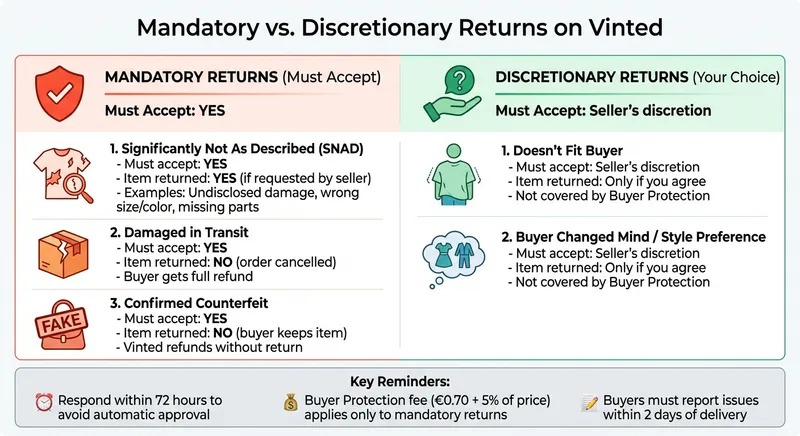
There are three situations where returns are mandatory: when the item doesn’t arrive, is damaged during shipping, or is deemed "Significantly Not As Described" (SNAD). In cases of confirmed counterfeit items, Vinted refunds the buyer without requiring a return. However, if authenticity is unclear, the buyer must return the item to receive a refund.
For issues like size or style mismatches, the decision to accept a return is entirely up to you. Vinted clarifies: “The Refund Policy unfortunately doesn't cover items that don't fit you or don't suit you. You can still talk to your seller about a return, but it's their decision whether to accept the return or not”.
| Situation | Must You Accept? | Item Returned? |
|---|---|---|
| Significantly Not As Described | Yes | Yes (if requested by you) |
| Damaged in Transit | Yes | No (order cancelled) |
| Confirmed Counterfeit | Yes | No (buyer keeps item) |
| Doesn't Fit Buyer | Seller discretion | Only if you agree |
| Buyer Changed Mind | Seller discretion | Only if you agree |
Keep in mind that the Buyer Protection fee - €0.70 plus 5% of the item's price - only applies to mandatory returns.
Clearly outlining these return rules in your profile can help set the right expectations for buyers.
Communicating Your Return Policy
To avoid misunderstandings, include your stance on discretionary returns in your profile and item descriptions. For example, if you’re unlikely to accept returns due to fit or style, make that clear upfront.
If a buyer files an SNAD claim and you disagree, make sure to respond within 72 hours to prevent the claim from being automatically approved. If Vinted decides the item was accurately described, the order will be marked as complete, and you’ll receive payment.
Also, ensure your default return address is up to date in your profile settings, as this is the address Vinted shares with buyers during disputes. If you’ve moved or prefer returns to go to a service point, communicate this directly with the buyer through the chat to avoid complications.
sbb-itb-d4aa959
Returns for Cross-Border Sales
When it comes to cross-border sales, Vinted's standard return policies are just the starting point. These transactions bring additional legal and logistical factors into play, largely influenced by the buyer's country of registration. Below, we break down the key rules and responsibilities for sellers.
EU 14-Day Return Rights for Pro Sellers
Under EU consumer law, buyers purchasing from Pro sellers enjoy a 14-day cooling-off period. This means they can return items for any reason within 14 days of delivery. After notifying the seller, buyers then have another 14 days to send the item back.
Private sellers, however, are not bound by this rule. As noted by Your Europe, "Goods bought from a private individual are not covered by the right of withdrawal". That said, private sellers must still comply with Vinted's standard Refund Policy if an item is lost, damaged, or significantly not as described.
In most cases, buyers cover return shipping costs unless you’ve agreed to pay them or failed to clearly outline these costs before the purchase. To avoid confusion, make sure to specify these details in your item descriptions.
Returns from Outside the EU
Cross-border returns outside the EU operate under different guidelines. For example, selling to buyers in countries like the UK or US involves added complexities, often requiring a Vinted UK reshipper to manage logistics. If a buyer requests a return for valid reasons - such as the item being lost, damaged, or not as described - Vinted will refund the full amount, including any customs tax and import VAT collected at checkout.
For transactions between the US and UK, international shipping is limited to items weighing under 2 kg and valued at less than £120 (excluding fees).
It’s also crucial to check the list of prohibited items specific to the buyer’s country. For instance, perfumes, aerosols, and dietary supplements cannot be shipped between the US and UK. If customs seizes a prohibited item, it won’t be returned to you, and compensation is unlikely. Always review the prohibited items list for your buyer's country before shipping to avoid unnecessary losses.
Handling Return Requests and Disputes
Common Return Request Situations
When a buyer raises an issue, your payment is temporarily put on hold until the matter is resolved. Make sure to respond within 72 hours to avoid the situation escalating further.
Most return requests fall into three main categories. The first is Significantly Not As Described (SNAD) claims. These happen when buyers report issues like undisclosed damage, incorrect sizes or colors, or missing parts. The second involves damage during transit, where items arrive broken due to shipping problems. Lastly, there are counterfeit concerns, where you must provide proof of authenticity within a strict 48-hour window. It's worth noting that Vinted’s Refund Policy doesn’t cover subjective issues like fit or personal preference unless you agree to the return.
You have three ways to resolve these situations:
- Full refund: Refund the buyer entirely without requiring the item back, which cancels the order.
- Partial refund: Offer a partial refund for minor problems, letting the buyer keep the item (this isn’t an option for bundles).
- Request a return: Ask the buyer to return the item, giving them five business days to ship it back.
These options ensure you’re prepared for the dispute resolution process that follows.
How Vinted Resolves Disputes
If you believe your item was accurately described, you can dispute the claim. Vinted Support will review the evidence, such as photos and item descriptions, to determine if the item qualifies as SNAD. If it doesn’t, the order will be completed, and you’ll receive your payment.
For authenticity disputes, timing is critical. You need to respond to the claim within 72 hours and provide proof of authenticity within 48 hours. If required, use the remaining 24 hours to submit additional evidence. Be aware that if you don’t respond to a dispute within 14 days, Vinted may automatically cancel the order and issue a refund to the buyer.
When you accept a return, always request a valid tracking number and a photo of the shipping label. Once the item arrives back, take a photo of the unopened parcel and its contents. You then have two days to confirm that "Everything is OK." If you don’t act within this time, the refund will be processed automatically. However, if the returned item is damaged or doesn’t match what you originally sent, report it to Vinted immediately. Keep in mind that confirming "Everything is OK" will close the case permanently.
Reducing Returns Before They Happen
Writing Accurate Item Descriptions
One of the simplest ways to cut down on returns is by providing honest and detailed descriptions of your items. Be specific. Include centimetre measurements, list the materials used, and mention any alterations. If brand labels or accessories are missing, make sure to point that out. For electronics, include essential details like the brand, model, storage capacity, display size, and plug type.
Make your titles clear and descriptive. For example, instead of saying "nice dress", go with something like "New pink Zara mini evening dress." Transparency is key - list every imperfection, such as marks, stains, holes, pilling, fraying, stretched fabric, faded colours, or odours. Match these flaws with clear photos. By being upfront about any issues, you can avoid "Significantly Not As Described" (SNAD) claims. Following expert reselling tips can further help you navigate these marketplace challenges.
Proper Packaging to Prevent Damage
Accurate descriptions are just one part of the equation. Proper packaging is equally important to avoid return claims due to damage during transit. Packaging items securely helps protect against "damaged in transit" claims, which can often result in full refunds.
Here's a tip: perform a shake test after packing. If the item moves around inside the box, add filler materials like crumpled kraft paper, packing peanuts, or honeycomb cardboard. Secure the box with H-taping, covering all seams and flaps.
To protect against moisture, place items in a waterproof bag or zip-lock pouch before putting them in the outer mailer or box. For fragile items, use the double-skin technique: wrap the item in bubble wrap, add interior padding, and place it inside a sturdy outer box. Choose your packaging wisely - poly mailers work for lightweight clothing, while heavier items need double-walled boxes. If shipping shoes, place the shoebox inside another cardboard box for added protection.
Finally, document everything. Take photos of the item, its packaging, the sealed box (with the label visible), and the package on a scale. This simple step can resolve up to 95% of shipping disputes. If you're shipping electronics, remember to perform a factory reset and disconnect any personal accounts (Google, Apple, Samsung). This ensures the buyer can start using the device right away.
Cost of Returns in Cross-Border Sales
Currency Exchange and Refund Fees
When selling internationally on Vinted, a 1.2% currency conversion fee is applied by Adyen N.V. This fee is included in the exchange rate shown at checkout, which means it directly impacts your final payout.
If a buyer requests a return, the refund usually covers several components: the item price, Buyer Protection fee, initial shipping fee, sales tax, and customs tax. For partial refunds, the buyer gets a full refund of the customs tax but only a proportional refund of the other costs. To maintain your profit margins, it’s wise to maximize your reselling success by accounting for this 1.2% fee when setting prices for cross-border sales.
Additionally, sellers need to keep VAT obligations in mind when handling returns.
VAT and Secondhand Margin Scheme Considerations
For secondhand sellers in the EU, the Secondhand Margin Scheme can ease VAT requirements. Under this scheme, you only pay VAT on your profit margin instead of the full sale price. This applies to most secondhand goods purchased without VAT.
If a return results in a negative profit margin, you can record €0 for VAT. It’s important to keep margin goods separate in your records. Also, invoices for these items shouldn’t include VAT but must state "special scheme - used goods" (or in Dutch: bijzondere regeling - gebruikte goederen). For secondhand items purchased for €500 or more without VAT, ensure you retain a purchase statement.
Conclusion
Navigating Vinted's return policies and handling cross-border sales comes with its challenges, but understanding the rules can help you protect your profits and avoid unnecessary disputes.
Refunds on Vinted are only required for items that are significantly not as described (SNAD), damaged during shipping, or not delivered at all. Returns for reasons like fit or personal preference are left to the seller's discretion, giving you some flexibility in those cases.
To minimize disputes, focus on optimized and detailed listings. Include precise measurements, clear photos (especially of any flaws), and use secure, sturdy packaging to reduce the risk of SNAD claims or damage during transit.
For cross-border sales, keep in mind the added costs. Refunds may include customs taxes and a 1.2% currency conversion fee, which can eat into your margins. If you're a professional seller, you’ll need to comply with the EU’s 14-day withdrawal right, while private sellers have more leeway. Always account for customs and currency fees when pricing your items to avoid surprises.
In the event of a dispute, act quickly. Respond within 72 hours and document your items and packaging thoroughly. This can help you negotiate partial refunds or avoid full returns. Ultimately, Vinted has the final say in how buyer protection and disputes are resolved.