
Selling on Vinted in the Netherlands? Here’s what you need to know:
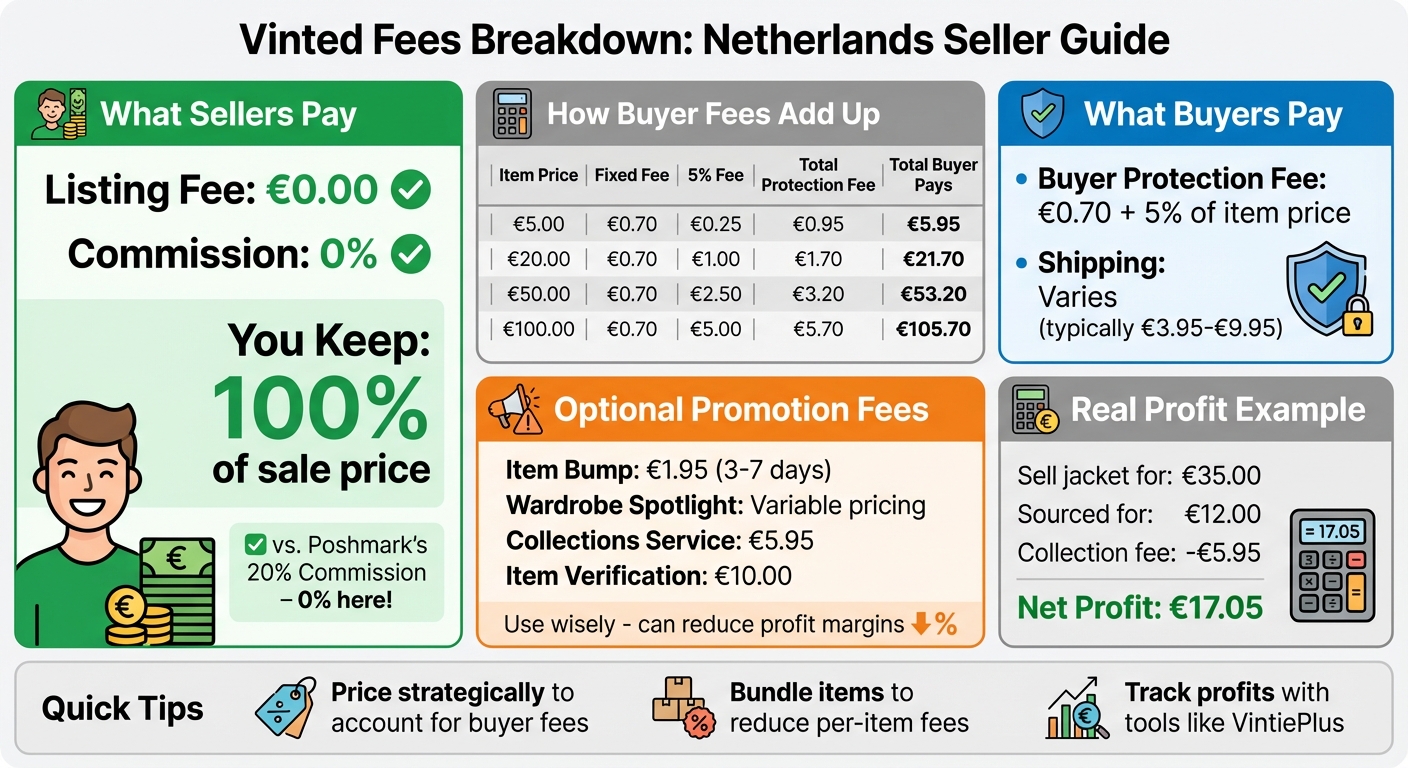
- No Seller Fees: You keep 100% of your sale price. For example, sell an item for €30,00, and you receive the full €30,00.
- Buyer Costs: Buyers pay a Buyer Protection Fee - €0,70 + 5% of the item price. This covers secure payments and support.
- Shipping: Buyers usually pay for shipping, but offering free shipping means you’ll absorb the cost. Adjust your pricing accordingly.
- Paid Promotions: Optional tools like Item Bumps (€1,95) or Wardrobe Spotlight can boost visibility but may reduce your profits. Use these wisely, especially for higher-value items.
- Profit Margins: Always factor in sourcing, shipping, and optional fees to calculate your net profit.
Example: Sell a jacket for €35,00, sourced for €12,00. After a €5,95 promotion, your profit is €17,05.
Want to sell smarter? Price your items strategically, bundle listings to reduce fees, and track profits with tools like VintiePlus.
Vinted Fees Breakdown: Seller vs Buyer Costs in the Netherlands
How Vinted's Zero Seller Fee Model Works
Vinted's zero seller fee model allows you to list items, sell them, and pocket 100% of your asking price. There’s no commission or listing fee. For example, if you sell a jacket for €30,00, that entire amount lands in your Vinted wallet or bank account - no deductions.
This approach sets Vinted apart from competitors. Take Poshmark, for instance: selling an item for €20,00 there would leave you with only €16,00 after a 20% commission. Over time, these fees can pile up, especially for sellers dealing in high-volume brands like Nike, Zara, or H&M. Knowing what sells best on Vinted can help you maximize these fee-free profits. That’s why Vinted’s model is particularly appealing.
So, how does Vinted make money without charging sellers? The platform shifts the cost to buyers via the Buyer Protection Fee. This fee usually includes a fixed amount of €0,70 plus 5% of the item’s price. Additionally, Vinted earns revenue through optional paid features like Item Bumps (which promote your listings) and partnerships with shipping providers.
"While other platforms were charging me for the privilege of selling, Vinted was charging the buyer for the privilege of buying." - CLOSO
One thing to keep in mind: while you keep 100% of your listing price, offering free shipping will cut into your earnings by the shipping cost. Typically, buyers pay for shipping separately, but some sellers choose to cover the cost to attract more buyers. If you take this route, make sure to adjust your pricing to account for it.
Up next, learn how the Buyer Protection Fee influences the dynamics between buyers and sellers.
sbb-itb-d4aa959
Buyer Protection Fee: Structure and Calculation
Whenever a buyer clicks 'Buy Now,' a Buyer Protection Fee is automatically added to their total. This fee helps cover secure payment processing, tracking, and customer support. While sellers in the Netherlands don't pay this fee directly, it does influence the total amount buyers spend.
The fee consists of two parts: a fixed fee of €0,70 and a variable fee of 5% of the item price. Let’s say you’re selling a vintage denim jacket for €50,00. The buyer would pay €0,70 plus €2,50 (5% of €50,00), making the total Buyer Protection Fee €3,20. Before shipping, the buyer’s total cost would be €53,20.
| Item Price | Fixed Fee | Variable Fee (5%) | Total Buyer Protection Fee | Total Price Paid by Buyer |
|---|---|---|---|---|
| €5,00 | €0,70 | €0,25 | €0,95 | €5,95 |
| €20,00 | €0,70 | €1,00 | €1,70 | €21,70 |
| €50,00 | €0,70 | €2,50 | €3,20 | €53,20 |
| €100,00 | €0,70 | €5,00 | €5,70 | €105,70 |
This structure means that for lower-priced items, the fee represents a larger percentage of the total cost. For example, a €5,00 item increases by about 19%, while a €100,00 item only increases by 5,7%.
Fee Differences by Region
Although the €0,70 + 5% fee model is standard across much of the European Union, including the Netherlands, other regions have different systems. In some non-Eurozone markets, tiered fee structures are used. For instance, items under US$10 might carry a fixed fee of US$0,70, while items in a higher price range (e.g., US$25–US$50) could incur a flat fee of US$2,00.
In the Netherlands, the fee structure mirrors the broader EU model. This consistency became even more established after Vinted acquired United Wardrobe in 2020.
How These Fees Affect Buyer Behavior
Understanding how this fee works can help you fine-tune your pricing strategy on Vinted. The Buyer Protection Fee directly impacts what buyers are willing to spend. For instance, a buyer eyeing a €20,00 jumper will see a total cost of €21,70 (excluding shipping), which might cause hesitation at checkout.
To address this, smart sellers adjust their pricing. If you’re selling a premium item priced at €100,00, buyers will see a total cost of €105,70 before shipping. Pricing that same item at €95,00 instead results in a total of €100,45, which could appeal more to budget-conscious buyers.
Another strategy is to encourage buyers to bundle items. Each transaction incurs the fixed fee, so separate purchases can quickly add up. For example, if a buyer purchases three items priced at €5,00 each, they would pay three separate fees totaling €2,85 (3 × €0,95). However, bundling those items into a single €15,00 purchase incurs just one fee: €1,45 (€0,70 + 5% of €15,00). Bundling spreads the fixed fee across a higher total, offering better value for buyers and increasing the likelihood of a sale. For high-volume sellers, using automation tools can further streamline these processes and maximize margins.
Paid Promotion Options: Bumps and Visibility Features
Vinted offers several paid tools to help sellers increase the visibility of their listings. However, balancing these costs with a Vinted fee calculator is key to keeping your profit margins intact. One of the most popular options is the Item Bump (also called a Boost), which moves a specific listing back to the top of search results. This service costs around €1.95 and lasts for either 3 or 7 days. Another option is the Wardrobe Spotlight, which promotes your entire shop rather than a single item. The price for this service varies based on the number of items in your wardrobe and their combined value.
Other features include the Collections service (€5.95), which lets you group related items, and Item Verification (€10.00), designed for higher-value pieces. Keep in mind that these promotions are non-transferable, meaning payments apply only to the specific listing or wardrobe you’ve selected.
For lower-margin items, the cost of promotions can quickly eat into your profits. As Lee, Founder of Vinkit and a Vinted expert, points out:
"For an article of 20 €, with a margin of 10 €, the 1.95 € cost for a Vinted-boost takes almost 20% of your win".
Because of this, it’s generally smarter to reserve paid promotions for high-value items or listings that have been sitting unsold despite good photos and competitive pricing.
Pricing and Duration of Promotions
Item Bumps are available for either 3 or 7 consecutive days, with activation occurring daily. Before you invest in a boost, make sure your listing is in top shape - update your photos, polish the description, and set a fair price. While you’re allowed to lower the price during an active promotion, increasing it is not permitted. For Wardrobe Spotlight, you’ll need at least 5 active listings for the promotion to run effectively over its 7-day duration.
Now that we’ve covered the pricing and duration, let’s dive into when these tools work best.
Best Times to Use Paid Promotions
The timing of your promotions can significantly impact their success. For the best results, activate boosts during peak activity periods: weeknights between 18:00 and 22:00, or all day Sunday, which is Vinted’s busiest day. On the other hand, avoid promoting items during off-peak hours, such as late at night, when user activity is low.
Use Item Bumps for listings that need a quick visibility boost, such as high-demand or trending items, or for listings that have had fewer than 5 views in 30 days. Wardrobe Spotlight works particularly well if you’re trying to grow your follower base or have multiple related items. Research suggests this tool can increase your chances of reselling by up to three times. For highly competitive categories like streetwear, consider promoting every 7–10 days. However, for niche vintage pieces, a boost every 2–3 weeks may be sufficient.
Shipping Costs and Their Effect on Profits
Shipping fees on Vinted play a big role in shaping your profit margins. Understanding how different shipping models and costs work is key to protecting your earnings and pricing items smartly.
Free Shipping vs. Buyer-Paid Shipping
Vinted typically uses a buyer-paid shipping model. In this setup, the buyer covers both the shipping costs and the Buyer Protection Fee (€0,70 + 5% of the item's price) at checkout. This means you get the full listing price without shipping costs eating into your profits. It’s a straightforward way to keep your earnings intact.
Alternatively, you can offer free shipping, where you absorb the shipping costs. While this might attract more buyers, it reduces your net profit. For example, if you sell a vintage jacket for €30,00 with a shipping cost of €5,95, your actual profit drops to €24,05. To maintain the same profit margin, you’d need to list the jacket at €35,95. However, a higher price might put off potential buyers.
There’s also the option of custom shipping, where you choose the carrier and set the shipping price. Keep in mind that taxes may apply, adding to your costs.
To better manage your pricing strategy, it’s helpful to know the common shipping costs in the Netherlands.
Common Shipping Costs in the Netherlands
In the Netherlands, most sellers rely on PostNL for shipping. Other carriers, like DHL, DPD, Homerr, Mondial Relay, and UPS, are also available through Vinted’s integrated label system. Shipping rates depend on the size, weight, and destination of the package. If you're looking to shop from UK Vinted while based in Europe, reshipping services can help manage these international logistics. These costs are displayed on the item page and during checkout.
| Package Type | Typical Weight Range | Typical PostNL Cost |
|---|---|---|
| Small parcel (letterbox) | Up to 2 kg | €3,95–€4,95 |
| Medium parcel | 2–5 kg | €5,95–€6,95 |
| Large parcel | 5–10 kg | €7,95–€9,95 |
To avoid disputes, always use tracked and insured shipping methods. This ensures you’re protected against "item not received" claims. If you can’t provide tracking proof, Vinted may side with the buyer. As an extra precaution, take photos of the item, its packaging, and the shipping label before sending. These steps can be crucial if any issues arise.
Profit Calculation Examples for Netherlands Sellers
When figuring out your profits, it’s essential to consider shipping and promotional costs. Let’s explore how these factors impact your earnings across different price ranges.
Profit Breakdown by Price Range
To calculate your profit, subtract sourcing costs and optional fees from your listing price. While you keep 100% of the listing price, additional costs like buyer protection fees and optional promotions can reduce your net earnings.
For items priced under €10, your profit margin stays untouched since you retain the full listing price. For example, selling a vintage T-shirt for €8,00 that you sourced for €2,00 results in a gross profit of €6,00. Keep in mind that the buyer protection fee and shipping costs are added separately. To maintain your margins, it’s best to avoid promotions on lower-priced items.
Mid-range items (€10–€50) offer room to use promotions without heavily impacting your profits. Take a vintage jacket sold for €35,00, which you sourced for €12,00. This gives you a gross profit of €23,00. After deducting a €5,95 Collection fee, your net profit becomes €17,05. Promotions may help boost visibility and speed up sales. Again, buyer protection fees and shipping costs apply separately.
For high-value items (over €50), opting for the Item Verification Service can be a smart choice. Let’s say you sell a designer handbag for €150,00, which cost you €60,00 to source. Your gross profit is €90,00, but after deducting the €10,00 verification fee, your profit drops to €80,00. This service can help build trust with buyers, especially for luxury goods. Buyer protection fees and shipping costs are also added separately.
Here’s an example of how this plays out with €2,50 shipping:
| Item Price | Item Cost | Optional Fee | Seller Profit | Buyer Protection Fee | Total Buyer Cost (incl. €2,50 shipping) |
|---|---|---|---|---|---|
| €8,00 | €2,00 | €0,00 | €6,00 | €1,10 | €11,60 |
| €35,00 | €12,00 | €5,95 (Collection) | €17,05 | €2,45 | €39,95 |
| €150,00 | €60,00 | €10,00 (Verification) | €80,00 | €8,20 | €160,70 |
Using VintiePlus to Track Fees and Margins
If you’re managing multiple listings, calculating profits manually can quickly become overwhelming. That’s where VintiePlus comes in. This tool simplifies the process with a profit analytics dashboard. You can input details like item costs, listing prices, and promotional fees to instantly see your profit margins.
VintiePlus doesn’t just calculate profits - it tracks your revenue across all listings in real time, factoring in optional services like bumps or verification. This means you can make faster, more informed pricing decisions. For instance, you can quickly determine if buying an item for €15,00 and listing it for €45,00 will generate enough profit.
Additionally, VintiePlus provides valuable insights to help you optimise your inventory. Over 10.518 sellers already use this platform to grow their Vinted shops. Analytics might show, for example, that items priced between €20–€40 sell the fastest, while those over €80 bring in higher profits per unit but sell more slowly. Armed with this data, you can balance your inventory to maintain steady cash flow while maximising your overall earnings.
Summary: What Resellers Need to Know About Vinted Fees
Here’s a quick rundown of the key points about Vinted fees: Vinted operates on a zero-commission model, meaning you keep the full sale price of your items. Buyers, however, pay a fixed fee plus 5% as part of the Buyer Protection Fee, which helps keep your listings attractive compared to other platforms.
Keep an eye on optional expenses like Item Bumps and Wardrobe Spotlight promotions. If you offer free shipping, make sure to factor that into your pricing to safeguard your profit margins. Calculating your net profit in advance is crucial to avoid selling items at a loss.
For sellers managing a large number of listings, manually tracking fees and expenses can become a hassle. Tools like VintiePlus simplify this by automating profit tracking, taking into account everything from sourcing costs to promotional fees and shipping.
Vinted’s algorithm prioritises new or recently updated listings, so delisting and relisting items periodically can help optimize your Vinted SEO. Combine this with accurate shipping estimates and smart use of promotions to optimise your profits. The key is to strike a balance between selling quickly and maintaining healthy profit margins - Vinted rewards both efficiency and thoughtful inventory management.