
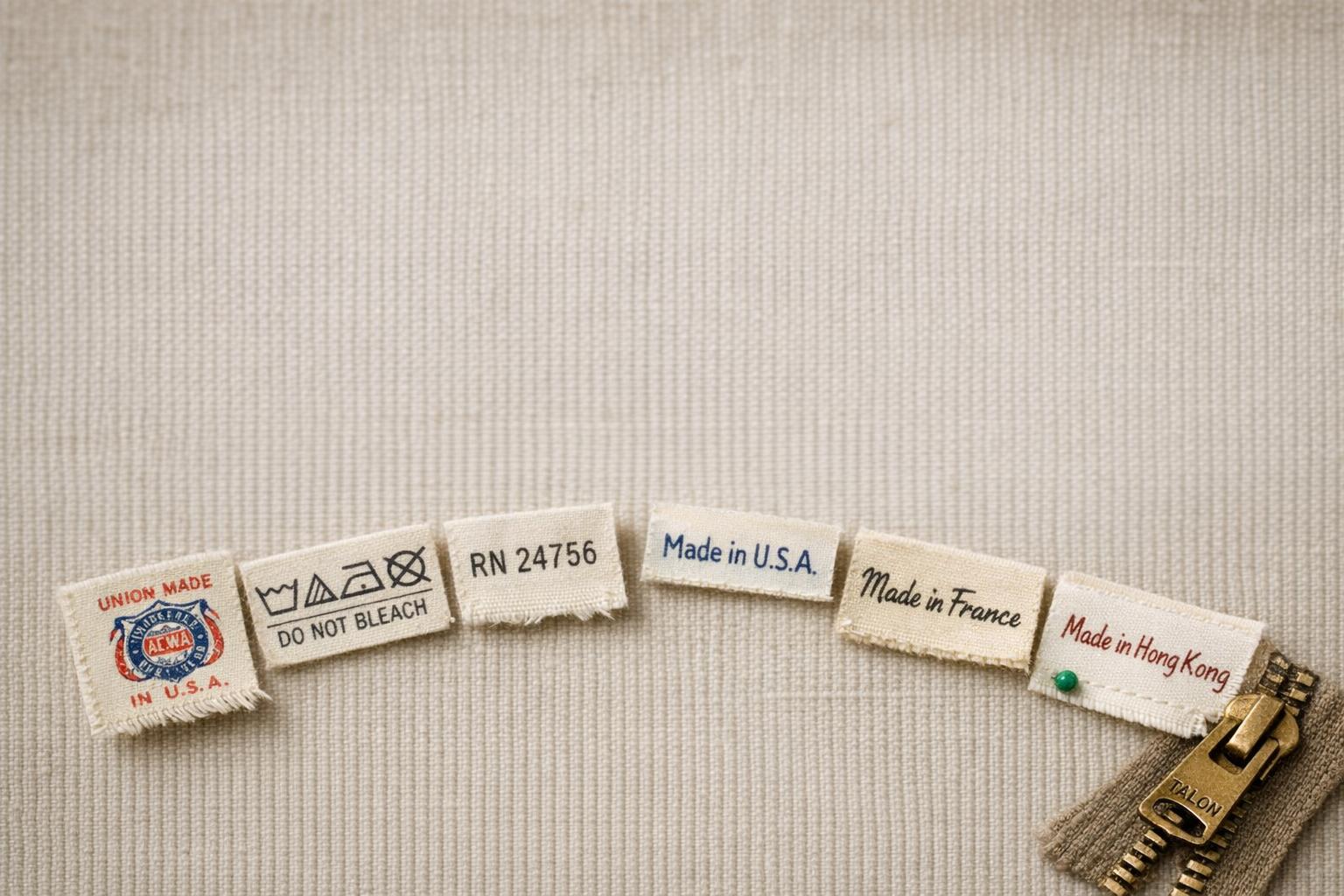
Vintage clothing labels are a treasure trove of information, helping you determine a garment's era, origin, and even value. Whether you're a reseller in the Netherlands or a collector, understanding labels can turn a €15 find into a €150 gem. Here’s the core takeaway:
- Union Labels: Key for dating items; look for ILGWU or ACWA tags to pinpoint production years.
- Care Labels: Mandatory in the U.S. from 1971; their absence signals pre-1971 production.
- Material Tags: Fibre percentages became standard after 1960; earlier pieces often lack these details.
- Country-of-Origin Labels: Tags like "Made in British Crown Colony of Hong Kong" (1950s–1983) or "Made in Yugoslavia" confirm vintage status.
- Typography: Script fonts suggest pre-1960s, while sans-serif styles are common after 1980.
Tools like VintiePlus simplify sourcing, with features like auto-buying and label filters for rare finds. Whether you're spotting a Woolmark logo from 1964 or an NRA Blue Eagle tag from 1934, label knowledge is key to identifying and pricing vintage clothing effectively.
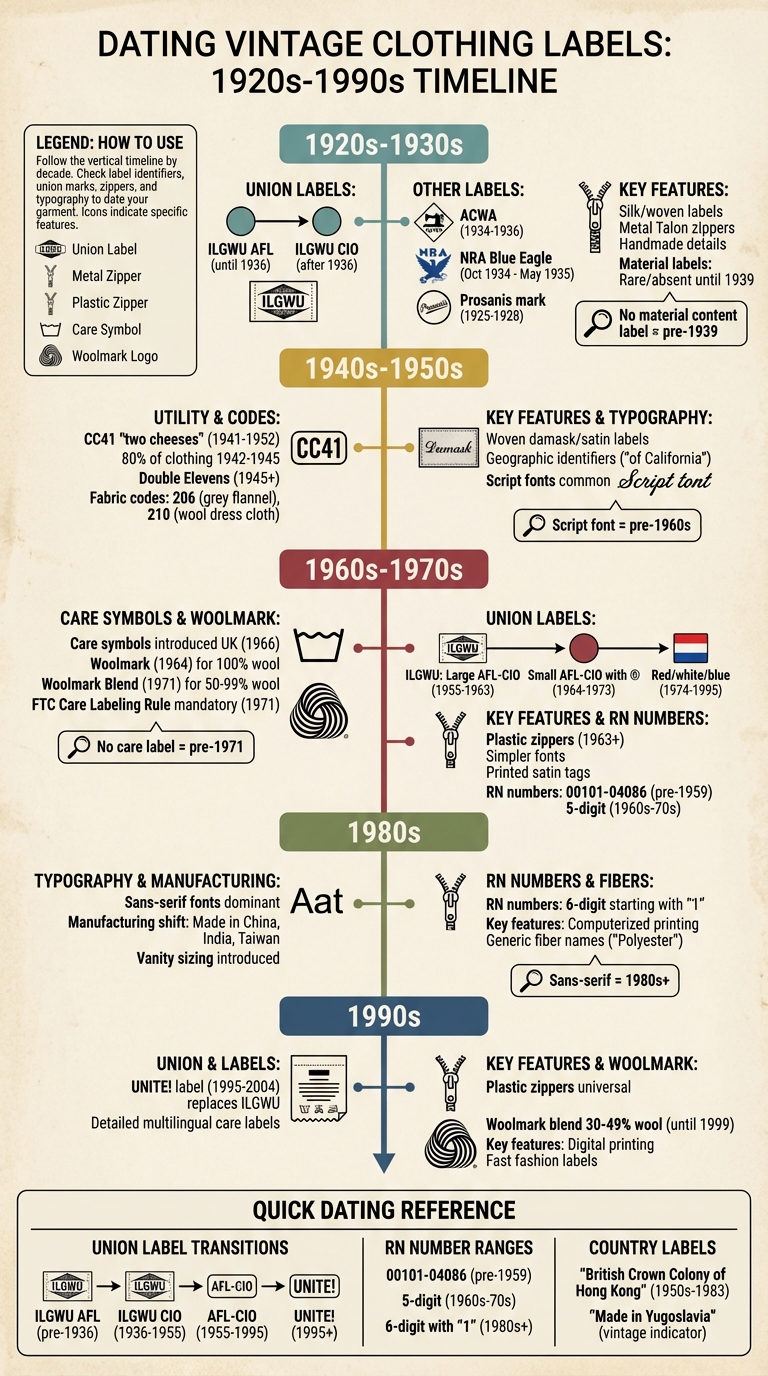
Visual Guide to Dating Vintage Clothing Labels by Decade (1920s-1990s)
How To Date Vintage Garments || Detailed and with examples
sbb-itb-d4aa959
1920s–1930s: Early Union Labels and Handmade Details
Clothing from the 1920s and 1930s holds a special allure, partly because union labelling wasn’t yet a widespread requirement. Before 1933, major unions like the Amalgamated Clothing Workers of America (ACWA) didn’t mandate labels on manufactured garments, and even wool items typically lacked material labels until 1939. Finding a labelled piece from this era is a rare and exciting discovery.
Union Tags and Early Label Materials
Union labels from this time reveal a lot about labour history and production practices. For example, the International Ladies' Garment Workers' Union (ILGWU), founded in 1900, used labels marked "ILGWU AFL" until 1936. After a union split that year, the labels changed to "ILGWU CIO", helping to date garments to within a specific 10- to 20-year period.
In men’s fashion, the ACWA had become a dominant force by 1920, producing 85% of men’s garments. However, union labels didn’t become standard until 1933. Early ACWA tags from 1934 to 1936 are particularly distinctive, featuring a design with a sewing machine and scissors framed in a diamond, along with red numbering. These tags often include "Copyright 1934" or "Copyright 1936", making them a handy tool for dating mid-to-late 1930s pieces.
One of the most precise indicators is the NRA Blue Eagle label, depicting an eagle clutching lightning bolts. This label was used for a short seven-month window - from 13 October 1934 to 27 May 1935 - before the Supreme Court declared the legislation behind it unconstitutional. Another noteworthy label is the Prosanis mark (1925–1928), issued by the Joint Board of Sanitary Control to certify that garments were made under sanitary conditions, aimed at preventing the spread of tuberculosis.
"The union tag's design, which has changed eight times since 1900, can help narrow the garment's age within a window of approximately 10 to 20 years." – Sammy, Vintage Expert, Sammy D. Vintage
Handmade Elements in Clothing
Craftsmanship was a hallmark of clothing from this era. Garments were often made from high-quality natural materials like silk, wool, and cotton and featured labour-intensive techniques such as French seams and hand-stitched hems. Metal "Talon" zippers, introduced in the 1920s, became a common side closure in the 1930s, with back zippers only becoming widespread later.
Labels themselves were often printed on silk or intricately woven, sometimes even including details like the city and state of manufacture. This reflects a time when domestic production was the standard, long before global outsourcing became the norm.
For collectors or vintage enthusiasts, tools like VintiePlus can be incredibly helpful. Their custom filters allow users to search for specific label markers such as "ILGWU AFL", "ACWA", or "Talon" zippers. With 24/7 scanning alerts, you can quickly spot rare finds and secure high-value pieces for your collection.
The transition from handmade details to more uniform practices during this period paved the way for the post-war shift to utility and mass production labels.
1940s–1950s: Post-War Utility and Quality Labels
The post-war period brought significant changes to clothing labels, shaped by wartime restrictions and a booming consumer market. Labels evolved from simple utility marks to intricate woven designs that highlighted durability and craftsmanship.
War-Era Utility Labels
One of the most iconic labels from the 1940s is the CC41 mark, often called the "two cheeses" due to its design by Reginald Shipp. Introduced in 1941, this British utility label originally stood for "Civilian Clothing 1941" (later changed to "Controlled Commodity"). It appeared on roughly 80% of clothing produced between 1942 and 1945. Unlike today’s association of "utility" with affordability or lower quality, the CC41 label guaranteed high standards, including non-shrinking fabrics and colourfast dyes. Labels from this era often included fabric codes, such as 206 for grey flannel or 210 for wool dress cloth. If a garment has a CC41 label, it was likely made between 1941 and 1952.
"CC41 was a guarantee of quality. It allowed poorer people to buy decent clothing." – Liz Tregenza, Fashion Historian
In 1945, the "Double Elevens" label was introduced, featuring a circle with two vertical lines. This label signified luxury utility items crafted from finer fabrics with more elaborate detailing. Starting in 1948, an "X" before the fabric code indicated "Super Utility" pieces, which were more expensive. For vintage enthusiasts, searching terms like "CC41", "Double Elevens", or specific fabric codes on platforms like VintiePlus can help identify these historically significant garments. As restrictions eased, label designs became more decorative, reflecting the changing times.
Rise of Woven Labels
The 1950s saw a shift from utility marks to woven labels, which were often as detailed as the garments themselves. Made using materials like damask or satin on Jacquard looms, these labels featured intricate logos, elegant fonts, and sometimes geographic identifiers like "of California" or "of Miami", which highlighted the garment's origin and prestige . Unlike printed tags, which were cheaper to produce, woven labels were a hallmark of quality and durability. Many labels from this era included phrases like "Originals" or "An Original" to emphasize unique designs, while city or state names confirmed domestic production before outsourcing became common.
The introduction of synthetic fibres like nylon and polyester also brought new possibilities. These materials were more durable and resisted wear better than older cotton tags. When examining vintage pieces, pay attention to label texture - authentic 1950s woven labels are usually softer and thicker than modern ones and lack the "papery" feel of later tags.
| Label Type | Material | Characteristics | Quality Indicator |
|---|---|---|---|
| Woven Damask | Silk or high-quality rayon | Detailed, intricate designs | Designer "Originals" |
| Woven Satin | Rayon/synthetic blends | Smooth, shiny texture | Evening wear and lingerie |
| Woven Taffeta | Cotton/synthetic | Crisp, flat weave | Everyday "Sportswear" |
| Printed Tags | Acetate/nylon | Ink-printed text | Lower production cost |
1960s–1980s: Standardization and Mass Production
The period from the 1960s to the 1980s marked a shift in label design, largely driven by the demands of mass production. This era saw a move from woven labels to more affordable printed satin tags. Regulations introduced in 1960 and 1971 meant that garments with care labels could now be dated to 1971 or later. These changes laid the groundwork for the standardized care label designs we recognize today.
Introduction of Care Symbols
In 1966, the UK's Home Laundering Consultative Council (HLCC) launched the first standardized system of care symbols, starting with wash instructions. These symbols were especially useful for dealing with the care requirements of new synthetic fabrics like polyester, acrylic, and spandex. By transcending language barriers, they made it easier for consumers to understand how to care for garments produced internationally.
"In the UK, the first standardised symbol-based care system was created in 1966, evolving over the next few decades before we opted to synchronise with the International Standards (ISO)." – The Collector's Companion
While Europe and Japan quickly adopted care symbols in the late 1960s, the United States lagged behind, only allowing symbols in 1993. Meanwhile, Canada introduced a unique "traffic light" system in 1970, using green for safe, amber for caution, and red for stop. The Woolmark logo, introduced in 1964 to identify 100% pure wool, expanded in 1971 to include the Woolmark Blend label.
Union Labels and Globalisation
Union labels also evolved during this time, reflecting broader industry trends. Between 1955 and 1963, ILGWU labels prominently featured a scalloped crest with large "AFL-CIO" lettering. In 1964, the logo was trademarked, and the "R" symbol was added. By 1974, the union adopted a patriotic red, white, and blue color scheme as part of the "Buy American" campaign, aimed at countering the rise of imported goods.
Labels like "Made in the British Crown Colony of Hong Kong" were common between the 1950s and 1983, while "Made in Korea" became prevalent in the late 1960s and 1970s. By the 1980s, manufacturing had increasingly shifted to countries such as China, India, and Taiwan.
The evolution of union labels and regulatory changes is summarized below:
| Era | ILGWU Label Feature | Key Material/Regulatory Change |
|---|---|---|
| 1955–1963 | Large AFL-CIO; no "R" symbol | Textile Fibre Products Identification Act |
| 1964–1973 | Small AFL-CIO; "R" symbol | Woolmark introduced; Plastic zippers |
| 1974–1995 | Red, white, and blue scheme | FTC Care Labelling Rule; Care symbols mandatory |
| 1980s | Decline of union labels | Shift to China/India production; Vanity sizing |
Fabric Tags and Material Changes
Typography on labels evolved significantly during this era. The elaborate scripts of the 1950s gave way to simpler fonts in the 1960s, and by the 1980s, modern sans-serif typefaces dominated label design. Trade names like Qiana nylon, introduced in 1968, fell out of favor, and generic terms like "Polyester" became more common, signaling production from the 1970s onward.
"In the 1960s brands started to transition away from fancy script fonts to simpler ones. By the 1980s most labels used sans serif fonts." – Blair Carpenter, Shine Daily
Other changes included the introduction of plastic zippers in 1963, which replaced metal options in mass production. Vanity sizing also became widespread in the 1980s, with garments labeled in smaller sizes than in previous decades - a modern size 6 might have been marked as a 12 or 14 in the 1960s. Additionally, computerization in the late 1970s allowed manufacturers to print label information, although embroidered labels briefly regained popularity in the late 1980s.
1990s: Detailed Care Tags and Brand Transitions
The 1990s brought significant changes to clothing labels, driven by globalisation and the rise of fast fashion. These shifts reflect an ongoing effort to provide clearer information about garment origins and care instructions. A major development during this period was the 1995 merger of the International Ladies' Garment Workers' Union (ILGWU) with the Amalgamated Clothing and Textile Workers Union (ACTWU), creating UNITE! (Union of Needletrades, Industrial and Textile Employees). This union initially represented between 250,000 and 300,000 workers, responding to the decreasing demand for garments made in the United States.
Transition to UNITE!
As mass production continued to evolve, the 1990s saw notable updates to union labels. One key change was the disappearance of the iconic scalloped circle featuring a needle and thread - an ILGWU label design staple since the 1950s. Instead, UNITE! introduced a simpler label design, featuring the word "UNITE!" in blue with a bold red exclamation point. This shift allows collectors to easily date garments: those with the red, white, and blue ILGWU label were made between 1974 and 1995, while garments bearing the UNITE! label date from approximately 1995 to 2004.
"The disappearance of the quintessential scalloped circle design with the needle and thread motif is a direct consequence of a significant union merger [in 1995]." – Sammy Davis, Vintage Fashion Expert, Sammy D. Vintage
This evolution in union labels paved the way for even more detailed garment information, particularly in care labels.
Detailed Care Labels and Plastic Zippers
Care labels in the 1990s became increasingly specific, listing exact fibre compositions (e.g., 65% polyester/35% cotton) and featuring care symbols with multilingual instructions. Advances in digital printing allowed for compact, intricate designs that cut costs and sped up production - hallmarks of the fast fashion industry.
Plastic zippers, which had been introduced in 1963, were nearly universal by the 1990s. A garment with a UNITE! label and a plastic zipper can be reliably dated to the mid-to-late 1990s. Additionally, the Woolmark logo offers another clue for dating garments: wool blends containing 30–49% wool were classified under a specific standard until 1999. These detailed care labels and the widespread use of plastic zippers provide valuable tools for resellers and collectors to determine a garment's production era with precision. For more professional advice, explore our reselling blog and tips to stay ahead of market trends.
How to Use Vintage Labels in Reselling
Understanding and analyzing vintage labels is a powerful way to authenticate items and increase their resale value.
Identifying High-Value Items by Labels
Union tags are a goldmine for identifying production eras. For example, ILGWU labels transitioned from "AFL" to "CIO" and later to a red, white, and blue logo, with each change marking a specific time period. These details can significantly influence an item's resale value.
RN numbers (Registered Identification Numbers) are another quick way to date garments. Numbers ranging from 00101 to 04086 signify production before 1959. Five-digit RN numbers typically belong to the 1960s–70s, while six-digit numbers starting with "1" indicate production from the 1980s onward.
The Woolmark symbol is another key indicator. It certifies 100% wool starting in 1964, while wool blends (50–99% wool) began appearing after 1971. Cross-branding on tags, like Nike logos on Fruit of the Loom tags from the 1990s, can also reveal rare, high-value items.
To make this process even easier, technology can help narrow down your search with advanced label filters.
Using VintiePlus for Label-Based Sourcing

VintiePlus provides a game-changing tool for resellers, allowing you to use its custom filter system to target specific labels and markers. You can automate searches for union tags like ILGWU and UNITE!, RN number ranges, or country-of-origin labels such as "Made in USA" or "Made in British Hong Kong" (1945–1997). The platform continuously scans marketplaces and automatically purchases undervalued items, saving you time and effort. For example, you can filter for pieces with Woolmark symbols and metal Talon zippers, a combination often linked to premium 1950s–60s garments.
VintiePlus offers two subscription plans tailored to resellers:
- Basic Plan (€29,95 per month): Includes 10 custom filters and auto-buy functionality, ideal for those focusing on specific eras or label types.
- Pro Plan (€69,95 per month): Offers unlimited filters, perfect for sourcing items across multiple decades and label characteristics. This plan is particularly handy for finding rare pieces like 1980s Harley Davidson 3D Emblem tags or Nike "Grey Tags" from 1989–1994.
Once you've secured authentic vintage items, accurate pricing and detailed descriptions will help you maximize profits.
Pricing and Descriptions for Maximum Profit
When listing your items, include as many specific details as possible. Mention RN numbers, union stamps, and "Made in USA" tags to highlight authenticity. Typography can also be a clue: script fonts often indicate pre-1960s production, while sans-serif fonts are more common from the 1980s. Labels from defunct countries like "Made in Yugoslavia" are another way to guarantee vintage status.
"Label analysis is the fastest way to narrow down a garment's era. Combine it with stitching style and fabric knowledge, and you've got a solid timeline." – Diana Reyes, Vintage Textile Archivist, Fashion History Museum
Include modern measurements alongside vintage sizes, as sizing standards have changed. For instance, a vintage size 12 often corresponds to a modern size 4 or 6. Be sure to photograph all labels clearly, even hidden ones in side seams or waistbands. Use specific terms like "ILGWU" or "ACTWU" in your titles and descriptions to attract serious collectors. Lastly, remember that the absence of care labels can indicate pre-1971 production, as permanent care labels became mandatory that year.
Conclusion
Understanding vintage clothing labels plays a key role in authenticating, dating, and pricing vintage garments. From the handmade details and early union tags of the 1920s to the standardized care symbols introduced in the 1990s, each decade left behind distinct markers. These markers act as "time capsules", revealing a garment's origin and value. For example, recognizing an ILGWU label transition, decoding an RN number range, or spotting a Woolmark logo from 1964 can significantly enhance your ability to assess a piece's worth. These details not only confirm authenticity but also provide clues about market value.
Relying on multiple clues - like fabric composition, zipper materials, seam finishes, and typography - ensures a more accurate assessment. Labels such as "Made in British Hong Kong" or "West Germany" can confirm vintage status, while the absence of care instructions often points to pre-1971 production. These small but meaningful details connect the history of labels with modern reselling strategies.
VintiePlus transforms label expertise into a competitive advantage. Its custom filter system allows users to automate searches for specific union tags, RN numbers, or Woolmark symbols. With 24/7 real-time scanning and instant auto-buying, you can secure underpriced items before others even notice them. The Basic Plan (€29,95 per month) offers 10 custom filters, perfect for targeting specific eras, while the Pro Plan (€69,95 per month) provides unlimited filters, ideal for sourcing rare labels and spanning multiple decades. This combination of technology and label knowledge creates a powerful tool for modern vintage reselling.
"Label analysis is the fastest way to narrow down a garment's era. Combine it with stitching style and fabric knowledge, and you've got a solid timeline".
Whether you're examining a hidden waistband tag or using filters to find 1980s Harley Davidson 3D Emblem tags online, these insights give you the confidence to authenticate, price, and sell. They also help you connect with fashion history while building a profitable vintage business.