
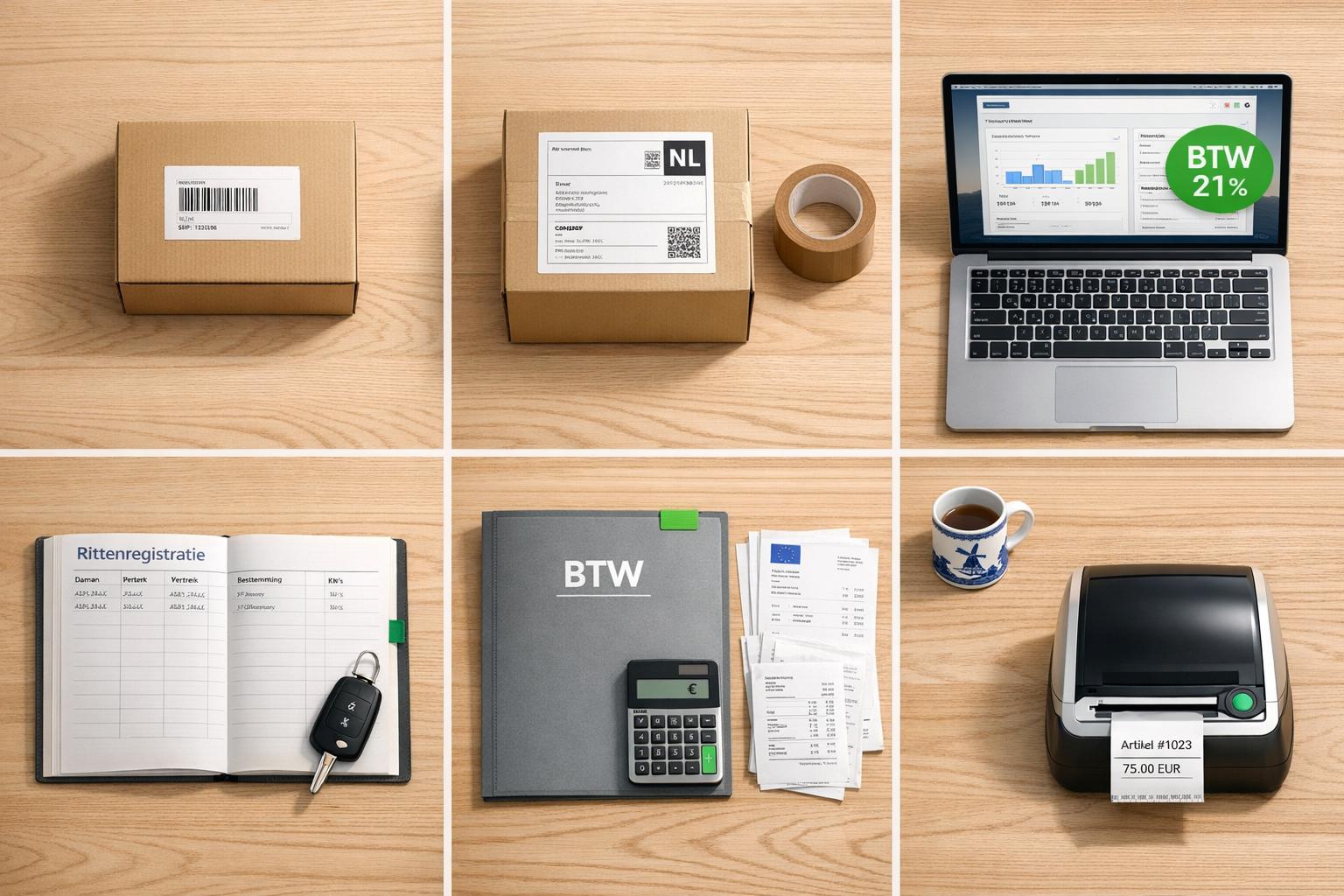
Want to pay less tax as a reseller in the Netherlands? Here’s how. You can deduct many business expenses, reducing your taxable income and keeping more profit. From packaging materials to vehicle mileage, these deductions add up quickly if managed correctly.
Key takeaways:
- Business expenses: Deduct costs like shipping, packaging, and inventory under €450 immediately. Larger items require depreciation over time.
- Special allowances: The SME profit exemption (12.7% in 2026) and private business ownership allowance reduce your taxable income further.
- VAT rules: Track VAT on purchases and sales carefully. Use the Margin Scheme for second-hand goods to simplify VAT calculations.
- Record-keeping: Maintain detailed records for 7 years, including receipts, invoices, and mileage logs, to stay compliant.
What can I deduct in my reselling business?
sbb-itb-d4aa959
Cost of Goods Sold (COGS) and Inventory Costs
COGS represents the total cost of acquiring the inventory you sell during a specific period. It's calculated using this formula: Beginning Inventory + Purchases – Ending Inventory. By subtracting COGS from your total turnover, you determine your gross profit, which also lowers your taxable income. With inventory costs addressed, let’s now dive into storage and handling - two key areas in managing overall expenses.
Purchasing Inventory
COGS includes the purchase price of stock acquired from sources like thrift shops, wholesalers, or auctions. But that's not all - it also factors in inbound freight, import costs, and preparation expenses, collectively known as the landed cost .
- Inbound freight: Covers shipping, insurance, and handling costs to get goods to your location.
- Import costs: Includes customs duties and taxes for imported items.
- Preparation expenses: Encompasses costs like cleaning supplies, replacement parts, authentication certificates, and labeling.
For smaller items valued under €450, these can typically be expensed entirely in the year of purchase. However, more expensive assets require depreciation over time. Keep in mind that expenses such as customer shipping (freight-out), marketplace fees, and marketing are not part of COGS - they fall under operating expenses instead.
Storage and Handling Costs
If you use off-site storage, such as rented units or warehouses, the associated rental fees are fully deductible . Handling costs, including storage bins, display racks, shelving, and labor for refurbishing or packaging, also qualify as deductible expenses. Even small necessities like tape, bubble wrap, and poly mailers are eligible for deductions.
For those storing inventory at home, deductions are only allowed if the space is used exclusively for business purposes. Make sure to document this according to the Tax Administration's guidelines .
Shipping and Packaging Expenses
When managing your inventory costs, don't overlook shipping and packaging expenses. Every euro spent on delivering products to your customers is deductible. Payments to couriers like PostNL or DHL for shipping orders qualify as 100% business expenses. This includes costs for standard postage, express deliveries, and even return shipping when customers send items back.
Packaging materials are also deductible. Items like boxes, bubble wrap, poly mailers, packing tape, labels, and printer ink used to fulfill orders all count as business expenses. Even custom touches, like branded inserts, stickers, and thank-you cards, qualify.
Postage and Delivery Charges
Shipping fees for both domestic and international deliveries are fully deductible, with no limits on these expenses. It's important to note that outbound shipping (sending products to customers) is categorized as a business expense, while inbound freight (receiving inventory) is part of your Cost of Goods Sold (COGS). For international sales, import duties and customs fees are also considered part of COGS and are 100% deductible.
VAT plays a role here too. If you're a reseller in the Netherlands, the VAT paid on shipping services can usually be deducted as input tax in your VAT return. Additionally, if you use your personal car to drive to the post office or courier depot, you can claim a fixed deduction of €0.23 per kilometre in 2026. Keeping a detailed mileage log will help ensure you claim this correctly. These VAT deductions align with the broader input tax rules already mentioned. Don’t forget to factor in the cost of packing supplies, which are just as deductible and essential for ensuring safe deliveries.
Packing Supplies
The cost of packaging can add up, but when used exclusively for business, it’s fully deductible. Common supplies like poly mailers, thermal labels, boxes, and tape are all eligible. Even materials like newsprint packing paper or chipboard stiffeners for items such as prints or vinyl records qualify. Additionally, business-related purchases under €450 can be deducted in the year of purchase instead of being depreciated over time. Lastly, if you sell through platforms like eBay or Etsy, cross-check the shipping fees they deduct with your records to ensure you capture all eligible deductions accurately.
Home Office Deduction
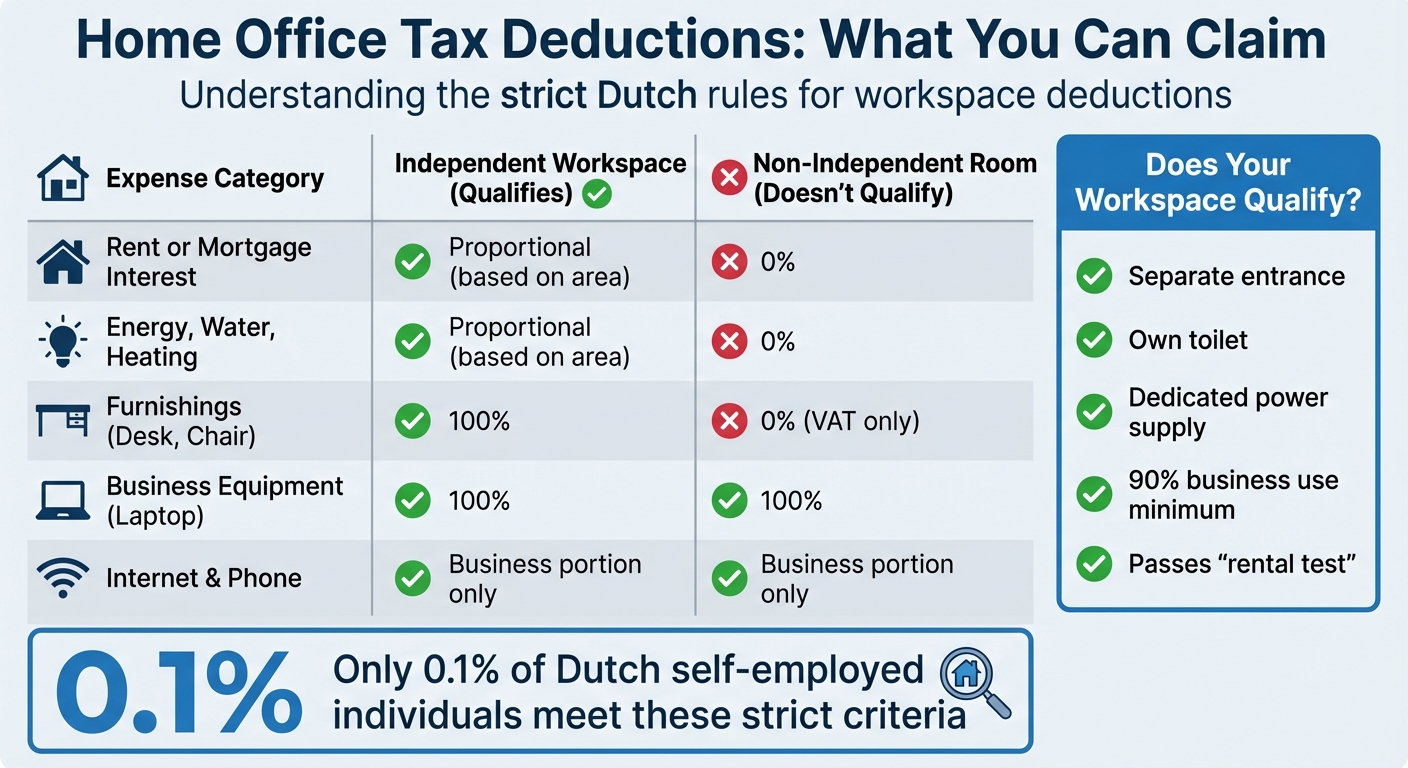
Home Office Tax Deduction Eligibility Guide for Dutch Resellers
Eligibility for Home Office Deductions
In the Netherlands, the rules for claiming home office deductions are quite strict. To qualify, your workspace must be fully independent, meaning it needs a separate entrance, its own toilet, and a dedicated power supply. The Dutch Tax Authority (Belastingdienst) uses the "rental test" to assess eligibility. This means the space should be suitable for renting out to someone else, such as a converted garage, a garden house, or an extension with its own facilities.
Additionally, there are income and time requirements. You can claim either 30% or 70% of your home office costs, depending on whether you work exclusively from home or split your work between home and another location. To qualify, the space must be used at least 90% for business purposes.
It's worth noting that only about 0.1% of self-employed individuals in the Netherlands meet these stringent criteria. If your workspace does not meet the independence requirements, you cannot deduct housing costs like rent, mortgage interest, or utilities from your income tax. However, you can still reclaim VAT on business-related purchases for the space, such as desks, chairs, and computers.
Next, let’s look at how to calculate your deduction based on the percentage of your home used for business.
Calculating Your Deduction
If your workspace qualifies as independent, you can calculate your deduction by allocating a portion of your home expenses to the business area. To do this, divide the area of your office by the total area of your home and apply that percentage to the eligible expenses.
| Expense Category | Independent Workspace | Non-Independent Room |
|---|---|---|
| Rent or Mortgage Interest | Proportional (based on area) | 0% |
| Energy, Water, Heating | Proportional (based on area) | 0% |
| Furnishings (Desk, Chair) | 100% | 0% (VAT only) |
| Business Equipment (Laptop) | 100% | 100% |
| Internet & Phone | Business portion only | Business portion only |
The Dutch Tax Authority provides a tool called "Rekenhulp Werkruimte" (Workspace Calculation Tool) to help you determine whether your housing situation qualifies for these deductions.
Note: Even if your workspace doesn’t qualify as independent, you can still deduct 100% of the costs for business-specific equipment like printers, professional cameras, and shipping label printers.
For shared expenses like internet and phone subscriptions, you can allocate 50–80% of the costs to your business, provided you can justify this with a usage analysis. This method helps ensure you’re maximizing your deductions while staying compliant with tax regulations.
Software Subscriptions and Tools
In addition to storage and shipping costs, software tools are essential for running a reselling business efficiently - and they can also help reduce your taxable income.
VintiePlus Subscription

If you're using software exclusively for your reselling business, the good news is that it's fully deductible in the Netherlands. Take VintiePlus, for example. This tool offers 24/7 monitoring, automatic purchasing of underpriced items, and profit analytics to make sourcing easier and more profitable.
The subscription fees for VintiePlus are classified as "ordinary and necessary" business expenses. Since the tool directly contributes to generating revenue by helping you secure high-margin inventory, the costs are deductible in the year you pay them. Plans range from €29,95 to €109,95 per month, and because the annual cost falls below the €450 threshold, you can claim the entire expense immediately rather than spreading it out over several years. Just make sure to save your digital invoices and payment receipts for at least seven years, as required by Dutch tax laws.
Other Business Software Tools
Beyond VintiePlus, other software tools that support your daily business activities are also deductible. For instance, accounting platforms like QuickBooks or Xero can help you track income and expenses, making them eligible for deduction. Similarly, inventory management systems that assist with cross-listing products or organizing stock across multiple marketplaces qualify as business expenses.
If a tool serves both business and personal purposes, you’ll need to calculate the percentage used for business and only deduct that portion. For example, if you use cloud storage 70% for business documents and 30% for personal files, only 70% of the subscription cost is deductible. Be sure to document how you arrived at your usage percentage in case of an audit.
Using a separate business bank account can help you track and organize all software-related expenses, making it easier to manage your finances and prepare for tax filings. Up next, we’ll dive into vehicle and mileage expenses to uncover more ways to maximize your deductions.
Vehicle and Mileage Expenses
Just like shipping and home office costs, vehicle-related expenses can play a big role in lowering your taxable income - if you track them properly. If you’re driving to thrift stores, flea markets, or customer locations for your reselling business, these trips can help reduce your tax burden. How you claim these expenses depends on whether you use a private car or a vehicle registered as a business asset.
Mileage for Sourcing and Delivery
In 2026, if you’re using a private car for business purposes, you can deduct €0.23 per kilometre from your taxable profit. This flat rate covers all operating costs, so you can’t claim items like fuel or repairs separately. Business trips that qualify include visits to vintage markets for sourcing or deliveries to customers.
To claim this deduction, you’ll need to maintain a detailed trip log. This should include the date, starting and ending addresses, purpose of the trip, and total kilometres driven. Keep these records for at least seven years. If you charge customers for delivery, make sure to list the kilometres on the invoice (e.g., 100 km × €0.23) and include VAT, as this reimbursement is considered part of your turnover. If your vehicle is registered as a business asset instead of being privately owned, different rules apply (see below).
Fuel, Maintenance, and Depreciation
If your car is registered as a business asset, you can’t use the fixed mileage rate. Instead, you’re allowed to deduct all actual costs related to the vehicle. This includes fuel, repairs, insurance, road tax, parking fees, and depreciation. For depreciation, follow the standard method of writing off up to 20% per year, just like you would for other high-value business assets.
However, if you drive a company car for more than 500 kilometres of private use annually, the tax office will add 22% of the car’s catalogue value to your taxable income. To avoid this, keep a detailed trip log to prove your private use stays under 500 kilometres.
For VAT purposes, if you’re using a private car, you can reclaim VAT on maintenance and fuel costs based on the proportion of business use - provided your turnover is VAT-eligible. If you don’t maintain detailed trip records, a fixed VAT correction of 1.5% of the car’s catalogue value might apply. Keeping thorough documentation of your vehicle-related expenses ensures you’re maximizing your deductions while staying compliant with tax regulations.
Marketing and Advertising Costs
Marketing expenses can help lower your taxable income when properly categorized. In the Netherlands, the tax treatment of these costs depends on whether they fall under advertising or representation.
This section focuses on expenses that enhance your market visibility and builds on earlier tax strategies.
Paid Advertising
Direct advertising expenses are fully deductible. These include costs for paid social media ads, fees for promoting listings on platforms like eBay or Vinted, and online campaigns where your business name is prominently displayed - provided these campaigns generate measurable exposure.
Promotional Materials
Items like business cards, branded packaging, and catalogues are typically classified as representation costs in the Netherlands. For the 2026 tax year, sole traders can deduct 80% of these expenses or choose to deduct only amounts exceeding €5,700. For BV companies, the deduction rate is set at 73.5%.
An exception applies to branded work clothing: these costs are fully deductible if the logo covers at least 70 cm². Additionally, when giving promotional gifts to clients, VAT is deductible only if the total expenditure per recipient stays under €227 (excluding VAT) annually. It’s crucial to track spending per recipient to ensure compliance with VAT recovery rules.
When combined with deductions for inventory, shipping, and home office expenses, these marketing costs can further refine your overall tax-saving strategy.
Record-Keeping and Documentation Requirements
Keeping proper documentation is the backbone of any tax claim. Tax authorities require businesses to maintain VAT-specific records, especially for cases like immovable property or One Stop Shop (OSS) schemes, with a 10-year retention period. Without organized records, you risk losing deductions during audits and could face penalties.
Importance of Organized Records
An organized audit trail is essential. This means linking source documents - like invoices, receipts, and bank statements - to the totals reported in your VAT and income tax returns. Every business expense should have both a supporting document and a corresponding bank transaction. For example, to qualify for the self-employed deduction (zelfstandigenaftrek) of €2,470 in 2025, you’ll need a detailed time log proving at least 1,225 hours of business activity annually. This could be recorded in an agenda, a time-tracking app, or even a simple Excel sheet.
Travel expenses require specific documentation as well. For public transport, save your tickets or download travel summaries from your public transport card. If you’re using a private car for business purposes, you’ll need to maintain a mileage log that includes the date, purpose, and kilometers driven. For the Small-scale Investment Deduction (KIA), ensure you have an asset statement and purchase invoices for items costing at least €450.
Digital backups are critical. Photograph paper receipts as soon as possible and store them in well-organized digital folders. Always retain documents in their original format - digital invoices should stay digital, and scanned paper receipts must clearly replicate the originals.
Next, let’s look at how automation can simplify this process.
Using Tools to Simplify Record-Keeping
Automation tools can significantly reduce the effort involved in maintaining records. Platforms like VintiePlus offer advanced profit analytics, helping you track expenses and profitability across your inventory. This can simplify financial tracking and ensure all income and fees are properly accounted for during monthly reconciliations.
For more comprehensive bookkeeping, tools like e-Boekhouden.nl can be invaluable. They provide mobile apps for scanning receipts and invoices, automate VAT (btw) returns, and integrate directly with the Belastingdienst. To stay on top of your records, close your books monthly by saving bank statements, logging new invoices, and marking unpaid items. Using cloud-based systems ensures your data remains secure and accessible for the full retention period, even in the event of hardware failure.
Conclusion
Knowing how to claim the right tax deductions can make a big difference to your business's profitability. By deducting eligible business expenses from your revenue, you lower your tax liability, freeing up funds to reinvest in inventory, equipment, or operational upgrades.
The Dutch tax system provides resellers with several valuable options beyond standard expense deductions. For example, the SME profit exemption, the entrepreneur allowance (if you meet the work-hour requirements), and the margin scheme for second-hand goods traders can all lead to meaningful tax savings that directly enhance your bottom line. However, these benefits are only accessible if you maintain organized and thorough documentation.
To make the most of these deductions, proper record-keeping is non-negotiable. Use a dedicated business bank account, keep detailed records of vehicle use, and digitize receipts as soon as possible. Whether you're writing off platform fees, shipping supplies, or your VintiePlus subscription for inventory automation and profit tracking, having everything well-documented not only maximizes your deductions but also ensures you're prepared for any audits.
Incorporating these deductions into a well-thought-out tax strategy can help your business grow steadily while staying compliant. Effective tax planning allows you to reinvest in your business, scale operations, and retain more of your hard-earned income. By applying the tips in this guide and keeping up with Dutch tax regulations, you'll be setting your reselling business up for long-term success while staying on the right side of the Belastingdienst.