
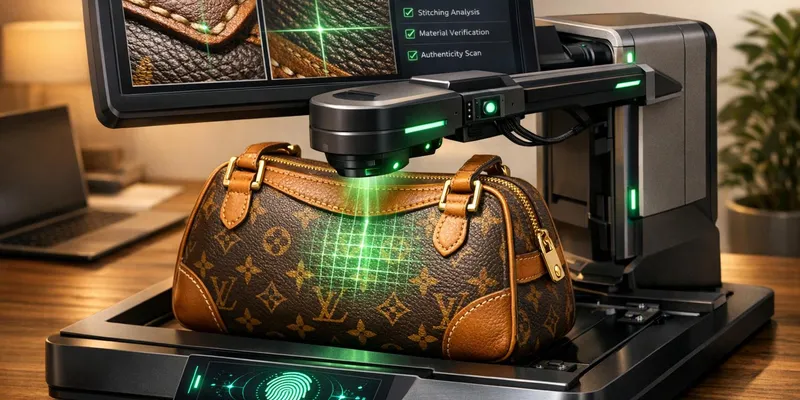
Counterfeit items are a growing issue in the secondhand fashion market, especially with the rise of "superfakes" and AI-driven scams. Platforms like Vinted and The RealReal are using AI to tackle this problem by analyzing product images, listing details, and seller behavior. These tools help identify fake goods, flag suspicious activity, and protect buyers and sellers alike. For example:
- AI tools detect superfakes by analyzing stitching, logos, and materials invisible to the human eye.
- Generative AI scams are creating fake product photos and fraudulent refund claims.
- Platforms like Vinted offer expert verification services (€10 for items over €100) and use AI to scan millions of listings daily.
This combination of AI and expert reviews is making online resale safer and more reliable for Dutch shoppers and sellers. Following Vinted selling tips can further help users navigate these platforms safely. But as scammers evolve, platforms are constantly refining their detection methods to stay ahead.
Fashion resellers using high-tech tools to combat luxury handbag dupes
Why Traditional Verification Methods Don't Work
Resale platforms have historically depended on manual checks and community reports to weed out counterfeit goods. However, these methods fall short in combating the highly sophisticated techniques used by modern counterfeiters.
Problems with Manual and Community Moderation
Manual verification is struggling to keep pace as counterfeiters now use advanced tools to create fakes that include holograms, UV-reactive ink, and meticulously scanned barcodes. Even AI-generated images can replicate genuine items so convincingly that even trained experts find it challenging to spot the differences without specialised equipment.
Take the case of seller Mike Winnet, who faced this issue firsthand. A buyer flagged a subtle, AI-generated alteration in a €70 Lacoste set, leading to an immediate refund and the deletion of his account. This highlights how even minor counterfeit details can disrupt the system. Consumer campaigner Martyn James summarised the broader issue:
"Platforms tell me they ban buyers who exploit the system, but identifying them is not easy because they can just set up multiple accounts".
Community reporting is too slow to be effective. Even when users flag suspicious items, these reports still require manual review. Meanwhile, scammers use AI to churn out thousands of convincing fake listings in a matter of minutes. Lisen Kaci, co-founder of Discrepancy AI, put it bluntly:
"Trying to catch them with manual reviews is like trying to find a specific grain of sand on a beach. It's inefficient and, ultimately, ineffective".
The scale of the problem is staggering. In 2022, eBay's automated systems blocked 88 million suspected counterfeit listings, while only 1.3 million were reviewed manually. This vast discrepancy underscores why human-only verification methods are no longer sufficient.
The Scalability Problem
Manual verification is neither fast nor cost-effective. Expert checks are expensive and time-intensive. For example, Vinted charges €10 per item for expert reviews (which you can factor into your margins using a Vinted fee calculator), but this service is only available for items priced above €100. This makes it impractical for the millions of lower-priced listings uploaded daily. Similarly, Vestiaire Collective employs over 120 people at its French authentication centre, with each authenticator undergoing more than 180 hours of training. As Amanda Pun from EU-Startups noted:
"Manual authentication alone is not a scalable solution".
Fraudsters work faster than platforms can react. Scammers use automated tools to create hundreds of nearly identical fake listings every day. They often mix genuine products with counterfeits to make detection even harder. By the time a manual review flags a single counterfeit, dozens of new listings may already be live. Christopher Brossman, VP of Machine Learning at The RealReal, explained:
"While people have to do a lot of tasks to get a good signal of authentication, using this tech is able to make them a bit quicker".
These challenges illustrate why manual and community-based approaches are no longer enough. The limitations of these methods have driven the growing adoption of AI as the primary tool to combat counterfeit listings, which the next section will explore in detail.
How AI Identifies Counterfeit Products
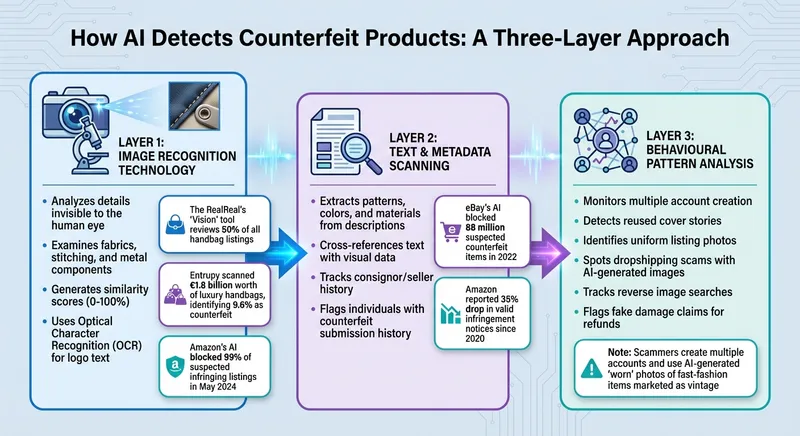
How AI Detects Counterfeit Products on Resale Platforms
Resale platforms are increasingly turning to AI to combat counterfeit goods, using three main technologies to inspect product images, listing details, and seller behaviour. These tools work together to detect fakes in ways that manual checks simply can't match.
Image Recognition Technology
AI delves deep into product photos, analysing details invisible to the naked eye. For instance, The RealReal uses an internal tool called "Vision" to evaluate images and identify counterfeit items. This system currently reviews around 50% of all handbag listings on the platform. Samantha McCandless, Chief Merchandising Officer at The RealReal, described how the technology improves over time:
"The more items that we've pulled into our platform, the smarter and smarter it's going to get".
Entrupy, another AI-driven solution, employs a microscopic iPhone attachment to examine fabrics, stitching, and metal components across millions of data points. To date, the company has scanned luxury handbags worth approximately €1.8 billion, identifying 9.6% of them as counterfeit. AI tools also generate a "similarity score" (ranging from 0% to 100%) to measure how closely an item matches authentic reference images. Additionally, Optical Character Recognition (OCR) is used to extract text from photos - like logo lettering on a T-shirt - to spot trademark irregularities. In May 2024, Amazon's AI blocked 99% of suspected infringing listings and helped seize over 15 million counterfeit items globally. But AI's capabilities go beyond images - it also analyses text and metadata to strengthen authentication.
Text and Metadata Scanning
AI doesn’t stop at visuals; it meticulously reviews the text in listings. It extracts details like patterns, colours, and materials from descriptions and cross-references them with visual data. The RealReal’s "Shield" system even tracks consignor activity, flagging individuals with histories of submitting counterfeit goods. Christopher Brossman, VP of Machine Learning at The RealReal, explained:
"Shield collects information about a consignor and signals if that consignor has submitted fakes before".
This metadata-driven approach helps platforms prioritise high-risk listings for further manual checks. In 2022, eBay used AI tools to block 88 million suspected counterfeit items before they were listed. Meanwhile, Amazon reported a 35% drop in valid infringement notices from brands since 2020, as AI now intercepts most counterfeit attempts automatically. Beyond examining product details, AI also keeps an eye on seller behaviour to detect fraudulent activity.
Behavioural Pattern Analysis
AI doesn’t just analyse products - it also monitors user behaviour. Fraudulent sellers often create multiple accounts, reuse the same cover stories, and upload uniform listing photos. AI can even detect dropshipping scams, where sellers use AI-generated "worn" photos of low-cost fast-fashion items from brands like Shein or Temu, falsely marketing them as vintage or designer pieces. By conducting reverse image searches and tracking accounts that exclusively receive seller reviews, AI identifies these patterns.
However, scammers are also using AI to manipulate buyer behaviour. Some fabricate damage claims by altering photos to show fake tears or holes, demanding refunds while keeping the genuine item. Martyn James, a consumer campaigner, highlighted the challenge:
"Identifying [scammers] is not easy because they can just set up multiple accounts. That's why ID checks and proper verification are so important".
A spokesperson for Vinted noted that their platform is actively tackling such issues: "We have a range of tools to monitor suspicious behaviour, whether or not it involves AI". Commenting on the evolution of AI-driven detection, Samantha McCandless of The RealReal observed:
"The new AI really allows you that behavioural stuff and the learning, and I think we'll get better and better at that".
sbb-itb-d4aa959
What AI Detection Means for Dutch Buyers and Sellers
AI detection is reshaping the resale market in the Netherlands, making it safer for buyers and offering legitimate sellers a fairer playing field. Platforms like Vinted now use AI to filter out fake listings before they reach Dutch shoppers, boosting trust and security in the process.
Benefits for Buyers
For buyers in the Netherlands, AI detection provides immediate protection by stopping counterfeit listings from appearing in the first place. On top of that, Vinted offers an Item Verification service tailored for Dutch shoppers. This service allows items priced over €100 to be examined by experts at a hub in Hamburg for a flat fee of €10. Verified items come with a "diamond badge", signaling professional authentication. If an item is flagged as counterfeit during this process, the buyer is fully reimbursed for the purchase price, service fee, and shipping costs.
But the benefits don’t stop there. AI systems work behind the scenes to further reduce risks. For instance, in 2022, eBay's AI tools blocked 88 million suspected counterfeit items from being listed. This kind of technology ensures Dutch buyers encounter fewer fake products, making online shopping both safer and more convenient. These measures not only protect buyers but also encourage a more secure environment for everyone involved.
Benefits for Sellers
AI detection isn’t just a win for buyers - it’s a game-changer for sellers too. Legitimate Dutch sellers benefit from reduced competition as counterfeiters and dropshippers are weeded out. For example, AI can detect generative AI-created images that some dropshippers use to pass off cheap fast-fashion items as premium vintage goods. Additionally, it helps protect sellers from fraudulent buyer claims, such as those involving fake photos of damage (like fabricated tears or stains) used to demand refunds while keeping the item. By identifying suspicious behavior, platforms strengthen defences against these scams.
For sellers offering luxury goods priced over €100, Vinted’s verification service is free. This not only boosts buyer confidence but often allows sellers to achieve higher sale prices, making it a win-win for both parties.
How Professional Resellers Can Use VintiePlus

With counterfeit listings on the decline, professional resellers in the Netherlands now face a cleaner and more competitive marketplace. Success increasingly depends on speed - spotting and securing authentic, underpriced items quickly. Tools like VintiePlus (https://vintieplus.com) make this easier by offering 24/7 real-time scanning, instant auto-buying for great deals, detailed profit analytics, and custom filters to help Dutch resellers snap up high-margin inventory before others.
That said, compliance is key. Resellers must maintain transparent supply chains, avoid using AI-generated images that might trigger platform moderation, and stick to using original photos taken with a phone camera. Ensuring labels are clearly visible can also prevent buyer complaints. Vinted’s AI, combined with manual moderation, flags suspicious activity, and sellers who repeatedly list counterfeit items risk permanent account bans.
What's Next for AI in Counterfeit Detection
The tug-of-war between scammers and platforms is intensifying. As detection tools powered by AI get smarter, fraudsters are upping their game with more sophisticated tactics. Meanwhile, platforms are racing to outpace these schemes with cutting-edge technologies.
New Scammer Tactics
Fraudsters are now turning to AI to refine their tricks. Since mid-2024, generative AI has been used to create hyper-realistic images of damage - like tears, stains, or cracks - on genuine items. These doctored images are then submitted to claim automatic refunds while the fraudsters keep the products. Michael Reitblat, CEO and cofounder of Forter, highlights this trend:
"This trend started in mid-2024, but has accelerated over the past year as image-generation tools have become widely accessible and incredibly easy to use".
The numbers back this up: refund claims involving AI-manipulated images have risen by more than 15% since early 2024. In one alarming case, an organised fraud ring used altered images of home goods to claim over €1,000,000 in refunds.
Beyond refund scams, fraudsters are crafting synthetic seller personas. They use AI-generated profile pictures and rotate IP addresses to appear credible. Some even enhance basic product photos with AI tools, transforming cheap fast-fashion items from sites like Shein or Temu into what look like premium vintage goods. Organised crime groups are also flooding platforms with refund claims in short bursts to evade detection. Kassi Socha, Director Analyst at Gartner, raises another concern:
"There's also a risk that counterfeiters could use this machine learning to try to get ahead of the game and make better fakes".
To counteract these evolving scams, platforms are stepping up their defenses with next-generation AI systems and expert reselling strategies.
New AI Detection Methods
Platforms are fighting back with smarter tools. The RealReal, for instance, is developing "Vibranium", a multimodal AI system that merges seller history analysis with image recognition into a single powerful model. Meanwhile, LVMH-owned brand Patou introduced the "Authentique Verify" system in April 2023. This system photographs microscopic details of Le Petit Patou bags during production, creating a unique "digital fingerprint" stored as an NFT. Customers can later verify authenticity by comparing a smartphone photo with this fingerprint.
Physical verification methods are also evolving. Digital Product Passports, which use NFC chips, RFID tags, and blockchain certificates, are becoming more common. Initiatives like the Aura Blockchain Consortium, supported by brands such as LVMH and Cartier, provide permanent and tamper-proof authenticity records.
These advanced measures are setting the stage for a more secure future in the fight against counterfeiting.
Conclusion
Platforms like Vinted are leveraging AI to combat counterfeit goods effectively. In 2022, eBay's AI systems intercepted 88 million suspected fake items before they could even be listed. Vinted offers a verification service for items priced over €100, ensuring buyers can trust the authenticity of their purchases. These systems are even capable of identifying subtle details, like slight misalignments in logos, that human inspections might miss.
However, the fight against counterfeits is an ongoing challenge. Fraudsters are now using generative AI to create fake damage photos for refund scams, pushing platforms to constantly refine their detection methods. For buyers in the Netherlands, these advancements mean safer transactions and more confidence when purchasing items marked with Vinted's "diamond badge". Sellers also benefit from a marketplace where genuine products stand out more clearly.
These improvements serve everyone involved, from casual shoppers to dedicated resellers. For resellers, tools like VintiePlus offer features such as 24/7 real-time scanning, instant auto-buying, advanced profit analytics, and customised filters to quickly identify authentic, underpriced items. As Adam Jay, CEO of Vinted, explains:
"Authenticity and trust are paramount in the world of online second-hand shopping and we believe this should be accessible to all".