
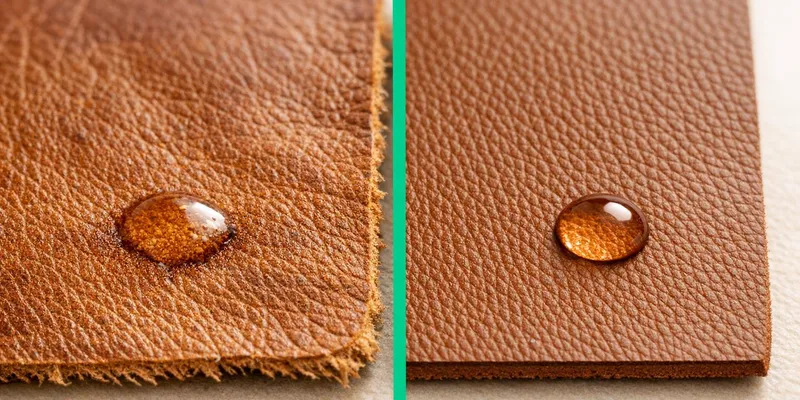
When deciding between real and synthetic leather, understanding their differences is essential. Real leather, made from animal hide, offers durability, develops a patina, and can be repaired. Synthetic leather, often crafted from PU or PVC, mimics the look but lacks longevity, tending to crack or peel over time. Mislabeling materials can harm your credibility, especially in resale markets.
Key Points:
- Real Leather: Natural imperfections, fibrous edges, warm texture, absorbs water, ages well with a patina.
- Fake Leather: Uniform patterns, smooth edges, plastic-like feel, repels water, prone to cracking.
- Tests: Check labels, texture, feel, smell, water absorption, and wear patterns for authenticity.
For resellers, tools like VintiePlus can streamline finding genuine leather items by scanning for specific terms like "full-grain" or "top-grain." Combining manual checks with such tools ensures confidence in sourcing high-quality products.
Faux Leather vs. Real Leather - How To Tell The Difference (5 Tests to Try)
sbb-itb-d4aa959
How to Tell Real Leather from Fake Leather
Spotting genuine leather among synthetic alternatives is easier than you might think. With a few simple checks, you can quickly determine authenticity. Start by inspecting the product label for clear indications of real leather.
Check the Label
Labels are often the first giveaway. Genuine leather is typically marked with terms like "genuine leather", "full-grain", "top-grain," or even the Italian phrase "vera pelle", all of which signify proper tanning processes. On the other hand, synthetic materials carry labels such as "PU", "PVC", "bonded leather", "vegan leather", "pleather", "LeatherSoft," or "man-made materials." It’s worth noting that bonded leather, despite its misleading name, usually contains only about 10% to 20% real leather scraps mixed with polyurethane binders. While labels are a good starting point, they work best when combined with other tests.
Look at Texture and Appearance
The texture and appearance of the material also hold vital clues. Real leather often has unique natural imperfections like irregular pore patterns, small scars, or subtle wrinkles - marks of the animal's life. In contrast, fake leather looks too perfect, with uniform, machine-made patterns and evenly spaced pores. Colour is another telltale sign: genuine leather rarely has a perfectly consistent hue, whereas synthetic options often boast unnaturally even colouring.
Another key difference lies in the edges. Real leather has rough, fibrous edges, while synthetic leather features smooth, plastic-like edges, often revealing a fabric backing. A quick bend test can also help: authentic leather flexes naturally and may show a slight colour change, known as "bloom", along the crease.
Feel the Material
Touching the material can reveal a lot. Genuine leather feels warm, soft, and supple, and wrinkles under pressure much like human skin. In contrast, fake leather feels cooler, stiffer, and often has a plastic-like or rubbery texture. Real leather also has a subtle drag when you run your fingers across it, whereas synthetics feel slick or overly smooth. This tactile quality is a key factor in assessing the material’s value, as the difference is immediately noticeable to buyers. For those looking to scale their inventory, following expert reselling tips can help refine these authentication skills.
Smell the Material
The smell test is another reliable method. Authentic leather carries a rich, earthy scent from the tanning process - an aroma that’s hard to replicate. On the other hand, fake leather often smells like chemicals, plastic, or, at best, has no scent at all.
"The smell of real leather is unmistakable and distinctive. Synthetic materials, on the other hand, smell of plastic, naphtha or (at best) absolutely nothing." – Tannins.org
While the scent test is helpful, it’s not foolproof. Modern manufacturing techniques can mask synthetic odours with artificial fragrances, so it’s best to pair this method with visual and tactile evaluations.
Check Cut Edges and Backing
Finally, take a close look at the edges and backing. Real leather has rough, fibrous edges and a suede-like texture on the underside, reflecting its natural origins. Fake leather, by contrast, has smooth edges and often reveals a woven or gauze-like fabric backing beneath its plastic coating. If you can view a cross-section, genuine leather will show dye penetration throughout, while synthetic materials clearly display separate layers - a dead giveaway of their manufactured nature.
Advanced Authentication Tests
When basic methods leave room for doubt, these advanced tests can provide more definitive proof of leather authenticity. They’re particularly useful for high-value items where accuracy is crucial.
Water Absorption Test
Real leather is naturally porous, allowing it to absorb moisture, whereas synthetic leather often has a sealed polymer coating that repels water. To perform this test, choose an inconspicuous spot to avoid visible damage. Place a drop of clean water on the surface and wait 30 to 60 seconds. If the water gradually soaks in and darkens the area, the material is likely genuine leather. If the water beads up and remains on the surface, it’s probably synthetic .
It’s worth noting that many modern genuine leathers are treated with water-repellent finishes, which can reduce their natural absorbency . Additionally, unfinished or lightly treated leather may develop permanent marks from this test, so it’s best to blot the area dry immediately. To put it in perspective, hydrostatic head tests show PU leather typically withstands 1,500–2,500 mm of water pressure, while untreated real leather resists only 200–800 mm.
While water tests can offer insights, observing how the material ages over time often provides an even clearer distinction.
Long-Term Wear Patterns
One of the hallmarks of genuine leather is its ability to age gracefully. Over time, it develops a rich "patina" as it absorbs oils from handling, softens, and gains character. In contrast, synthetic leather tends to crack or peel as the top coating deteriorates. Real leather can often be revitalized through re-oiling and re-dyeing, restoring its appearance and durability. On the other hand, synthetic materials typically crack, peel, or delaminate at stress points like corners and creases, with no way to repair the damage .
For those assessing vintage pieces on Vinted, the presence of a natural patina and softening can be strong indicators of authenticity, while surface cracking and peeling are telltale signs of synthetic materials.
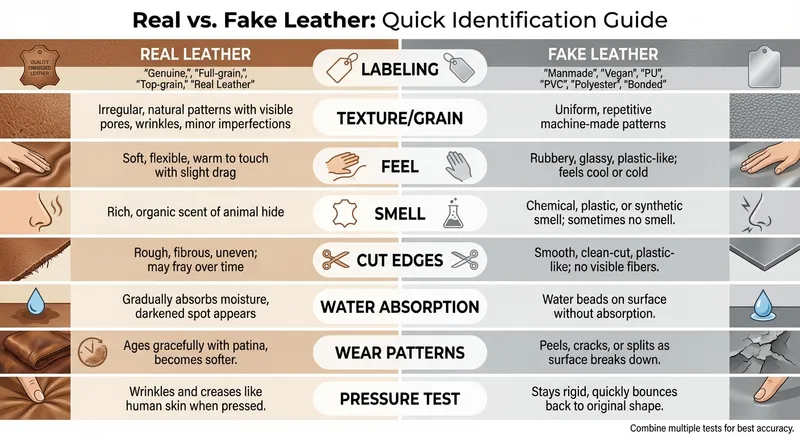
Real vs. Fake Leather Comparison Table
Real vs Fake Leather: Visual Comparison Guide
Here's a handy table to help you quickly spot the differences between genuine leather and synthetic alternatives based on key characteristics.
| Test/Feature | Real Leather | Fake Leather |
|---|---|---|
| Labelling | Labels like "Genuine", "Full-grain", "Top-grain", or "Real Leather" | Labels such as "Manmade", "Vegan", "PU", "PVC", "Polyester", or "Bonded" |
| Texture/Grain | Irregular, natural patterns with visible pores, wrinkles, or minor imperfections | Uniform, repetitive patterns that look machine-made |
| Feel | Soft, flexible, warm to the touch with a slight drag | Rubbery, glassy, or plastic-like; often feels cool or cold |
| Smell | Rich, organic scent reminiscent of animal hide | Chemical, plastic, or synthetic smell; sometimes no smell at all |
| Cut Edges | Rough, fibrous, and uneven; may naturally fray over time | Smooth, clean-cut, and plastic-like; lacks visible fibres |
| Water Absorption | Gradually absorbs moisture, leaving a darkened spot | Water stays on the surface, forming beads without being absorbed |
| Wear Patterns | Ages gracefully with a patina, becoming softer and more appealing | Prone to peeling, cracking, or splitting as the surface layer breaks down |
| Pressure Test | Wrinkles and creases like human skin when pressed | Stays rigid under pressure and quickly bounces back to its original shape |
This comparison table provides a straightforward guide to help you identify leather authenticity with confidence. If you find a rare vintage piece on Vinted UK, you can use a reshipper to get it delivered anywhere.
How VintiePlus Helps Resellers Find Authentic Items

For resellers focused on sourcing genuine leather, VintiePlus takes the hassle out of the process. Instead of manually combing through countless listings, this platform uses 24/7 real-time scanning on sites like Vinted to identify underpriced, authentic leather goods. The moment a high-margin item pops up, you’ll get an alert - saving time and giving you a competitive edge.
What makes this tool even more effective are its custom filters. You can set alerts for keywords like "full-grain," "top-grain," or "vegetable-tanned" - terms often associated with premium leather that holds its value over time. It also helps uncover hidden gems: items that might not explicitly state "genuine leather" but show telltale signs of authenticity, such as irregular grain patterns, visible pores, or rough, fibrous edges. These filters work hand-in-hand with the platform’s scanning and analytics to ensure every alert is worth your attention.
But VintiePlus doesn’t stop at alerts. Its profit analytics dive deeper, helping you assess whether an item’s price aligns with its quality. This ensures you’re not just finding authentic items but also making smart, profitable purchases.
On top of that, the VintiePlus community offers additional support. Members share expertise on verifying certifications like Leather Working Group seals or trademarks such as "Pelle Conciata al Vegetale in Toscana." They also help each other spot misleading terms like "bonded leather," which can be easily mistaken for higher-quality materials. Together, these features and resources make VintiePlus a powerful ally for resellers aiming to source authentic, high-value leather goods.
Conclusion
Identifying genuine leather versus synthetic alternatives comes down to careful observation and a few simple tests. Genuine leather feels warm and natural, features irregular grain patterns, and has fibrous edges. You can further confirm its authenticity with water absorption tests and by inspecting cut edges. These straightforward methods can boost your confidence when evaluating leather goods.
Full-grain leather, prized for its durability and ability to develop a rich patina over time, is a premium material. In contrast, bonded leather, which contains only 10–20% genuine leather, is prone to peeling and cracking. Understanding these differences ensures you can stock products that align with customer expectations.
That said, modern synthetic materials can closely mimic the look and feel of real leather, making tools like VintiePlus incredibly useful. VintiePlus offers 24/7 scanning and custom filters for terms like "full-grain", helping you spot genuine, underpriced items before your competitors. Its profit analytics feature also aids in making smart, high-margin purchasing decisions.
Combining these traditional inspection techniques with advanced tools helps build buyer confidence. As Mallika Sharma, a Certified Leather Care Technician, explains:
"Real leather is more imperfect, with random grain patterns, while fake leather seems more perfect and synthetic".
With these strategies and tools at your disposal, you can confidently secure authentic, high-quality leather products while steering clear of costly mistakes.