

Setting the right price for vintage denim can mean the difference between a quick sale and missed opportunities. Here's what you need to know to maximize profits in the Netherlands, where the denim resale market is growing rapidly:
- Condition matters: Check for wear, repairs, and fabric quality. Heavier, older denim often holds more value.
- Authenticity is key: Look for details like Levi’s "Big E" tabs (pre-1971) or selvage edges (pre-1982) to verify vintage status.
- Era influences value: For example, 1940s Levi’s 501XX can sell for €730–€2,740, while 1980s 501s typically fetch €110–€275.
- Trends drive demand: Dutch buyers favor high-waisted flares and baggy fits over skinny jeans. Branded items like Levi’s or Diesel sell faster and for higher prices.
- Platforms matter: Use Vinted for value-conscious buyers, Depop for trend-focused shoppers, and Instagram for curated premium sales.
To stand out, price competitively using tools like eBay’s sold listings or Vinted’s filters. For rare pieces, aim for 4–5x your costs or more. Presentation also counts - lifestyle photos can boost perceived value by 10–20%. Tools like VintiePlus (€29,95/month) can help automate pricing research and track trends.
Pro tip: Start with the "3x Rule" (buy for €6, sell for €18–€22) for common items, but adjust for rarity and market trends. Always monitor buyer engagement to fine-tune your strategy.
What Are Vintage Levi's Jeans Worth?

Assessing Denim Condition and Authenticity
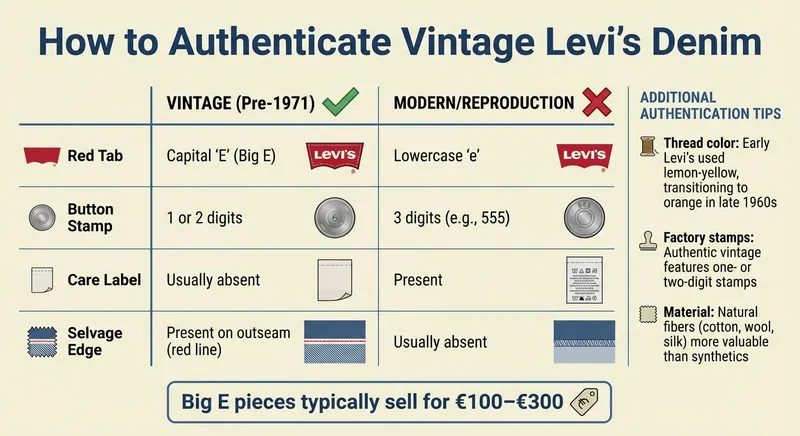
Vintage Levi's Denim Authentication Guide: Pre-1971 vs Modern Features
Evaluating the condition and authenticity of denim is crucial for determining its value. Genuine vintage pieces, especially premium ones, often fetch much higher prices compared to modern reproductions.
Checking for Wear and Repairs
Start by examining the denim for signs of wear and tear. Look for issues like crotch blowouts, holes, rubbing, cuff fraying, staining, or indigo marbling - these can significantly affect the item's value. Also, check for environmental damage such as smoke, fire, or storage odours, as these factors play a role in pricing accuracy.
Perform a "touch test" to assess the fabric. Authentic vintage denim tends to feel heavy and dense, a tactile quality that sets it apart from modern, mass-produced alternatives. If the fabric feels flimsy or lightweight, it may not justify a premium price tag.
Inspect any previous repairs carefully. Hand-darning, replaced zippers, or patched areas aren't necessarily deal-breakers, but they do impact the overall value. When pricing, consider these repair and cleaning costs. For example, if you spent €5 on a new zipper and €2 on cleaning, include those expenses - plus your time - when determining the final price.
"Something is only worth what the customer will pay. But there are many different customers for vintage... the trick is knowing who your customers are and what their needs are".
Once you've assessed the condition, move on to verifying the item's authenticity.
Verifying Authenticity
Authenticity is often determined by small but telling details. For Levi's denim, start with the red tab. If the word "LEVI'S" features a capital "E" (known as the "Big E"), it indicates the piece was made in 1971 or earlier. These items typically sell for €100–€300. Additionally, the "R" trademark and dual-side inscription date back to around 1950.
Examine the button backs for factory stamps. Authentic vintage Levi's usually feature one- or two-digit stamps, whereas three-digit stamps (like "555") often signify modern LVC reproductions. Another key detail is the selvage edge - a red line on the outseam - which is a hallmark of pre-1982 production and indicates higher manufacturing standards.
Care labels can also provide clues. These labels became mandatory in 1971, so finding one on a "Big E" piece likely suggests it's a reproduction. Thread colour is another marker: early Levi's used lemon-yellow thread in bar tacks under pocket flaps, transitioning to orange thread in the late 1960s.
| Feature | Vintage Indicator (Pre-1971) | Modern/Reproduction |
|---|---|---|
| Red Tab | Capital "E" (Big E) | Lowercase "e" |
| Button Stamp | 1 or 2 digits | 3 digits (e.g., 555) |
| Care Label | Usually absent | Present |
| Selvage Edge | Present on outseam | Usually absent |
Finally, consider the material. Natural fibres like cotton, wool, and silk are generally more sought after than synthetics like polyester or nylon, which became common after the 1950s. These markers not only confirm authenticity but also help you price vintage denim more effectively.
Dating Vintage Denim and Pricing by Era
Once you've confirmed a denim piece's authenticity, the next step is to determine its age. The value of vintage denim is heavily influenced by its era and rarity. While older items can be more valuable, that's not always the case - certain periods are particularly sought after due to limited surviving stock and exceptional craftsmanship. Understanding these era-specific details can help fine-tune your pricing strategy.
Identifying Features by Decade
Each decade leaves its mark on denim through unique design elements, making it possible to date pieces with some detective work. For instance, pre-1980s denim often features selvage edges with a red outseam, which signals a denser, higher-quality fabric compared to modern mass-produced options.
The stitching style is another clue. Levi's jeans made before the mid-1980s commonly have a single felled inseam running along the inner thigh. In 1984, Levi's introduced hand warmer pockets to their Type III jackets, increasing the number of exterior pockets to four. Jackets without these side pockets are usually older and hold greater value for collectors.
Hardware details also tell a story. For example, Levi's transitioned from hidden back-pocket rivets to visible ones after 1937. During World War II (1941–1944), material rationing led to features like donut buttons and the absence of pocket flaps, making denim from this era especially collectible.
Pricing varies widely by era. For example:
- 1940s–1950s 501XX jeans typically sell for €730–€2.740.
- 1970s 501s are valued between €180–€550.
- 1980s 501s usually fetch €110–€275.
As for jackets, pre-1971 Type III jackets with a "Big E" tab can sell for €90–€275, while earlier models often command much higher prices.
Case Study: Levi's Jackets
Levi's jacket designs provide a clear example of how subtle changes over time can significantly impact value. Let’s break it down:
- Type I (506XX): Produced from 1905 to 1953, this jacket features a single left chest pocket and a cinch-back. The cinch slider was silver before 1941 and bronze between 1944 and 1952. These jackets are extremely rare, often selling for €900–€5.500.
- Type II (507XX): Manufactured from 1953 to 1962, this version introduced two chest pockets and waist tab adjusters, replacing the cinch-back. Early models used leather patches, which were replaced by press card labels in the mid-1950s. These jackets generally sell for €730–€1.370.
- Type III (Trucker): First introduced in 1962, this style is still in production today. It features pointed pocket flaps and a slimmer fit. Early models (1962–1971) with a "Big E" tab and no hand warmer pockets are the most desirable in this category.
One extraordinary example highlights the potential value of vintage denim. In 2021, a collector in Portland bought a box of old work clothes at a garage sale for just €37. Inside, they found a pair of 1953 Levi’s 501XX jeans, identifiable by the "XX" stamping and Big E tab. After authentication, the jeans sold on Grailed for €2.285 to a Japanese denim enthusiast - within just three days.
"Denim is one of the few textiles that carries both functional history and cultural mythology. Vintage Levi's sit at the intersection of industrial innovation and countercultural expression." – Sarah Byrd, Textile Historian
Researching Current Market Prices
Once you've determined the age of your denim, the next step is to look at actual buyer transactions. Instead of relying on active listings, focus on completed sales to gather real data. This approach gives you a realistic foundation for setting competitive prices in the Dutch market and helps you avoid overpricing or undervaluing your items.
Comparing Prices on Online Platforms
When it comes to pricing data, eBay's sold listings are often regarded as the most reliable source because they reflect actual sale prices. To access this information, search for your denim item on eBay and use the "Sold Items" filter. This will show you final sale prices, sale dates, and sometimes even buyer locations. For example, if multiple pairs of 1970s Levi's 501s have recently sold between €180 and €220, you can use that range as a solid pricing reference.
In the Netherlands and across Europe, Vinted is a key platform for vintage resellers. Use Vinted's search tool to find similar items and apply the "Sold" filter to see confirmed sale prices. Dutch buyers on Vinted often look for value, while platforms like Depop attract trend-conscious shoppers who may pay a premium for stylishly presented denim.
Keep in mind that platform fees vary, which can affect final pricing.
Understanding Dutch Market Demand
To refine your pricing strategy, it's essential to understand local buyer preferences. In the Netherlands, vintage denim trends lean heavily toward high-waisted flares and baggy fits, reflecting broader European streetwear influences. Skinny jeans, on the other hand, continue to fall out of favour. Dutch buyers particularly appreciate tapered, high-rise cuts and relaxed silhouettes that align with these trends.
Platforms like Marktplaats can provide additional insights into regional demand and competitor pricing. Beyond platforms, social media can be a goldmine for spotting trends. For instance, hashtags like #vintedhaul on TikTok or Instagram live sales can reveal what styles are currently in demand. Distressed Carhartt or Dickies workwear, for example, often fetch higher prices because buyers value the worn-in aesthetic over pristine versions.
Geographic demand also plays a role. Authentic American vintage denim, such as Levi's or Wrangler, tends to sell for higher prices in European markets compared to the US. This is especially true for Dutch buyers, who are often willing to pay a premium for genuine American-made pieces.
Finally, always cross-check your findings with the latest sold listings. Market trends can shift quickly, so staying updated is key.
sbb-itb-d4aa959
Setting Prices to Maximize Profit
With your market data ready, it’s time to apply pricing strategies that align with your inventory and sales goals.
Flexible Pricing Methods
For everyday vintage denim, like common Levi's 501s or basic Lee jeans, the 3x Rule is a solid starting point. Add up all costs - purchase price, cleaning, and platform fees - and multiply by three. For instance, if a pair of jeans cost you €12, you’d list them at €36.
For items in varying conditions, the 60/80/95 Rule works well. Price denim in "good" condition at 60–70% of its original retail value, "very good" at 70–85%, and "new with tags" at 85–95%. For example, G‑Star jeans originally priced at €120 in excellent condition could sell for €84–€102.
Rare or collectible pieces require a different approach. While standard items might sell at 2–2.5x cost for quicker turnover, rare finds - like 1960s Levi's Big E or selvedge workwear - can go for 4–5x cost, with "Holy Grail" items reaching 6–10x. These premium prices depend on rarity, condition, and original retail value.
Dutch buyers are often strategic and may wait for discounts before committing to a purchase. To navigate this, use anchor pricing by listing items 10–15% above your target price to allow room for negotiation. Also, set a "Floor Price" - the lowest amount you’re willing to accept - at 10% below your target price. For example, if your target price is €68, you could list at €75–€79 and refuse offers below €61.
Pay attention to buyer engagement. If an item gets many views but few favourites, your pricing or photos might need adjustment. If it has plenty of favourites but no offers, consider a 5% price drop or offer a bundle deal. On the flip side, if an item sells within 10 days, it might be underpriced. In that case, increase prices for similar inventory by 10–15%.
Finally, consider using automation tools to simplify and refine your pricing process.
Using VintiePlus for Pricing Data
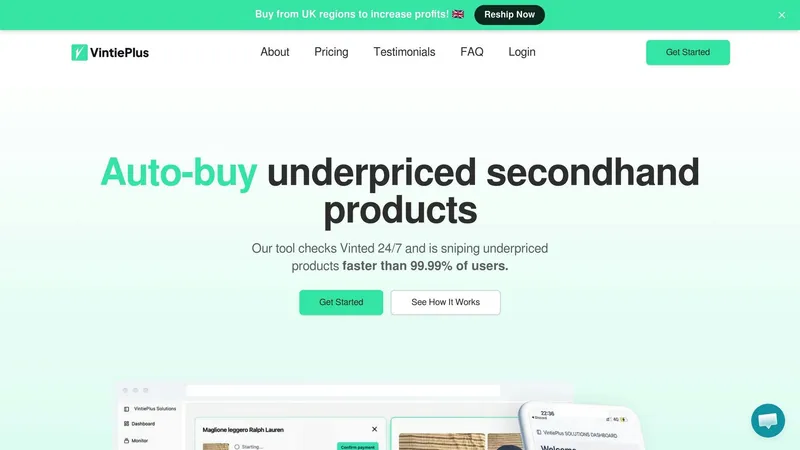
Researching prices manually can be time-consuming, especially when juggling multiple platforms and trends. That’s where VintiePlus comes in. This tool automates pricing research by scanning marketplaces in real time and providing advanced profit analytics, helping you spot underpriced inventory before your competitors.
With custom filters, you can track specific brands, eras, or conditions. For example, set filters for 1970s Levi's 501s in excellent condition, and VintiePlus will notify you the moment an underpriced listing appears. Its auto-buy feature even allows you to secure these items instantly, ensuring you don’t miss out on high-margin opportunities.
The platform’s analytics dashboard offers insights into your profit margins, showing which denim styles, sizes, and price points deliver the best returns. Over time, this data helps you fine-tune your pricing strategy.
You can also use VintiePlus to monitor competitor discounts and adjust your listings accordingly. Features like batch label printing and one-click repost make it easier to experiment with different price points without the hassle of manual updates.
For resellers looking to scale, VintiePlus takes the guesswork out of pricing. The Basic Plan (€29,95/month) includes 10 custom filters and auto-buy functionality, perfect for beginners. The Pro Plan (€69,95/month) adds unlimited filters and full analytics, while the Ultimate Plan (€109,95/month) offers high-priority sniper access to secure the most competitive deals.
Pricing for the Netherlands Market
Pricing vintage denim for the Dutch market involves understanding local buyer preferences and staying updated on current trends. Let’s break it down.
Matching Local Buyer Preferences
Dutch shoppers are big on sustainable fashion, with platforms like Vinted leading the charge in Europe. This trend has created a market where buyers are willing to spend more on "Grade A" vintage pieces - those that are carefully curated and ready to wear - compared to uncurated thrift items.
"Vinted has grown into the platform for vintage resellers in the Netherlands and Europe."
– Vintage Wholesale Market
Presentation plays a key role in pricing. Dutch buyers value listings with lifestyle imagery, which can justify prices that are 10–20% higher than flat-lay images. Branded items from popular labels like Levi's, Nike, and Adidas typically command 20–30% higher prices than unbranded pieces. They also sell faster and attract more interest.
Trends like Y2K, "old money", and streetwear styles are driving higher price points, outpacing basic vintage staples. Seasonal trends can add up to 15% to prices, and setting prices just above common filter thresholds (e.g., €109 instead of €99) often makes listings more appealing.
To stay competitive and adapt to these trends, leveraging automated tools can make all the difference.
Tracking Dutch Trends with VintiePlus Filters
Navigating the fast-moving Dutch market can be overwhelming, but tools like VintiePlus simplify the process. Manually tracking trends on Vinted NL is time-consuming, especially when demand shifts quickly. VintiePlus allows you to set custom filters for brands, styles, and conditions that align with Dutch buyer preferences. For instance, you could filter for 1990s Levi's 501s in "very good" condition or Y2K-style denim jackets. The tool scans listings around the clock and alerts you when an underpriced item pops up.
The auto-buy feature ensures you can secure in-demand inventory before competitors step in - a crucial advantage in this competitive market. Additionally, its one-click repost tools let you experiment with pricing strategies without constant manual updates. The integrated analytics dashboard provides insights into which denim styles, sizes, and price points perform best in the Netherlands, helping you fine-tune your approach over time.
VintiePlus offers two plans: the Basic Plan (€29,95/month) includes 10 custom filters and auto-buy functionality, while the Pro Plan (€69,95/month) offers unlimited filters and advanced analytics for sellers aiming to scale their business.
Conclusion
Maximizing profits from vintage denim sales boils down to three essential steps: assessing the condition and authenticity of the item, determining its era and rarity, and understanding current market demand.
Once you've covered these basics, double-check your pricing against up-to-date market data. Review completed sales and apply pricing formulas, such as 2x to 2.5x your cost, to align with market trends effectively.
Dutch buyers place a high value on sustainability, precise measurements, and transparent pricing. In fact, two out of three people in the Netherlands are open to buying second-hand, with saving money being a primary motivation. This makes it crucial to provide detailed and accurate listings that meet these expectations.
To stay competitive, consider using technology to your advantage. Tools like VintiePlus can help you track trends, secure profitable inventory ahead of competitors, and refine your pricing strategy with analytics. With plans starting at €29,95/month for the Basic Plan and €69,95/month for the Pro Plan (which includes unlimited filters), it’s a smart investment for serious resellers.