
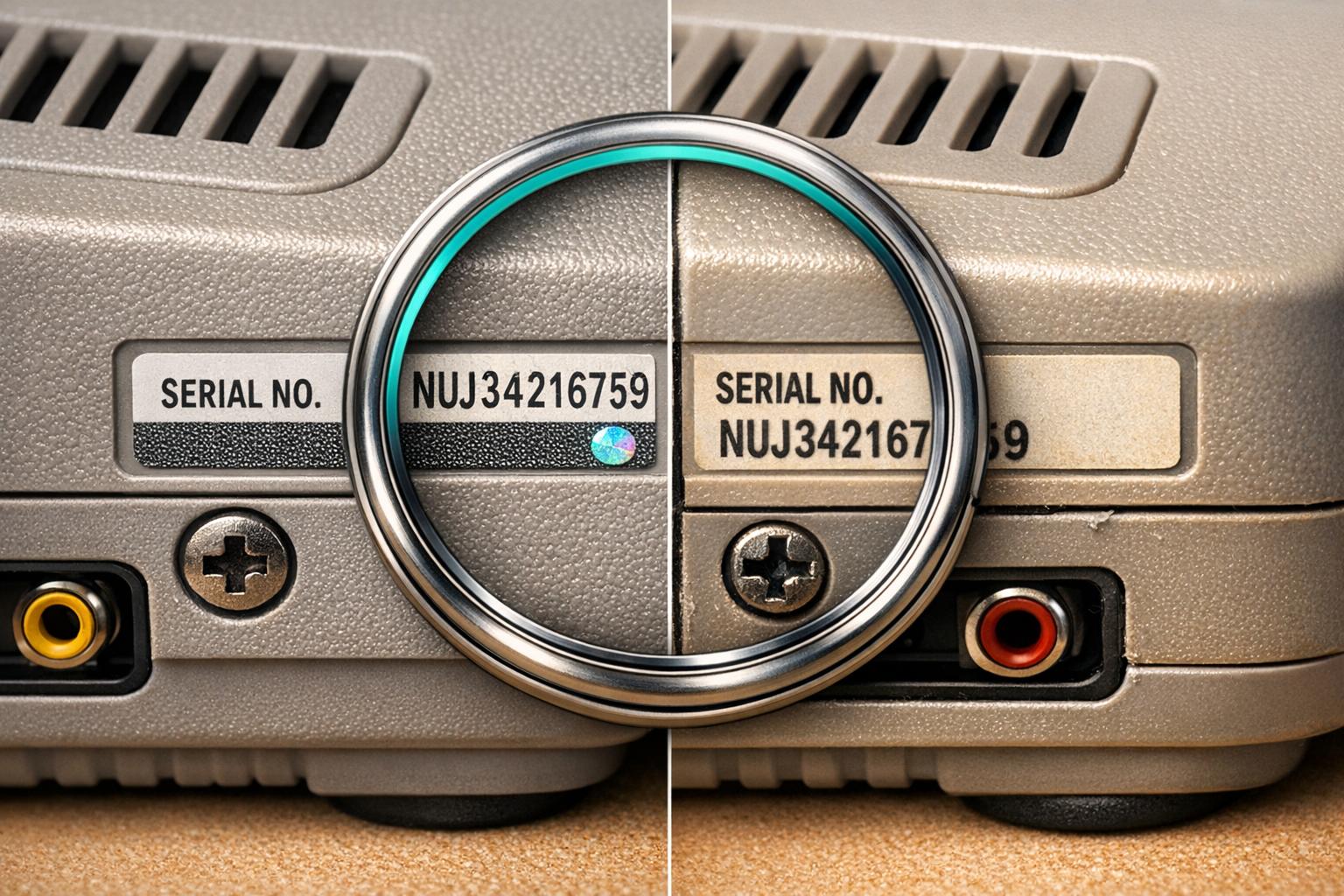
Fake retro gaming consoles are flooding the market, especially on platforms like eBay and AliExpress. These counterfeits often look convincing but come with flaws like poor build quality, frequent crashes, and subpar graphics. To avoid losing money and damaging your reputation, here’s how to identify fakes:
- Inspect labels and branding: Look for sharp text, correct spellings, and unique details like embossed quality stamps. For example, authentic Nintendo 64 cartridges have a square dot above the "i" in the logo.
- Check packaging: Genuine boxes show natural wear and use fibrous cardboard. Counterfeits often look too new or glossy.
- Weigh and feel the product: Originals are heavier and made from durable plastic. Fakes may feel light or have a gritty texture.
- Examine internal components: Use proper tools to check for official manufacturer logos, consistent soldering, and matching copyright years on PCBs.
- Vet the seller: Research their reviews, transaction history, and willingness to provide detailed photos. Be cautious of deals that seem too good to be true.
- Use tools like VintiePlus: Automation tools can monitor listings for high-quality options while avoiding counterfeits.
How to tell if an NES game is real or fake!
sbb-itb-d4aa959
Checking the Exterior for Fake Signs
How to Identify Authentic vs Fake Retro Gaming Consoles: Visual Inspection Guide
The first step in spotting counterfeit retro consoles is a careful visual inspection. Many fakes reveal themselves through sloppy construction, inaccurate branding, or inferior materials that fail to match the originals. This visual check is a key part of identifying counterfeit items.
Examine Label Quality and Branding
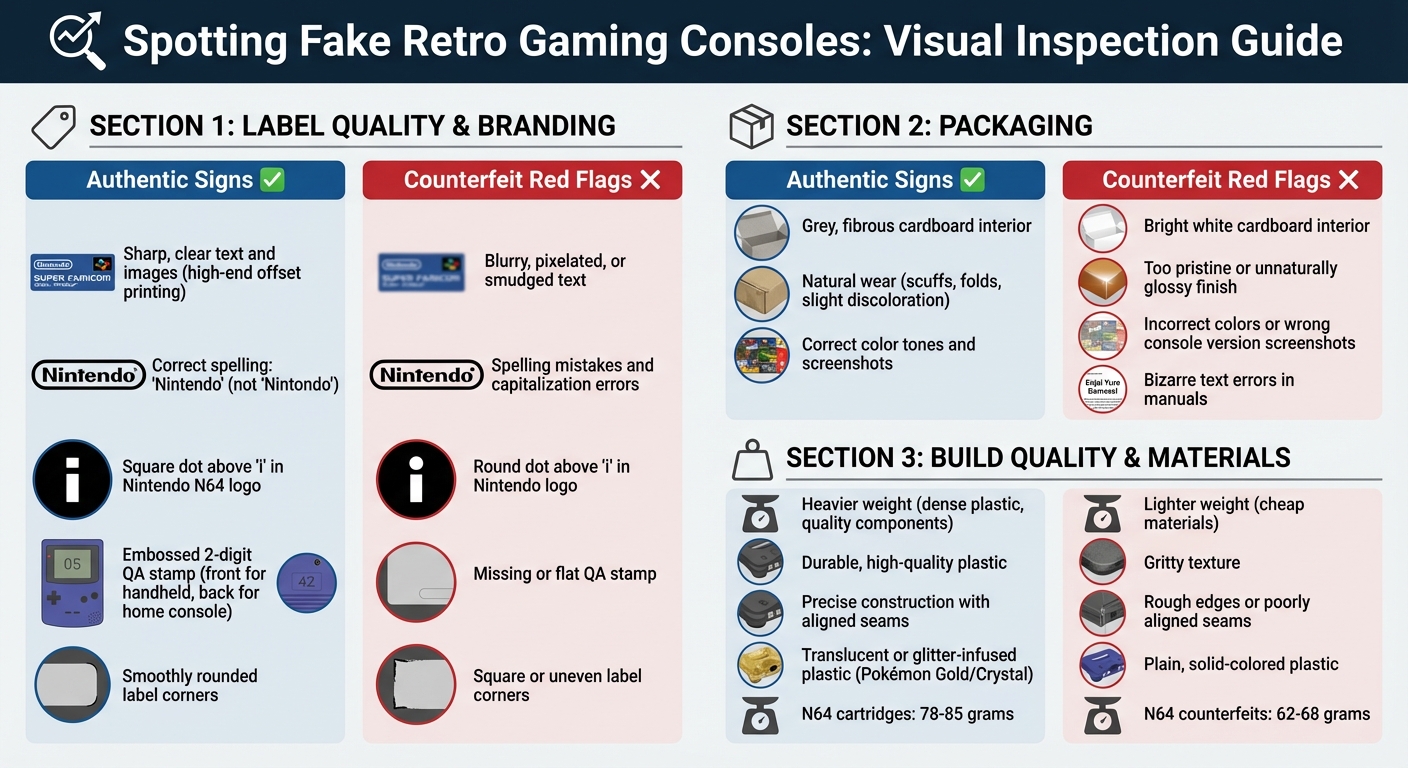
Original retro game labels were made with high-end offset printing machines, producing sharp, clear text and images. Counterfeit labels, however, often have blurry text, pixelated images, or smudged fine print. Hold the label under bright light - if the text looks fuzzy or the colors appear faded, it’s likely a fake.
Spelling mistakes are another common giveaway. Counterfeiters often misspell words like "Nintendo", turning it into "Nintondo", or they misuse capitalization in the "Official Seal of Quality". Fonts can also be a clue - fakes frequently use the wrong typeface or align text poorly compared to authentic labels.
A reliable indicator of authenticity is the two-digit quality assurance stamp found on genuine Nintendo cartridge labels. This number is embossed directly onto the label - on the front for handheld games and on the back for home console cartridges. Tilt the cartridge under a light to spot this mark; if it’s missing, you’re likely dealing with a counterfeit.
For Nintendo 64 cartridges, there’s a small but telling detail: the dot above the "i" in the Nintendo logo is square on authentic products. As noted by 8-Bit Basement:
The 'dot' above the 'i' is distinctly square. Many repros will often overlook this and have a circle dot.
This subtle feature can immediately signal whether a cartridge is authentic or fake.
| Feature | Authentic Sign | Counterfeit Red Flag |
|---|---|---|
| Nintendo Logo (N64) | Square dot above the "i" | Round dot above the "i" |
| Label Corners | Smoothly rounded | Square or uneven cuts |
| QA Stamp | Embossed 2-digit number | Missing or flat label |
| Text Quality | Crisp and clear | Blurry, pixelated, or smudged |
Once you’ve inspected the labels, shift your attention to the packaging for more clues.
Review Packaging and Box Design
Authentic NES and SNES boxes were made from grey, fibrous cardboard. If the inside of a box is bright white, it’s probably a modern reproduction. Genuine packaging also shows natural wear - scuffs, folds, and slight discoloration are expected for items that are decades old. In contrast, counterfeit boxes often look too pristine or have an unnatural glossy finish.
Another red flag is incorrect color tones or screenshots from the wrong console version. Manuals included in counterfeit packaging might also contain bizarre text errors.
From here, it’s time to examine the build quality and materials for more signs of inauthenticity.
Check Build Quality and Materials
Authentic consoles and cartridges are made from durable, high-quality plastic with precise construction. Counterfeit versions often feel different - they’re usually lighter, have a gritty texture, and show rough edges or poorly aligned seams.
Weight can also be a helpful indicator. Genuine hardware tends to weigh more because of its dense plastic and quality internal components. Interestingly, some counterfeit cartridges might feel heavier due to the use of thick, cheap EPROM chips, which can even cause the plastic shell to bulge slightly.
Certain games have unique features that are hard for counterfeiters to replicate. For instance, authentic Pokémon Gold or Crystal cartridges use translucent or glitter-infused plastic that gives them a distinctive shimmer. Fakes, on the other hand, often use plain, solid-colored plastic instead.
Checking Internal Components
While external features can hint at whether a cartridge or console is genuine, the real proof lies inside. Opening up a cartridge or console often exposes counterfeits that might otherwise pass a surface-level inspection. To access the internals, you'll need a 3.8 mm Gamebit screwdriver for most Nintendo cartridges (like NES, SNES, N64, Game Boy, and Game Boy Color) or a tri-wing screwdriver for Game Boy Advance units.
Before opening a cartridge, let it sit at room temperature for about 30 minutes, especially if it's been stored in a cold environment. This prevents condensation from forming inside. When removing screws, apply steady pressure - authentic cartridges are sturdy but can crack if too much force is used on their brittle plastic. These steps help ensure an accurate inspection of the internal components.
Check the Printed Circuit Board (PCB)
The PCB is one of the clearest indicators of authenticity. Genuine boards feature official manufacturer logos, copyright years, and serial numbers printed directly on the board. Pay special attention to the Nintendo logo, especially the "O", which has a distinct pill-shaped design that counterfeiters often struggle to replicate. Also, check the copyright date - it should match or be earlier than the game's release date. A later date is a clear sign of a reproduction.
Another giveaway is the quality of the soldering. Authentic boards have machine-soldered joints that are precise and uniform. Counterfeits, on the other hand, often show irregular solder blobs, lifted pins, or unnecessary wiring. Official ROM chips on authentic boards typically have laser-etched serial numbers that align partially with the game's ID. For example, a Paperboy cartridge might have a chip labeled "NES-PY-0."
Be wary of "black blob" chips - these are Chip-on-Board (COB) components covered in black epoxy. These are rarely found in genuine Nintendo cartridges, except for a few exceptions like some Tetris runs. Authentic boards also fit perfectly within the cartridge shell. Signs of a counterfeit include oddly shaped boards, stacked PCBs, or boards that don't align with screw posts. Once you've checked the PCB, move on to other components for further clues.
Examine Chips, Capacitors, and Batteries
Authentic consoles use proprietary ROM chips and custom graphics interfaces. Counterfeits often replace these with modern boards or modified ROMs, which can disrupt the system's original timing. Hiroshi Sato, a former Lead Hardware Architect at Nintendo EAD, highlighted these issues:
"The N64's bus architecture is unforgiving. A 5ns timing shift - barely perceptible to a logic analyzer - can corrupt DMA transfers. We tested over 200 'performance-modified' carts in our lab. 92% failed stress testing beyond 45 minutes of continuous operation."
When inspecting battery-backed games, check the save technology used. Genuine cartridges often use specific chips like EEPROM, while fakes might substitute FRAM or SRAM, which can lead to corrupted save data. To test this, save your progress, power off the console, and then turn it back on to see if the data persists. Many reproductions fail this simple test.
Take a close look at the gold-plated edge connectors using a macro lens or magnifier. Authentic contacts are smooth and mirror-bright, while counterfeits may show signs of oxidation or pitting. Additionally, inspect the contact pins - official pins are solid, whereas older counterfeits sometimes have small holes in the pins. Without fully opening the shell, you can also use a flashlight to check for darkened capacitors or white crystalline residue from battery leaks through ventilation slots.
Weight can also reveal a lot. Genuine N64 cartridges weigh between 78–85 grams, while counterfeits made with cheaper ABS plastic usually weigh only 62–68 grams. If you need to clean the contacts, use 99% isopropyl alcohol and a lint-free swab. Avoid abrasive tools like sandpaper or metal files, as these can damage the gold plating.
Researching Sellers and Purchase History
Even if a console looks authentic at first glance, digging into the seller's background can reveal whether you're about to make a regrettable purchase. Checking the seller's reputation and past transactions is a powerful way to spot potential scams that a physical inspection might miss. This extra step could save you money - and headaches.
### Check Seller Reputation
Start by reviewing the seller's transaction history and feedback ratings. Verified sellers on platforms like eBay or specialised retro gaming stores (or using a UK Vinted reshipper for international finds) are generally safer bets than unknown websites with limited information. Look for sellers with a long track record of positive reviews and hundreds of successful transactions - they're more likely to be trustworthy.
Be wary of sellers offering rare gaming consoles or accessories at prices that seem too good to be true. For example, in October 2023, scammers created fraudulent websites like AllModern-Sale.com and retrogamingofdenver-sale.com. These sites mimicked the legitimate RetroGamingofDenver.com, copying images and product descriptions, and advertised deals like a Nintendo Switch for €27.50 or a PlayStation 5 for €41.25. Victims lost around €92 each before realising the websites were tied to fraudulent operations based in China.
To avoid falling for similar schemes, search the store name followed by the word "scam" on Google. As Marc Baillargeon wisely advises:
Anything sounds fishy add the name of store plus scam usually they did scam people before you saw the add.
Additionally, check how long the website has been active. Sites created just days or weeks ago and claiming to "liquidate stock" are often red flags. Copy text from their "About Us" section or product descriptions and paste it into a search engine - if the text is plagiarised from legitimate retailers, that's another warning sign. Authentic sellers typically provide clear contact details, physical warehouse addresses, and warranties like 90-day or 1-year guarantees.
Once you've vetted the seller, the next step is to confirm the product's authenticity with additional proof.
Ask for Proof of Authenticity
Reputable sellers are usually willing to share detailed internal photos of their products. Request images of the PCB (printed circuit board) to check for key identifiers like "Nintendo" stamps or "MX" chip markings. Also, examine the rear label in the photos for small, two-digit imprinted numbers (e.g., "00" or "41") - these are often telltale signs of authenticity. Make sure the photos are of the actual product and not stock images, as scammers frequently use high-quality images lifted from official websites.
If a seller refuses to provide internal photos or avoids showing certain angles - like the rear label - it could mean they're hiding signs of counterfeiting. Stick with sellers who offer clear refund policies, giving you a safety net in case the item turns out to be a reproduction.
Using Technology to Find Genuine Inventory
Once you’ve vetted sellers and verified items through manual checks, technology can take your process to the next level. It works hand-in-hand with manual methods by automatically flagging legitimate opportunities. Let’s face it - manual searches can miss out on great deals. Automation tools, on the other hand, can monitor marketplaces around the clock, giving you a significant edge by securing inventory faster than any manual effort ever could.
How VintiePlus Supports Resellers

VintiePlus (https://vintieplus.com) is a powerful tool that keeps an eye on platforms like Vinted, Marktplaats, and Tweedehands 24/7. It scans new listings based on your custom filters, which can include specific brands (like Nintendo or Sega), price ranges, and item conditions. This means you can focus solely on high-quality inventory without wasting time on irrelevant listings. One standout feature is its auto-buy function, which completes purchases within seconds - way faster than any manual attempt. With over 6,000 members, 500+ daily purchases, and a 98% success rate, users have already secured more than €649,074 worth of inventory.
Here’s what one reseller had to say:
"The autobuy tool works like magic since manual sniping almost never lands the deals!" – HavocMT
VintiePlus also provides built-in analytics to identify high-margin console types, along with access to a Discord community and weekly "best items" summaries. These features not only help you lock in inventory but also pave the way for better profit margins.
Boosting Profits with Automation
Automation does more than save you time - it reduces the risk of counterfeit purchases. By setting filters for conditions like "New" or "Excellent", you can steer clear of heavily used clones or damaged items that often show up in lower-quality listings. Once an auto-purchase is made, a quick physical inspection for PCB trademarks, label quality, and internal components ensures everything checks out. This way, automation helps you focus on genuine opportunities while avoiding overpriced or unavailable listings.
As one satisfied user put it:
"One good purchase can pay back your subscription and everything after is pure profit." – Rayman
Conclusion
Every step - from basic visual inspections to detailed internal reviews and seller evaluations - works together to create a reliable strategy for verifying authenticity. By combining these methods, you can confidently identify counterfeit retro consoles and ensure genuine purchases.
Start with visual checks. Look for blurry text or grammatical errors on labels (e.g., "Official Seal Of Quality"), inspect packaging for overly glossy surfaces, and assess the weight of the plastic. If something seems off, it likely is.
For internal verification, follow established inspection practices. As Brandon Perton, Founder of The Old School Game Vault, points out, opening the device is often the most reliable way to confirm authenticity. Genuine boards typically feature Japanese components and quality soldering, while counterfeits often rely on modern, generic chips.
Seller vetting is equally crucial. Be wary of unusually low prices - they're often a red flag for counterfeits. Use the methods discussed earlier to evaluate sellers thoroughly.
Technology can also be a valuable ally. Tools like VintiePlus (https://vintieplus.com) simplify the process by monitoring marketplaces and flagging suspicious listings. When paired with physical inspections - such as checking PCB trademarks and label quality - automation can significantly lower the risk of buying counterfeits while helping to maintain profit margins.
Stay alert, rely on proven inspection techniques, and consider leveraging automation tools like VintiePlus to safeguard your inventory and investments.