
Finding reliable vintage wholesalers in Europe is essential for building a successful resale business. With over 3 million wholesale companies operating across the continent, navigating the market can feel overwhelming. The risks are real - low-quality stock, financial scams, and shipping delays can harm your brand and profits. Here's a straightforward guide to help you secure trustworthy suppliers and avoid common pitfalls:
- Research and Shortlist Suppliers: Use B2B directories like FLUF, Europages, or reseller communities on Facebook to identify wholesalers. Look for region-specific trends, such as American vintage in Spain or designer pieces in the Netherlands. If you find stock in restricted regions, you can shop from UK Vinted anywhere in Europe using a reshipper.
- Verify Supplier Credentials: Check VAT numbers via VIES, confirm business registrations, and ensure payment details align with official company records. Avoid suppliers using personal accounts or untraceable payment methods.
- Test Product Quality: Start with small orders (e.g., 20–25 kg packs) and inspect items for grading consistency. Focus on popular categories like Levi’s denim, branded sportswear, and Y2K fashion.
- Read Reviews and Feedback: Platforms like Trustpilot and Google Reviews can reveal red flags or highlight reliable suppliers.
- Build Relationships: Once a supplier proves reliable, negotiate better pricing, bulk discounts, and flexible payment terms for long-term partnerships.
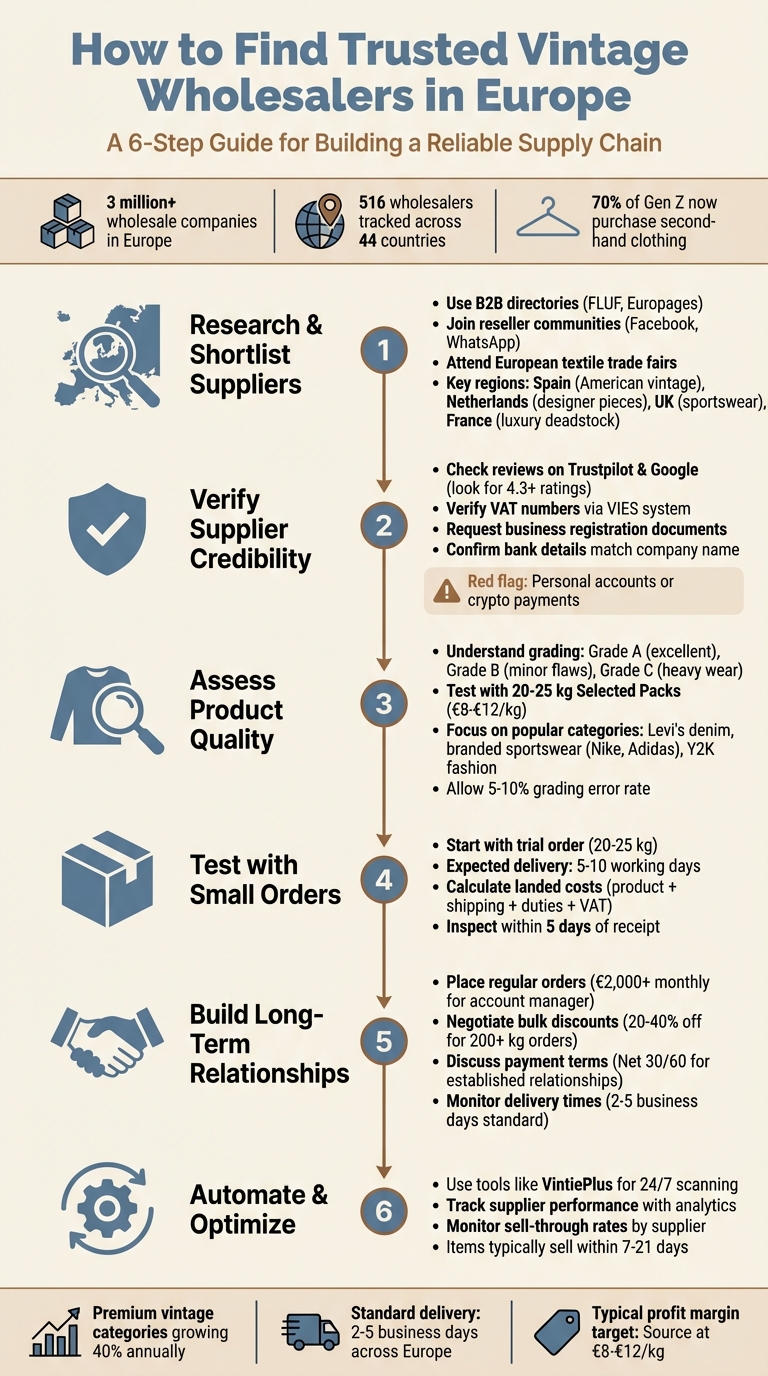
6-Step Process to Find Trusted Vintage Wholesalers in Europe
Vintage Clothing Wholesalers EXPOSED: How I Found The Best Secret Suppliers
sbb-itb-d4aa959
Step 1: Research Vintage Wholesalers Across Europe
Start by pinpointing markets that cater to the vintage styles you're after. Europe offers a diverse vintage wholesale scene, with each country showcasing its own strengths and product focus.
Find Established Wholesalers in Each Country
Leverage B2B directories like FLUF (fluf.io) and Europages to narrow down wholesalers by category and popularity. For example, FLUF currently tracks 516 wholesalers across 44 countries, while Europages lists 304 suppliers under vintage wholesale, with filters for location and delivery options. Platforms like Alibaba, SoloStocks, and Kompass also feature well-established textile warehouses.
Some suppliers stand out for their reliability and reputation. Vintage Wholesale Europe, based in Traiskirchen, Austria, has been operating since 2018 and employs 17 staff members to handle bulk sorting and distribution. In Amsterdam, Rebirth of Fashion (ROF Wholesale) requires a minimum order of 50 kg. Over in Valencia, Terranova Vintage Wholesale (rated 4.4/5 from 44 reviews) specializes in American vintage, offering 45 kg bales priced from €200. Another noteworthy option is the Netherlands-based Wing999, a trusted name in the vintage sourcing space.
Reseller communities on platforms like Facebook, WhatsApp, and Telegram can also be goldmines for insider tips. Members often share supplier contacts, reviews, and feedback you won’t find in official directories. Additionally, attending European textile trade fairs gives you the chance to meet wholesalers, assess product quality firsthand, and negotiate deals. Once you’ve identified potential partners, it’s time to align their offerings with regional market trends.
Review Market Trends by Region
After shortlisting wholesalers, dive into regional trends to ensure their stock matches your target audience’s tastes. Each European country has its own vintage focus, which can shape your sourcing strategy. For instance, Spain, particularly Valencia, is a hotspot for American vintage imports like Levi's denim, western shirts, collegiate graphic tees, and branded sportswear. In the Netherlands, Amsterdam’s vintage scene thrives on high-end designer pieces (think Fendi and Dolce & Gabbana), retro clothing from the 50s–80s, and European brands such as Barbour and Benetton. The UK market leans heavily on branded sportswear (Nike, Adidas, Puma, Reebok) alongside American vintage staples, while France is known for "Grade A" French vintage and luxury deadstock materials.
"A specialised vintage clothing supplier selects garments based on style, condition, era, and trends. That means you can access garments with true vintage value."
Fast-selling items across Europe include Levi's denim, branded sportswear, bold fleece jackets with colour-blocking, and graphic T-shirts featuring rock bands, colleges, or sports themes. By understanding these regional preferences, you can connect with suppliers whose stock aligns perfectly with your customers' needs.
Step 2: Verify Supplier Credibility
Once you've shortlisted potential wholesalers, the next step is to ensure they’re trustworthy. This is crucial to safeguard your business. Reliable suppliers should have no issue sharing proof of their legitimacy and providing the necessary documentation.
Check Reviews and Customer Feedback
Start by exploring independent review platforms like Trustpilot or Google Reviews for unbiased feedback. For instance, as of March 2026, Vintage Wholesale Europe (Austria) has a 4.3/5 rating from 327 reviews on Trustpilot. Customers often compliment their friendly staff and quick shipping, though some mention delays in customer support responses. Similarly, Terranova Vintage Wholesale in Valencia holds a 4.4/5 rating from 44 reviews, with users praising their well-curated lots and prompt communication.
Pay close attention to recurring complaints about issues like inconsistent quality, bait-and-switch tactics, or suppliers vanishing after payment. Be wary if a supplier frequently dismisses negative reviews by claiming they have "no record of the order" - this could be an attempt to undermine genuine feedback.
Additionally, ask suppliers for two or three international trade references. Reach out to these references directly to confirm details about order accuracy, delivery timelines, and how they handle disputes.
Once you’ve reviewed customer feedback, move on to verifying the supplier’s official credentials.
Request Business Documentation
Legitimate wholesalers will readily provide their business registration numbers, VAT IDs, and other key credentials. Use tools like the VIES VAT Information Exchange System to confirm that their VAT number is active and matches their registered business name. For UK-based suppliers, check their details on Companies House, while the EU Business Registers portal can be used for suppliers in other EU countries.
"Ask for the certificate number and issuing body, then contact the issuing body or its national accreditation body to confirm validity." – EuroSaleOnline.com
Request a bank confirmation letter that matches the registered business name exactly. If the supplier’s bank details don’t align with their company name or they ask for payments to personal accounts, consider it a major red flag. Also, ensure they use a professional email domain (e.g., @companyname.com) rather than generic ones like @gmail.com or @yahoo.com.
Here’s a quick reference table for key documents and how to verify them:
| Document Type | Purpose | Verification Tool |
|---|---|---|
| Business Registration | Confirms legal existence and address | National registries (e.g., Companies House) |
| VAT Number | Required for tax-free intra‑EU B2B trade | VIES VAT Checker |
| EORI Number | Required for customs identification | European Commission EORI Guidance |
| Bank Details | Prevents payment fraud | Match against the registered company name |
If a supplier refuses to provide documentation or pressures you to use untraceable payment methods like cryptocurrency or cash, it’s best to cut ties immediately. Fraudulent behavior often starts with such requests, so trust your instincts and prioritize transparency.
Step 3: Assess Product Quality and Inventory
Evaluating the quality of your stock is key to protecting your margins and avoiding unsellable inventory. This step builds on the supplier credibility checks you completed in Step 2.
Check Product Grades and Condition
European vintage wholesalers typically categorize items into Grade A (minimal wear, excellent condition), Grade B (good condition with minor flaws), and Grade C (heavily worn or suitable for upcycling). Since grading standards can vary, always confirm the criteria for each grade with your supplier.
"If you do not grade correctly, you cannot price correctly. If you cannot price correctly, you cannot scale profitably." – Hissen Vintage
Pay close attention to fabric quality. For example, when evaluating 1980s or 1990s cotton, stretch the material near the collar or hem - if it tears or feels powdery, it's not worth keeping. Use the light test: hold garments against a bright light to spot thinning or weak areas in the fabric.
Inspect stress-prone areas like armpits (which often degrade from sweat), collar seams (which may stretch), and waistband elastic (which can harden or crack over time). For graphic tees and sweatshirts, examine the print carefully. The graphic often accounts for over 70% of the item's resale value. While light cracking is acceptable, significant peeling or flaking can drastically lower its worth.
Before committing to large orders, ask for visual proof. Trustworthy suppliers will provide real-time videos of bales being opened or arrange virtual handpick appointments via video call, giving you the chance to approve items before they are packed. Be cautious with suppliers who rely solely on generic stock photos, as this often signals hidden quality issues.
To minimize risk, consider ordering a 20–25 kg Selected Pack instead of a full 45 kg sealed bale. These curated packs typically cost €8–€12 per kg and allow you to test the supplier's grading consistency without a major commitment. Keep in mind that professional wholesalers usually allow for a 5–10% grading error rate, but anything higher could indicate poor quality control.
Focus on Popular Categories
Once you've confirmed product quality, focus on stocking high-demand vintage categories. Branded sportswear from the 1990s - such as Nike, Adidas, Champion, Reebok, Puma, and Fila - performs well across European markets. Similarly, Levi's denim and American workwear brands like Carhartt and Dickies remain strong sellers.
Another growing trend is Y2K fashion, inspired by early 2000s styles. Items like baggy jeans, crop tops, and oversized fleece jackets are particularly popular with younger customers. Successful resellers aim for solid profit margins by sourcing these items from bulk packs.
To maintain a consistent aesthetic and cater to your target market, choose suppliers offering category-specific bales (e.g., "Branded Sportswear Only" or "Y2K Mix") rather than generic mixed bundles. This approach reduces the risk of receiving unwanted items. Steer clear of mystery boxes, as they are often used to dispose of poor-quality stock from larger bales.
Step 4: Test Suppliers with Small Orders
Before diving into large purchases, start with a small trial order to assess the supplier's reliability. This step helps safeguard your investment while giving you insight into how the wholesaler handles real-world transactions. For example, instead of ordering a 45 kg bale, opt for a smaller 20–25 kg Selected Pack priced at €8.00–€12.00 per kg. This approach not only verifies the supplier's claims but also lays the groundwork for future orders.
Pay close attention from payment to delivery. Reliable suppliers typically deliver within 5–10 working days. A Romanian business in February 2026 tested this process with Vintage Wholesale Europe, receiving their trial order in just 5 days. The shipment stood out for its cleanliness and lack of defects - impressive in an industry where a 10% Grade B rate is common. The order, prepared by a team member named Fede, reflected the supplier's meticulous approach. Consistent and prompt communication further solidifies a supplier’s trustworthiness.
When the products arrive, ensure that Grade A items meet the promised standards. Keep in mind, though, that a grading variance of up to 10% is generally acceptable in the used clothing sector. Inspect the items within 5 days of receipt and report any issues immediately.
Don’t forget to calculate the landed cost, which includes the product price, shipping, duties, VAT, and other fees (similar to how you would calculate Vinted seller fees for your resale listings). This figure gives you a clear understanding of the true cost per item and whether your profit margins align with your business goals.
Spot Warning Signs
Be alert for red flags that indicate an unreliable supplier. For instance, if a supplier pressures you to use untraceable payment methods like cryptocurrency, personal bank accounts, or cash-in-hand, consider it a major warning sign. Always stick to traceable payment methods, such as business banking, escrow services, or credit cards, to ensure there’s a clear paper trail.
Another way to confirm a supplier’s legitimacy is by checking their VAT status through the VIES (VAT Information Exchange System). If the VAT number is inactive or doesn’t match the company’s legal name, proceed with caution. As EuroSaleOnline puts it:
"Bank-name mismatches are a common fraud indicator. Ask for a bank statement or confirmation letter showing the account holder is the registered company name".
Be wary of suppliers who refuse to provide samples or allow third-party inspections. EuroSaleOnline advises:
"Reluctance to provide samples, or samples that differ from the bulk production quality, should be treated as an immediate concern".
Similarly, suppliers relying solely on generic stock photos instead of providing real-time videos of bales being opened may be concealing quality issues.
If prices seem far below market rates without a clear explanation, this could signal counterfeit goods or a bait-and-switch scheme. Other red flags include using generic email addresses (e.g., Gmail or Yahoo instead of a business domain), failing to provide a verifiable warehouse address, or offering vague return policies that only include credit notes instead of refunds.
A successful trial order not only builds trust but also sets the stage for a long-term partnership with reliable suppliers.
Step 5: Build Long-Term Supplier Relationships
After testing a supplier and confirming their reliability, the next logical step is developing a strong, ongoing partnership. These relationships can bring perks like exclusive inventory, better pricing, and personalized support. Transitioning from occasional purchases to a trusted collaboration simplifies your sourcing process and strengthens your supply chain.
Consistency plays a huge role here. Regular orders show suppliers that you’re a committed buyer worth their time and resources. For instance, resellers spending over €2.000,00 monthly often gain access to dedicated account managers who oversee orders and ensure smooth operations.
Building trust is also about maintaining open communication. Whether it’s through WhatsApp, phone calls, or in-person visits, direct interactions help foster a solid connection. Many resellers have found that visiting suppliers in person during handpicking sessions provides not only great inventory but also valuable advice. One customer of Vintage Wholesale Europe shared:
"I visited in person and had a great experience, very helpful staff, high-quality vintage pieces, and everything was well organized."
Negotiate Bulk Discounts and Payment Terms
Once a supplier has proven reliable, it’s time to discuss better pricing and payment terms. Larger, regular orders often qualify for tiered discounts. For example, upgrading from 45 kg to 200+ kg orders can significantly lower unit costs. Discounts on vintage categories like jumpers, denim, and fleeces typically range between 20% and 40% when bought in bulk.
Payment terms can also improve as trust builds. While initial purchases might require upfront deposits, you can negotiate terms like "Net 30" or "Net 60" as the relationship matures. These terms allow you to reinvest in inventory before fully settling payments. As EuroSaleOnline.com explains:
"Common terms are 30% deposit and 70% before shipment, or net 30/60 for established relationships; platforms may offer escrow or invoice financing."
It’s also essential to clarify all costs involved, especially for international orders. For early transactions, Delivered Duty Paid (DDP) terms ensure the supplier manages customs and taxes. Later, you might switch to Ex Works (EXW) terms, which give you control over shipping and logistics costs.
Monitor Supplier Performance
Just as you evaluated trial orders, ongoing monitoring ensures your supplier maintains high standards. Regular reviews of delivery times, product quality, and communication are essential for sustaining a reliable partnership. In Europe, standard delivery times typically range from 2 to 5 business days. Any significant delays should be flagged and addressed.
Consistency in quality is equally important. Suppliers should stick to agreed-upon standards, with a typical allowance of up to 10% variance for Grade B items in Grade A lots. Inspect all incoming goods promptly and report any issues within the supplier’s claim window, usually within five days, to maintain your credibility.
Resellers often highlight the importance of problem-solving in their supplier relationships. Viktor Fazekas, for example, praised Vintage Wholesale Supply Ltd for their dedication:
"The team, especially Errin, goes above and beyond to resolve any issues and ensure a smooth experience. I highly recommend VWS to anyone looking for a reliable partner."
Clear and direct communication is crucial for resolving problems before they escalate. If you notice quality dips or delays, address them immediately. Most wholesalers value feedback and will work with you to maintain high standards. By keeping an eye on these performance indicators, you can ensure your supplier remains a dependable partner as your business grows.
Step 6: Use VintiePlus to Improve Your Sourcing
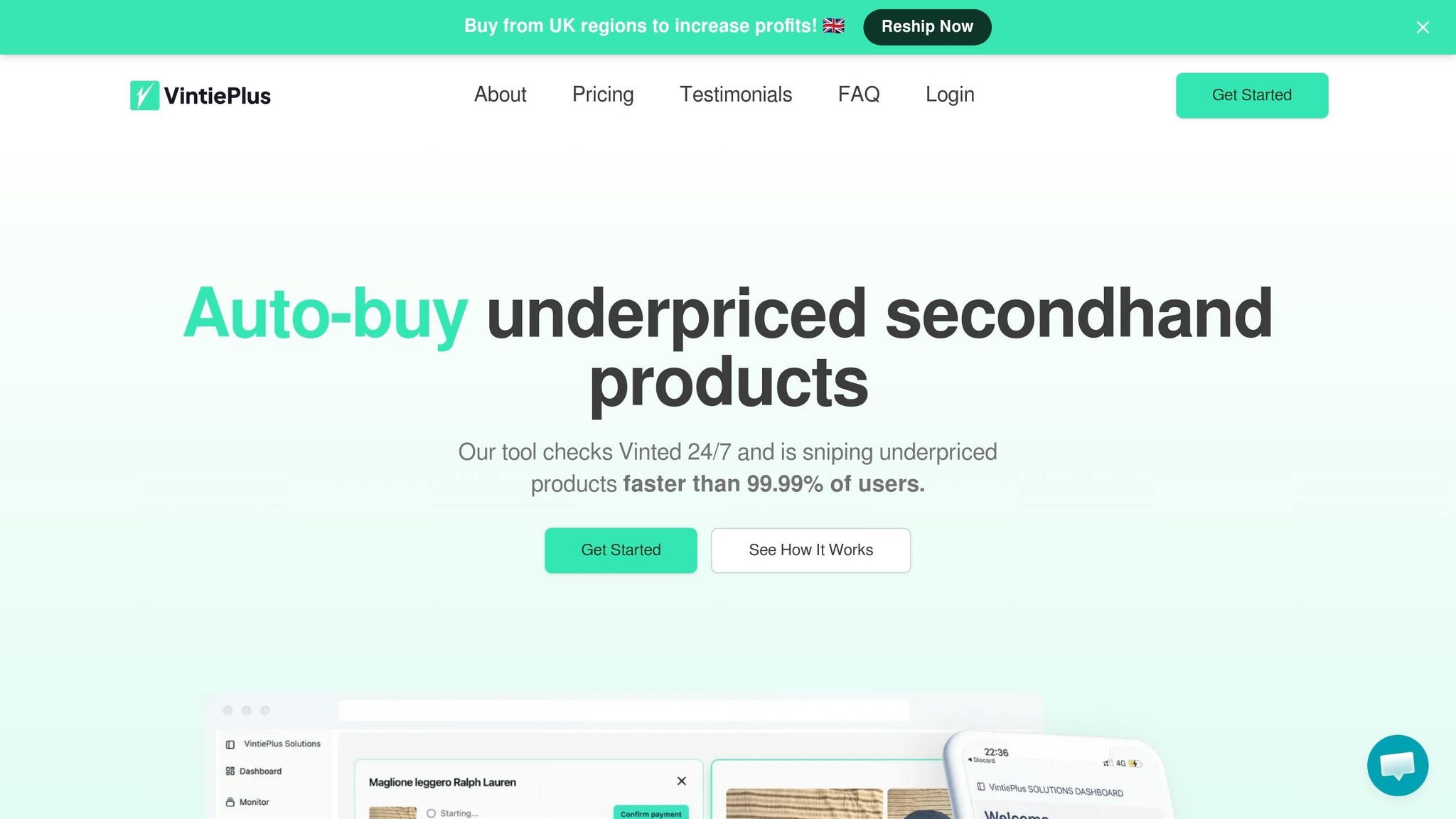
Once you've secured dependable European suppliers, the next step is to fine-tune your inventory sourcing. The vintage resale market moves at lightning speed, and high-margin items often disappear before you even notice. To stay competitive, automation is key. VintiePlus simplifies this process with its 24/7 real-time scanning and auto-buy features. These tools monitor marketplaces around the clock, snapping up underpriced treasures before your competitors can act.
One standout feature is its cross-border scraping capability, which is especially useful for European resellers. It helps you track listings across the EU, revealing regional price differences that can lead to higher profits. This automated system complements your supplier strategy by offering real-time inventory updates.
Automate Your Sourcing Process
Relying on manual searches for inventory can waste valuable time - time that could be better spent expanding your business. VintiePlus eliminates this inefficiency with customizable filters and instant alerts. These features let you automatically purchase underpriced items while you focus on more important tasks. This is particularly critical in fast-moving categories like sneakers and children's clothing, which are forecasted to dominate the resale market in 2026.
Track Supplier Performance with Analytics
VintiePlus doesn't stop at sourcing; it also helps you evaluate supplier performance. Its analytics tools provide detailed insights, enabling you to refine your sourcing strategy. You can monitor profitability and sell-through rates by supplier and region, helping you identify which wholesalers consistently deliver top-quality stock.
For example, the dashboard might reveal that jumpers from a specific German wholesaler sell 30% faster than similar items from other suppliers. Insights like these can be game-changers, allowing you to adjust your inventory strategy for maximum efficiency and profitability.
Conclusion
Sourcing reliable vintage wholesalers in Europe demands thorough research, careful verification, and building strong connections with suppliers. Begin by exploring B2B platforms like Ankorstore, Faire, and Zentrada to compile a list of 5–10 potential suppliers. Then, use the VIES system to verify their VAT status and legal business names, ensuring they are legitimate. Start with small trial orders (20–25 kg packs) and familiarize yourself with grading systems to avoid costly errors.
The vintage resale market is fast-paced, with high-demand items often selling out within 7 to 21 days. Establishing long-term supplier relationships ensures access to Grade A stock and minimizes risks. Negotiate clear terms, calculate landed costs accurately, and work with at least two suppliers to avoid disruptions.
Once these supplier relationships are in place, tools like VintiePlus can transform your sourcing process. Its 24/7 real-time scanning and auto-buy features help you secure underpriced items before competitors. Additionally, the analytics dashboard tracks supplier performance, offering insights to make smarter inventory decisions. By combining these technological tools with dependable suppliers, you’ll be better equipped to meet the demands of this fast-changing market.
With Gen Z leading the charge - 70% now purchasing second-hand clothing - and premium vintage categories growing by 40% annually, the potential for growth in vintage resale is immense. Pairing trustworthy European suppliers with automated sourcing solutions allows you to scale your business effectively while maintaining the quality and consistency your customers value.