
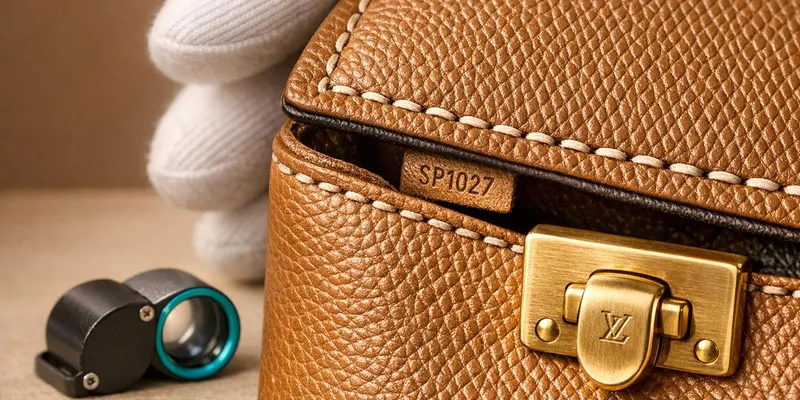
Authenticating pre-owned designer bags is essential to avoid counterfeit products and protect your reputation as a seller. With the luxury resale market expected to grow to €64.8 billion by 2028, understanding key features like material quality, stitching, hardware, logos, and serial codes is crucial. Counterfeit items often fail in these details, such as lightweight hardware, uneven stitching, or incorrect date codes. Professional services and AI tools like Entrupy can further ensure accuracy, offering up to 99.86% reliability. This guide walks you through practical steps to verify bags and build buyer trust in a competitive market.
How to Spot Authentic vs Fake Designer Bags: Visual Authentication Guide
The Best Luxury Handbag Authentication Services Comparison and How to Use Them
sbb-itb-d4aa959
Physical Features of Real Designer Bags
Spotting a counterfeit starts with examining the bag's material and craftsmanship. Luxury brands invest in premium materials and meticulous detailing that counterfeiters often fail to replicate. Knowing what to look for in these physical features is your best defense. For more professional advice, check out our reselling blog.
Material Quality and Leather Texture
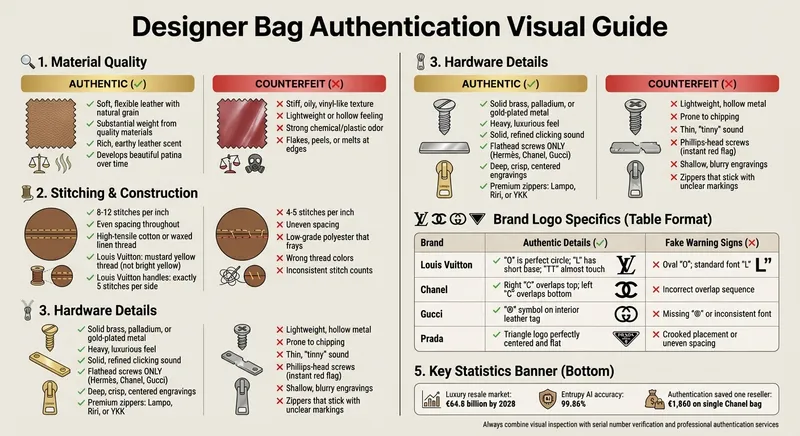
Genuine designer leather feels soft, flexible, and naturally grained, with a slight stretch to it. Counterfeit leather, on the other hand, often feels stiff, oily, or like cheap vinyl. This difference is immediately noticeable to the touch.
Weight is another clue. Authentic bags feel substantial due to high-quality leather and solid hardware. A bag that feels too light or hollow may be a fake.
Even the smell can give away authenticity. Real leather has a rich, earthy scent, while fake bags often have a strong chemical or plastic odor.
Aging also reveals authenticity. For example, Louis Vuitton's vachetta leather develops a beautiful patina over time, while fake materials tend to flake, peel, or even melt at waxed edges.
"Authenticity begins with material integrity. If the leather doesn't feel right, it probably isn't."
- Lena Moreau, Luxury Authentication Consultant, Rebag
Beyond the leather, stitching and hardware provide additional clues.
Stitching, Hardware, and Construction
Stitching is a key indicator. Authentic bags typically feature 8–12 stitches per inch, ensuring durability and precision. Counterfeits often have fewer stitches - around 4–5 per inch - with uneven spacing. For instance, Louis Vuitton consistently uses five stitches across each side of a handle tab.
Thread quality matters too. Luxury brands use durable materials like high-tensile cotton or waxed linen, while counterfeits rely on low-grade polyester that frays easily. For Louis Vuitton monogram canvas, the thread should be a specific mustard yellow shade - not bright yellow or orange.
The hardware is another giveaway. Genuine hardware is made from solid brass, palladium, or gold-plated metal, giving it a hefty, luxurious feel. Counterfeit hardware often feels lightweight, hollow, or prone to chipping. A simple test? Click or zip the hardware. Authentic pieces produce a solid, refined sound, while fakes sound thin or "tinny".
Screws are another detail to check. High-end brands like Hermès, Chanel, and Gucci use flathead screws exclusively. Spotting a Phillips-head screw is a clear sign of a fake.
"If you ever see a Phillips-head screw anywhere on a bag, just say: 'Nope. No, thank you. I'm done. Goodbye.'"
- Koyaana Redstar, Head of Luxury Buying, Luxe Du Jour
Finally, inspect the zippers. Authentic bags use premium zippers from manufacturers like Lampo, Riri, or YKK, which glide smoothly and feature clean, precise engravings. Counterfeits often have zippers that stick or show blurry, shallow markings.
Brand Logos and Markings
Logos and brand markings are another area where fakes fall short. Each luxury brand has strict standards for its designs.
For Louis Vuitton, check the font. The "O" should be a perfect circle, not oval. The "L" has a short horizontal base and long vertical leg, and the "TT" in "Vuitton" should almost touch. Louis Vuitton also rarely cuts the "LV" logo in half at seams.
Chanel's interlocking "C" logo has a specific overlap: the right "C" overlaps the left at the top, and the left "C" overlaps the right at the bottom. Any deviation suggests a fake.
Gucci bags feature an interior leather tag with the registered trademark "®" above the "GUCCI" name, followed by "made in Italy" in lowercase. Missing the "®" or inconsistent font weight are signs of a counterfeit.
For Prada, the inverted triangle logo plaque must be perfectly centered, with evenly spaced lettering. The interior lining should show a repeating "Prada" jacquard pattern.
Hardware engravings also demand close inspection. Authentic engravings are deep, crisp, and centered, while counterfeits often have shallow or uneven lettering.
Monogram alignment is crucial. Patterns like Gucci's GG or Louis Vuitton's fleur-de-lys should be symmetrical and align perfectly at seams. Misaligned quilting or monograms across pockets and seams is a clear red flag.
| Brand | Logo Detail | Counterfeit Signal |
|---|---|---|
| Louis Vuitton | "O" is a perfect circle; "L" has a short base | Oval-shaped "O"; standard font "L" |
| Chanel | Right "C" overlaps top; left "C" overlaps bottom | Incorrect overlap sequence |
| Gucci | Includes "®" symbol on interior leather tag | Missing "®" or inconsistent font weight |
| Prada | Triangle logo perfectly flat and aligned | Crooked placement or uneven spacing |
Checking Serial Numbers and Date Codes
Serial numbers and date codes act as a unique ID for luxury items. Each brand has its own system to track production, making these codes essential for verifying authenticity and identifying inconsistencies. When calculating potential resale value, remember to account for Vinted seller fees to ensure your margins remain profitable.
Finding and Reading Serial Numbers
Chanel updated its authentication system in April 2021. Bags made before this date have hologram stickers with unique serial numbers inside the bag. These stickers feature an "X" cut to prevent tampering. From Spring/Summer 2021 onward, Chanel introduced a rectangular metal plate (3 cm wide) engraved with the CC logo and an 8-digit alphanumeric code. For Wallet on Chains, you’ll find this inside the zip pocket.
Louis Vuitton uses date codes instead of unique serial numbers. These codes combine two letters (representing the factory location) with four digits that indicate the production week and year. You’ll usually find these embossed on leather tabs inside the bag or printed directly on the fabric lining. For example, "BC2108" means the bag was made in Italy during the 21st week of 2018.
Gucci bags, starting from the late 1990s, have a rectangular leather tag near the interior zip pocket. The tag displays 10–13 digits in two rows: the first row is the style number, and the second is the supplier code (letters are not included). Since 2016/2017, Gucci has also added a QR code on a black fabric tag inside the bag.
Hermès uses "blind stamps" directly embossed on leather straps, interior seams, or tabs. These stamps include a single letter for the production year, often accompanied by additional symbols.
These codes add another layer to physical inspections by providing specific production details.
How Date Codes Work
Date codes reveal when and where a bag was made. For Louis Vuitton, the two-letter prefix identifies the factory. French factory codes include AA, AH, AN, AR, AS, and BA, while Italian codes include BC, BO, CE, FO, MA, among others. The four digits following the letters represent the production week and year.
Chanel serial numbers (used between late 2005 and 2021) encode the production year in the first two digits. For instance, a serial number starting with "30" indicates a 2020 production, while numbers from "24" to "26" correspond to 2017–2019. Bags made from 2021 onward feature metal plates with NFC chips linked to a private blockchain. These chips can only be scanned by Chanel associates to access the bag’s full history.
A key factor to check is whether the date code aligns with the "Made in" stamp. For example, if a Louis Vuitton bag is stamped "Made in France" but its date code prefix (e.g., BC) points to Italy, the bag is fake. Likewise, for newer Chanel bags, the metal plate’s colour should match the hardware - gold hardware requires a gold interior plate.
Authentic codes are deeply and cleanly embossed, while counterfeits often show shallow stamping, blurry text, or uneven spacing.
| Brand | Code Type | Typical Location | Format |
|---|---|---|---|
| Chanel | Serial Sticker / Metal Plate | Interior corners, leather tabs, or centre lining | 7–8 digits; post-2021 models use NFC metal plates |
| Louis Vuitton | Date Code | Interior leather tab or printed on lining | 2 letters + 4 digits (factory/date) |
| Gucci | Serial Number Tag | Near interior zip pocket | 10–13 digits in two rows; no letters |
| Hermès | Blind Stamp | Leather straps or interior seams | Single letter (season) + number (year) |
Evaluating Wear-and-Tear Patterns
Once you've assessed the material quality and construction, the next step is to analyze how a bag ages. Authentic designer bags age gracefully, maintaining their structure and charm over time. On the other hand, counterfeit bags often reveal their poor craftsmanship through unnatural wear patterns. Being able to spot these differences can help you avoid costly mistakes when purchasing pre-owned luxury bags. If you're reselling, it's also vital to calculate your profit margins accurately.
Normal Aging Signs
Genuine leather has a way of maturing beautifully - it softens and develops a patina with use. For example, Louis Vuitton's untreated vachetta leather handles naturally darken over time due to exposure to sunlight and hand oils. This gradual change typically takes about a year of regular use. If you come across a vintage piece with handles that are still bright and untouched, it’s worth questioning its authenticity.
Authentic hardware also shows natural aging. While it may tarnish or oxidize, it retains its durability. A good example is the brass hardware on vintage Louis Vuitton bags, which often develops a greenish tint (verdigris) - a completely normal occurrence. Similarly, wax edges on handles might show minor hairline cracks after years of wear. However, significant peeling or splitting is not typical and should raise red flags.
"Knock-off luxury bags do not age well. The real bag vintages." - Vivian Turnage Leese, Author
In contrast, counterfeit bags exhibit unnatural wear patterns that starkly differ from these organic changes.
Warning Signs in Wear Patterns
Materials used in counterfeit bags react poorly to wear and tear. Fake leather, for instance, often cracks, peels, or becomes stiff instead of softening. Additionally, counterfeit hardware may lose its plating, exposing a cheaper base metal underneath. Authentic hardware, by comparison, feels heavy and solid, while fake clasps are often hollow or lightweight.
Watch out for misshapen bags or excessive creasing that doesn’t align with the bag’s age. While authentic bags may slouch slightly over decades, counterfeit ones often lose their shape entirely or develop sharp, unnatural folds. Wax edges on fakes might appear to "melt" or peel off in chunks. Other warning signs include chemical odors, loose stitching, and visible glue marks - all of which point to poor craftsmanship. Finally, consider the bag’s overall condition against its date code. A 10-year-old bag with pristine hardware and no signs of patina is a red flag.
| Feature | Authentic Aging | Counterfeit Warning Signs |
|---|---|---|
| Leather | Softens; develops patina; natural scent | Cracks; peels; chemical odor |
| Hardware | Tarnishes; retains weight; no rust | Plating chips; rusts; feels lightweight |
| Wax Edges | Minor hairline cracks | Melting; splitting; peeling |
| Structure | Slight slouching over time | Total shape loss; sharp creasing |
Using Technology and Professional Services
After analyzing wear patterns, technology-based authentication can give you the confidence you need to ensure an item's authenticity.
Professional Authentication Services
When your knowledge reaches its limits, professional authentication services can provide an added layer of assurance. Take Entrupy, for example. This service uses AI-driven microscopic imaging to analyze material grain, surface texture, and hardware finishes. These scans are then compared against a massive database containing millions of records of both genuine and counterfeit items.
Entrupy boasts an accuracy rate of 99.86% and supports over 20 high-end luxury brands, including Louis Vuitton, Chanel, Prada, and Hermès. One standout feature is their financial guarantee: every authenticated item is backed for a full year, protecting you in case an item certified as genuine is later found to be fake. Their pricing structure is flexible, catering to different levels of authentication needs.
"Entrupy's technology catches inconsistencies that even the experts can miss." - Entrupy
When choosing a service, make sure it specializes in the brands you deal with and provides a Certificate of Authenticity. This certificate not only adds credibility to the item's market value but also fosters buyer trust. For rare vintage items, it’s wise to combine AI technology with manual expert reviews. While algorithms excel at spotting patterns, human specialists bring historical knowledge that machines might miss. Once an item is authenticated, acting quickly to secure it is your next priority.
How VintiePlus Helps Resellers

Once your inventory is authenticated, efficient sourcing becomes key to scaling your business. That’s where VintiePlus steps in. This tool offers 24/7 real-time monitoring of online marketplaces, scanning for underpriced luxury items. With customizable filters, you can zero in on specific brands, price ranges, and item conditions. Plus, its auto-buying feature ensures you grab items instantly, beating out competitors.
VintiePlus also provides profit analytics to help you set optimal prices based on real-time market trends. By combining authentication expertise with smart sourcing tools, VintiePlus equips you to grow your reselling business while maintaining the high authenticity standards that buyers expect in the luxury pre-owned market.
Conclusion
Authenticating pre-owned designer bags goes beyond simply identifying counterfeits - it's about safeguarding your reputation and earning long-term buyer trust. As Lena Moreau, Luxury Authentication Consultant at Rebag, aptly states: "Authenticity begins with material integrity. If the leather doesn't feel right, it probably isn't". Careful manual inspections are the foundation of building credibility in the resale market.
While manual inspections are essential for catching visible inconsistencies, integrating technology takes your authentication process to the next level. For instance, in one case, authentication technology prevented a reseller from losing approximately €1.860 on a Chanel Classic Flap by identifying a subtle 2mm quilting misalignment. Combining hands-on expertise with digital tools not only helps avoid costly mistakes but also strengthens your standing in a market expected to grow to €63,5 billion by 2028. Buyers are willing to pay a premium when they trust the source, making authentication mastery a direct path to both credibility and profitability.