

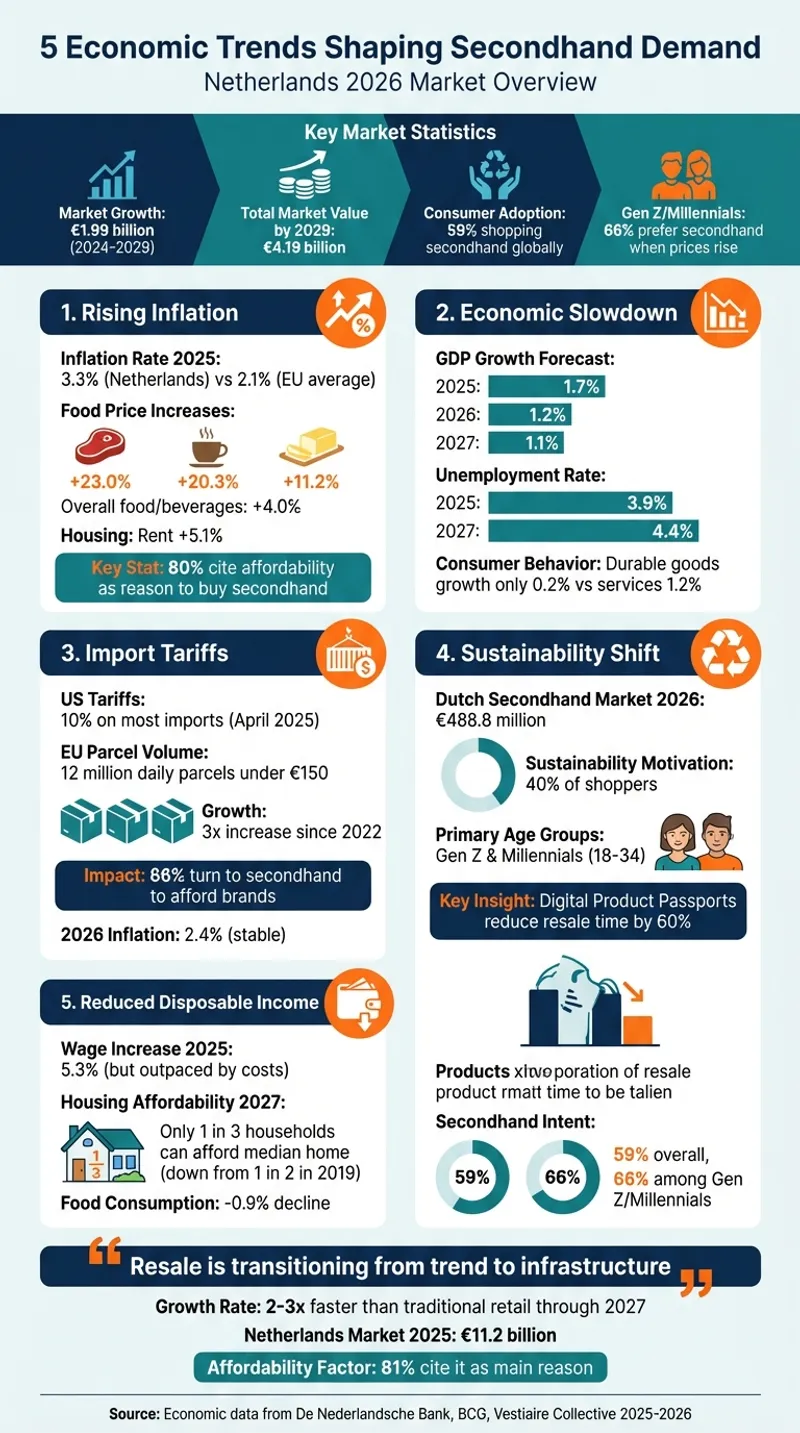
The secondhand market in the Netherlands is booming in 2026, driven by economic shifts and changing consumer habits. Inflation (2.4%) and slowing GDP growth (1.2%) are pushing households toward cost-effective options. Resale goods are becoming a practical solution for many, with 59% of global consumers expected to shop secondhand this year. Key trends shaping this shift:
- Rising Inflation: Higher costs for essentials (e.g., beef +23%, coffee +20.3%) are leading consumers to seek affordable alternatives.
- Economic Slowdown: GDP growth is slowing, unemployment is rising, and disposable incomes are shrinking, prompting more secondhand purchases.
- Tariffs Impacting Retail Prices: Import tariffs and EU policy changes are increasing the cost of new goods, driving demand for resale.
- Shifting Preferences: Younger generations (Gen Z, Millennials) are prioritizing secondhand shopping for affordability and ethical reasons.
- Reduced Disposable Income: Rising housing costs and limited budgets make resale a practical choice for Dutch households.
The secondhand market is expected to grow by €1.99 billion between 2024 and 2029, reaching €4.19 billion. Tools like VintiePlus are helping resellers navigate this growing demand by automating inventory sourcing and pricing. For consumers and businesses alike, secondhand is no longer just an option - it’s a necessity.
5 Economic Trends Driving Netherlands Secondhand Market Growth 2026
What’s behind a thrifting boom among American shoppers
1. Inflation Pushing Consumers Toward Affordable Options
Inflation in the Netherlands reached 3.3% in 2025, surpassing the euro area average of 2.1%. Persistent domestic demand and limited production capacity have kept prices elevated. This has left households grappling with rising costs, especially for everyday essentials, and searching for cheaper alternatives to stretch their budgets.
Food and non-alcoholic beverage prices climbed 4.0% last year, with some staples seeing sharp increases: beef soared by 23.0%, coffee by 20.3%, and butter by 11.2%. Housing costs also surged, with property rents rising 5.1%, up from a 3.7% increase the previous year. With these growing expenses, families are being forced to prioritize essentials, often at the expense of other spending.
One area gaining traction is the secondhand market. It offers a lifeline for cash-strapped consumers, providing high-quality items at much lower prices. This shift isn't limited to lower-income groups; it spans across demographics as households look for smarter ways to manage their finances.
"Affordability is the defining characteristic of secondhand fashion and luxury, cited by nearly 80% of respondents as a key reason to buy."
– BCG and Vestiaire Collective Report
Even with wages increasing by 5.3% in 2025, many are still feeling the pinch of inflation. Resale platforms have become a go-to solution, allowing people to access premium brands without the premium price tag. This trend underscores how inflation is reshaping spending habits, pushing more consumers to embrace secondhand options as a practical and cost-effective choice.
2. Recession Concerns and Slow Economic Growth
The Dutch economy is clearly hitting the brakes. After reaching a GDP growth of 1.7% in 2025, forecasts suggest this will drop to 1.2% in 2026 and slide further to 1.1% in 2027. This slowdown, largely tied to global trade tensions and widespread economic uncertainty, is starting to weigh on household budgets. Slower growth doesn't just mean weaker economic performance - it often translates to tighter personal finances.
Unemployment is also creeping upward. The rate, which stands at 3.9% in 2025, is predicted to climb to 4.4% by 2027. With job security on shaky ground, many families are tightening their belts, saving around 5% of their income.
"In an uncertain economic environment, firms are more reluctant to invest... Concurrently, households are saving a higher portion of their income... associated with elevated uncertainty and lower consumer confidence."
– De Nederlandsche Bank
This uncertainty is reshaping how people spend their money. Purchases of new durable goods - like clothing, electronics, and appliances - barely grew by 0.2% in September 2025, a stark contrast to the 1.2% growth seen in services. As a result, consumers are looking for more affordable options. Secondhand shopping, in particular, is gaining momentum as a practical alternative.
A 2025 survey by Boston Consulting Group and Vestiaire Collective, which included 7,800 participants, revealed that 66% of respondents turned to resale platforms to afford brands they otherwise couldn’t buy new. With economic growth slowing and uncertainty lingering, this trend toward secondhand purchases is likely to keep growing.
3. Higher Tariffs Increasing Retail Prices
US tariffs are having a noticeable impact on Dutch shoppers. In April 2025, the United States imposed 10% import tariffs on most foreign goods, with even higher rates targeting Chinese imports. As the Netherlands serves as a key logistics hub for the EU, these tariffs are indirectly pushing up retail prices across Europe.
Two key outcomes have emerged. First, Dutch companies rushed to import goods earlier in 2025, trying to beat the full brunt of the tariffs. However, this strategy only delays the inevitable, with higher prices anticipated in 2026. Second, the European Commission plans to remove the duty exemption for parcels valued under €150. This move aims to address unfair competition from non-EU online platforms. To put the scale into perspective, 12 million low-value parcels entered the EU daily in 2025 - a figure that has tripled since 2022.
"The introduction of import tariffs by the US is creating a lot of uncertainty worldwide. For Europe, the impact is twofold; retaliatory tariffs against the US could drive up costs."
– Katinka Jongkind, Senior Economist, ING
These rising costs are steering consumers toward secondhand goods as a more affordable option. With new retail prices climbing, 66% of consumers have turned to the secondhand market to buy or discover brands for the first time, often because they can no longer afford new items. Even with inflation holding steady at 2.4% in 2026, demand for pre-owned goods remains strong.
As discussed earlier, economic shifts like these are fueling interest in secondhand shopping. Vintage resellers can take advantage of this trend by using tools like VintiePlus (https://vintieplus.com). This platform offers real-time market scanning and instant auto-buying features, helping sellers secure inventory that meets growing demand.
sbb-itb-d4aa959
4. Growing Consumer Preference for Resale Shopping
In the Netherlands, resale shopping has undergone a major transformation. What was once seen as a budget-friendly alternative is now a lifestyle choice, deeply tied to concerns about the environment and the principles of a circular economy. More and more Dutch consumers are turning to resale as a way to combat the downsides of fast fashion - like excessive waste, high carbon emissions, and unethical labor practices.
The numbers back this up: the Dutch secondhand retail market is expected to hit €488.8 million by 2026, with 40% of shoppers motivated by sustainability. Leading this shift are Gen Z and Millennials (ages 18–34), who are making ethical fashion choices a priority and aligning their purchases with eco-conscious values.
This trend hasn’t gone unnoticed by key industry players.
"Whether seeking affordable, unique, pre-loved fashion or pursuing the thrill of the hunt for truly unique finds, resale is now firmly embedded in how people shop and build their wardrobes. Today, it's a deliberate choice."
– Fanny Moizant, Cofounder and President, Vestiaire Collective
Major brands are also stepping up to support this shift toward circular fashion. In October 2025, luxury label Chloé teamed up with Vestiaire Collective to introduce Digital Product Passports (DPPs) for their products. These passports simplify resale by providing instant authentication and detailed product history, cutting resale times by over 60%. Similarly, Patagonia’s 'Worn Wear' program, which allows customers to trade in used gear for store credit, has set a benchmark for circular initiatives.
For vintage resellers, this change in consumer attitudes presents a clear opportunity. Dutch households are no longer turning to secondhand shopping just for affordability - it’s also about aligning with their values. As demand for quality pre-owned items rises, platforms like VintiePlus (https://vintieplus.com) offer resellers tools like 24/7 monitoring and automated buying to secure the best inventory from this evolving market.
5. Reduced Disposable Income in Dutch Households
Dutch households are feeling the pinch as tighter budgets reshape spending habits, particularly in the secondhand market. Although wages increased by 5.3% in 2025, rising costs have left people with less disposable income for non-essential purchases. This financial strain has led many to seek more budget-friendly alternatives, including secondhand goods.
Housing costs are a major contributor to this squeeze. By 2027, only one in three Dutch households is expected to afford a median-priced home with a mortgage - down sharply from nearly half in 2019. At the same time, food and beverage consumption has dropped by 0.9%, as families cut back to manage their finances.
This economic reality is driving a noticeable shift toward secondhand shopping. A recent study found that 59% of consumers plan to opt for secondhand or lower-cost alternatives if rising expenses make new goods unaffordable. Among Gen Z and Millennials, this number is even higher, reaching 66%. For many Dutch households, secondhand shopping has become more than just an environmentally conscious choice - it’s a practical way to make ends meet while maintaining their quality of life.
This trend offers opportunities for vintage resellers. As more consumers adopt a "secondhand first" mindset to navigate reduced disposable income, demand for quality pre-owned items is climbing. Platforms like VintiePlus (https://vintieplus.com) help resellers keep up by automating inventory sourcing and spotting underpriced items, ensuring they can meet the growing appetite for secondhand goods.
Conclusion
Economic challenges in 2026, such as inflation and shrinking disposable incomes, have pushed secondhand shopping into the mainstream. With 59% of consumers turning to pre-loved items when prices climb - and that number rising to 66% among Gen Z and Millennials - the resale market has shifted from being a preference to an economic necessity. This changing dynamic offers resellers a chance to adapt and thrive in a tightening economy.
The secondhand market is projected to grow two to three times faster than traditional retail through 2027. For vintage resellers, this is a call to action. With traditional retail facing higher tariffs and stagnant growth, success lies in quickly identifying and acquiring underpriced inventory.
"Resale is transitioning from trend to infrastructure. From marketing to margin. From experiment to expectation." – Circular Resale
As competition heats up, automation is becoming a game-changer for resellers. Manual methods are no longer enough; AI-powered tools now define the leaders in this space. Tools like VintiePlus enable real-time scanning, authentication, and auto-buying, helping resellers secure sought-after inventory and price it competitively. Those clinging to outdated processes risk falling behind.
In the Netherlands, the secondhand market is forecasted to hit €11.2 billion by 2025, with 81% of consumers citing affordability as their main reason for shopping secondhand. This booming demand highlights the importance of leveraging advanced tools to stay competitive. Whether you're new to reselling or scaling an established business, the tools you use will determine whether you simply keep up with the trend or truly profit from it.