
DAC7 is an EU regulation introduced on 1 January 2023 that requires platforms like Vinted to report seller income data to tax authorities. It doesn’t create new taxes but ensures transparency by sharing seller data with authorities like the Dutch Belastingdienst.
Here’s what you need to know:
- Who is affected? Sellers on Vinted who exceed 30 sales or earn over €2.000,00 in a calendar year.
- What is reported? Personal details (name, address, BSN), financial data (IBAN), and transaction details (total sales, fees, etc.).
- When is it reported? Platforms submit data annually by 31 January for the previous year.
- What should you do? Keep accurate records, ensure your Vinted account details are correct, and verify the annual summary sent by Vinted.
Selling personal items at a loss isn’t taxable, but reselling for profit may be. Use tools like the Belastingdienst Ondernemerscheck to determine if your activity qualifies as taxable income.
Why Does DAC7 Apply to Vinted?
DAC7 applies to platforms like Vinted because it’s designed to target software that connects buyers and sellers for relevant activities. This includes selling goods where the platform can observe or calculate the payment involved.
Vinted meets this definition perfectly. It’s a marketplace where users sell items, and Vinted tracks the value of every completed transaction, which is possible because of how Vinted's fee system works. The European Commission pointed out that platforms are specifically included because they can collect and verify seller data more effectively than tax authorities.
For Vinted sellers, this means that data about your sales in 2023 will be reported to tax authorities, with the first reporting deadline set for 31 January 2024.
sbb-itb-d4aa959
Who is a Reportable Seller Under DAC7?
DAC7 Reporting Thresholds for Vinted Sellers: Are You Reportable?
In the EU, sellers using digital platforms like Vinted are subject to reporting under DAC7 if they surpass specific numerical thresholds. Let’s break down the conditions that determine if your activity on Vinted makes you reportable.
DAC7 Reporting Thresholds
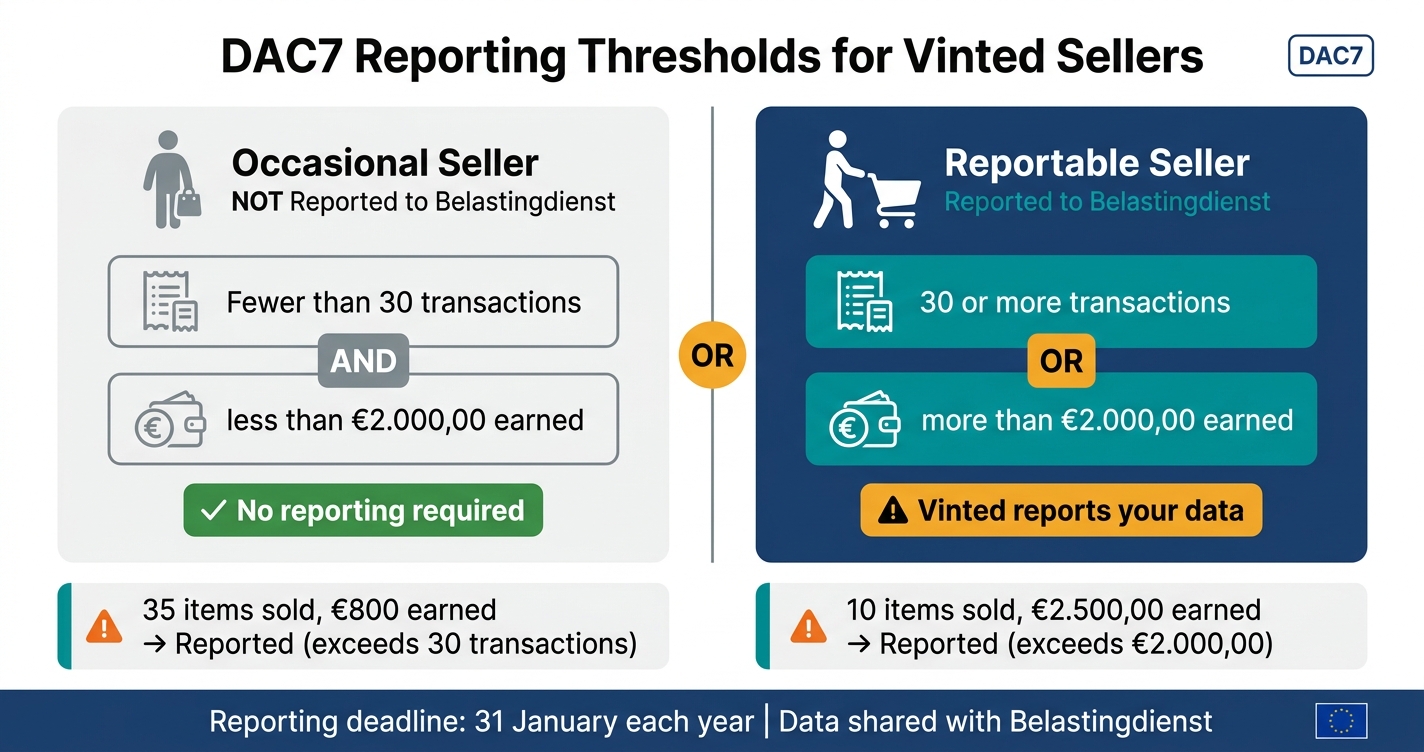
Vinted must report your data to tax authorities if, during a single calendar year (from 1 January to 31 December), you meet either of the following criteria:
- You complete 30 or more sales transactions, or
- Your total earnings exceed €2,000.
"If you have carried out more than 30 transactions or received a higher consideration than €2.000 per year, the platform must report on you."
You only need to meet one of these conditions to be reportable. For example:
- If you sell 35 items and earn €800, reporting is triggered because the transaction count exceeds 30.
- If you sell 10 items but earn €2,500, reporting is also triggered because your earnings surpass €2,000.
Exemptions for Occasional Sellers
Sellers who fall below both thresholds are not reportable. If you make fewer than 30 sales and earn less than €2,000 in a calendar year, Vinted will not share your transaction data with the Belastingdienst, even if you engage in cross-border trading.
| Seller Type | Transactions | Total Earnings (per calendar year) | Reported? |
|---|---|---|---|
| Occasional Seller | Fewer than 30 | AND less than €2,000 | No |
| Reportable Seller | 30 or more | OR more than €2,000 | Yes |
What Information Does Vinted Report?
When you meet the DAC7 thresholds, Vinted is required to collect and report specific information to tax authorities. Knowing what data is shared can help you stay informed and avoid any unexpected issues.
Seller Data Collected by Vinted
Vinted is obligated to gather both personal and financial transaction data for every seller who meets the reporting criteria. This isn't optional; as the European Commission puts it, "Platform Operators are responsible for conducting due diligence procedures to ensure the collection and the accuracy of the information reported concerning EU-sellers."
The collected data falls into four main categories:
| Category | Information Reported |
|---|---|
| Personal Identity | Full name, primary residential address, and date of birth |
| Tax Identifiers | Tax Identification Number (TIN/BSN), VAT ID, and business registration number (if applicable) |
| Financial Details | Bank account or financial account details (e.g., IBAN) where payments are made |
| Transaction Data | Total sales per quarter, number of sales, and any fees, commissions, or taxes withheld by Vinted |
It's important to note that gross figures may include shipping costs paid by buyers (a common consideration for those weighing Vinted Pro benefits and disadvantages), which means these amounts could be higher than the net earnings you receive.
Annual Reporting to Tax Authorities
Vinted submits this information to tax authorities annually, with a strict deadline of 31 January. This report covers all activity from the previous calendar year, from 1 January to 31 December.
"The reporting shall be made no later than 31 January of the year following the calendar year in which activities have been performed by EU sellers through the Platform." - European Commission
By the same deadline, Vinted is also required to send you a personal summary of the data it has reported. The Dutch Tax Authority advises: "In January of each year, the platform operator will provide an overview of data for the previous calendar year. You must check that the data and ask the platform to rectify the data if incorrect or incomplete."
Vinted initially reports to the tax authority in its registered EU country. From there, the information is shared with the Belastingdienst if you are a Dutch resident. This process is part of an EU-wide system for administrative cooperation, ensuring that the data is shared across member states rather than being limited to one country's jurisdiction.
DAC7 in the Netherlands: What Sellers Need to Know
The Role of the Dutch Tax Authority
After Vinted submits its annual report by 31 January, the Belastingdienst (Dutch Tax Authority) receives your data and runs automated checks to compare it with your personal tax return. According to the Belastingdienst:
"You will not automatically receive a (higher) tax assessment based on the information we receive about you. We will, however, include this information in the assessment of your tax return."
These checks ensure that the information provided by platforms like Vinted aligns with what you report. Here’s the key takeaway: selling personal items at a loss is not taxable, but reselling items for profit is. Ensuring your selling activity is classified correctly under DAC7 means that the data Vinted provides to the Belastingdienst will accurately reflect your taxable income.
To figure out whether your sales count as business activity for income tax or VAT purposes, use the Belastingdienst's Ondernemerscheck tool.
Euro and Date Formatting for Dutch Sellers
Keeping accurate records is essential to ensure your data matches what the Belastingdienst expects. When recording transactions, follow Dutch formatting standards:
- Use € for currency, with a comma as the decimal separator (e.g., €2.100,00).
- Write dates in the DD-MM-YYYY format (e.g., 01-01-2025).
Using these conventions helps avoid confusion or disputes if there are discrepancies between your records and the annual overview Vinted sends you each January. Proper formatting ensures your records are clear and defensible.
How to Prepare for DAC7 as a Vinted Seller
Keeping Clear Transaction Records
Staying on top of your sales throughout the year can save you from scrambling to organize everything at the last minute. Vinted provides tools like the "Your Wallet" and "Earnings" sections, which let you monitor your income in real time. But instead of waiting until the end of the year, exporting your data every quarter makes things much easier to manage.
For each sale, note the price, the DD-MM-YYYY date, the net amount, and the original cost of the item. This is especially important because the Belastingdienst is interested in your profit, not your total revenue. For example, if you sell a jacket for €35,00, but you originally bought it for €50,00, there’s no taxable gain. However, without proof of that original purchase, you can’t demonstrate this.
Hold onto all receipts and sales records for at least five years. Tax authorities can audit your past returns, and having detailed records will make the process smoother.
Keeping accurate logs also ensures your account details align with your actual activity.
Keeping Your Account Information Accurate
Vinted reports the information it has on file to the Belastingdienst. If your account details are outdated or incorrect, the report they send will reflect those errors. Double-check that your full name, primary address, date of birth, BSN (Dutch Tax Identification Number), and IBAN match your official documents.
If you notice any inaccuracies, request corrections from Vinted immediately. Ignoring these issues isn’t an option - and if you repeatedly fail to provide the necessary identification data, Vinted is legally required to deactivate your account.
For those managing higher volumes of sales, manual tracking might not be enough. This is where automation can be a game-changer.
Using Tools to Manage High-Volume Selling
If you’re a casual seller with just a few transactions each year, a simple spreadsheet should do the trick. But if you’re regularly buying and selling, manual tracking can become error-prone and time-consuming.
In such cases, platforms like VintiePlus can be incredibly helpful. VintiePlus offers real-time scanning and profit analytics, giving you the financial clarity needed to stay compliant with DAC7. This ensures your records and account information are always accurate and ready for reporting to the Belastingdienst.
Key Takeaways for Vinted Sellers
Under DAC7, Vinted sellers should be aware that this directive doesn’t introduce new taxes but focuses on transparency. Vinted must report seller data to the authorities if you exceed 30 transactions or €2.000,00 in sales. However, reaching this threshold only registers your activity with the Belastingdienst and doesn’t automatically mean you owe taxes.
Here’s what you need to know:
- Accurate data is essential: Provide your BSN, full name, address, and IBAN to Vinted. Also, review the annual summary they provide by 31 January. If there’s an error, request corrections quickly.
- Tax filing remains your responsibility: Even though Vinted reports your data, you’re still responsible for declaring any taxable income to the Belastingdienst.
The key difference lies in how tax authorities view your sales. Selling personal items at a loss is treated differently from reselling for profit. National tax rules determine whether your activity qualifies as a taxable source of income.
"The directive - and therefore also the threshold - does not in itself affect the answer to the question of whether a seller has a source of income or is an entrepreneur in the sense of national tax legislation." - Van Rij, State Secretary for Finance
To stay compliant, consider these practical tips:
- Keep purchase receipts for your items.
- Track your sales quarterly to maintain a clear overview.
- Ensure your account details on Vinted are always up-to-date.
If your sales volume increases, tools like VintiePlus can simplify profit tracking and help you prepare for reporting season.