
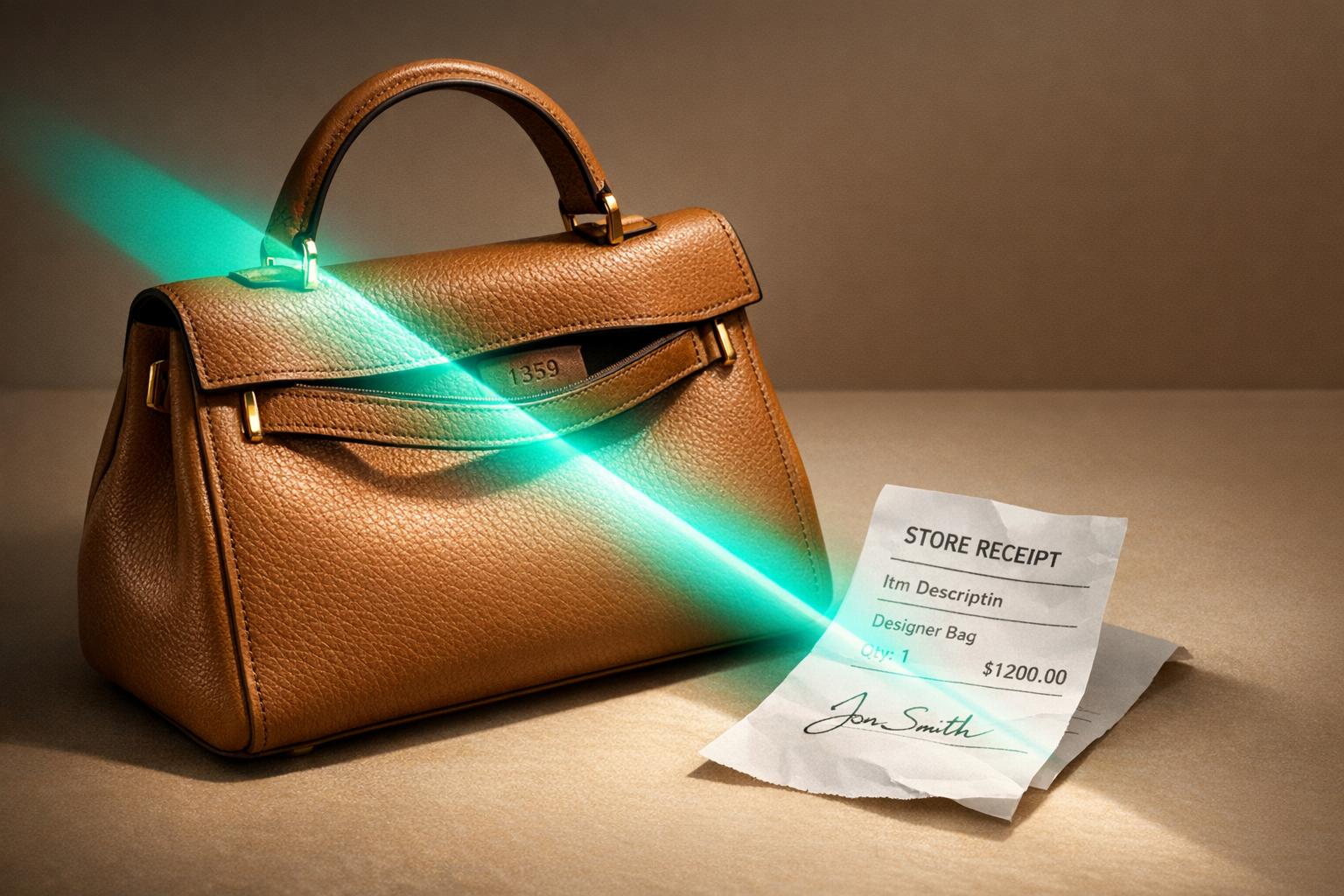
Buying secondhand luxury bags is popular, but the rise of counterfeits makes it risky. Scammers use advanced tactics like "superfakes", forged receipts, and fake authenticity cards to deceive buyers. For Dutch resellers, a single mistake can cost thousands of euros and damage their reputation. This guide highlights common scams, key red flags, and practical steps to protect yourself.
Key Takeaways:
- Too-good-to-be-true prices: Luxury bags heavily discounted (e.g., a €50,000 Hermès Birkin listed for €20,000) are likely fake.
- Forged documents: Scammers replicate receipts, authenticity cards, and even use fake third-party authentication sites.
- Unprotected payments: Avoid PayPal "Friends & Family", bank transfers, or gift cards - these leave you vulnerable.
- Suspicious sellers: New accounts, stolen images, or sellers avoiding authentication services are major warning signs.
- Physical flaws: Check stitching, material, hardware, and serial numbers carefully. Use brand apps or professional services for verification.
For resellers, safeguarding your reputation means combining careful inspections with reliable tools like VintiePlus and professional authentication services. Don’t let counterfeiters ruin your business.
THE DARK TRUTH: BUYING FAKES | The Rise Of Super Fake Handbags & How To Spot Them
sbb-itb-d4aa959
Common Counterfeit Bag Scams
The world of luxury resale is a tempting playground for scammers, and their tactics are becoming more sophisticated. Knowing how these scams operate is your best defense.
Fake Listings with Unrealistic Prices
Bargains that seem too good to be true usually are, though you can safely auto-buy underpriced secondhand products using the right monitoring tools. Imagine spotting a Hermès Birkin listed for €50,000 when the starting price is closer to €200,000. That’s a major red flag. Discounts on authentic luxury bags rarely exceed 20–30%, even during official sales. Anything priced at half or less of its retail value is almost certainly a counterfeit.
Scammers often combine polished stock photos with low-quality personal images to make their listings appear credible. They’ll also use high-pressure tactics like claiming “it must sell today” or “another buyer is ready to pay” to rush you into skipping proper checks.
"Suspiciously low prices represent the most significant red flag in the luxury goods market."
- Aman Mehta, D&D Lux
How to protect yourself:
Before engaging, research the current market value of the bag. Ask for timestamped photos or videos taken in natural daylight to confirm the seller actually owns the item. If a seller refuses authentication services or discourages independent verification, it’s likely a scam.
Next, we’ll look at how counterfeiters use fake documentation to mislead buyers.
Forged Documentation and Certificates
Fake documentation is a common tool used to trick buyers, but it often falls apart under close inspection. Scammers use digital tools to replicate brand receipts, complete with logos, timestamps, and SKU codes. A popular trick is pairing a genuine receipt (from a past authentic purchase) with a counterfeit bag.
Another deception involves fake third-party authentication websites. These sites often lack physical addresses or independent reviews, making them unreliable. Chanel authenticity cards and hologram stickers are frequently forged, with telltale errors in fonts or holographic effects that don’t change under proper lighting.
"Documentation supports authenticity. It does not prove it. The bag itself, its construction, materials, craftsmanship, tells the real story."
- Sign of the Times
How to protect yourself:
Examine receipts for missing store details, inconsistent fonts, or formatting issues. Check that dates on the documentation align with the bag’s production period. For example, Louis Vuitton replaced physical date codes with NFC microchips in 2021 - use their official app to scan and verify these chips. When possible, inspect the bag in person, focusing on brand-specific details like Hermès’ saddle stitching or Louis Vuitton’s handle tab stitches.
Now, let’s address payment scams and how they compromise buyer protection.
Unsecured Payment Methods and Diversion Tactics
Scammers often push for payment methods that leave you unprotected, such as PayPal “Friends & Family” transfers, direct bank transfers, or even gift cards. These methods not only eliminate buyer protection but also increase your financial vulnerability.
"If someone is asking you to remove your protection, that protection is likely needed."
- Sign of the Times
Another scam involves the "bait and switch." The seller advertises an authentic bag but ships a counterfeit instead. Asking for specific, unique photo angles can reduce this risk.
How to protect yourself:
Avoid using “Friends & Family” payments or direct bank transfers with unknown sellers. Stick to platforms that offer dispute resolution. If a seller pressures you to move off-platform, it’s a strong warning sign.
Finally, evaluating the seller’s credibility is crucial.
Suspicious Seller Profiles and Duplicate Listings
Fraudulent sellers often operate through new accounts with little to no history. They may impersonate established resale businesses on social media, using stolen images and usernames that closely mimic legitimate accounts. Sellers who restrict or disable comments may be trying to hide warnings from previous victims.
Be cautious of profiles offering multiple high-demand bags like Hermès Birkins or Chanel Classic Flaps at below-market prices. Genuine sellers rarely have several of these items available simultaneously.
How to protect yourself:
Check the account’s creation date and posting history. Verify social media usernames against official brand channels or customer-tagged posts. Use reverse image searches to see if the photos appear on other sites. If the seller is evasive or uncooperative, it’s best to walk away.
Physical Signs of Counterfeit Bags
After evaluating the seller and pricing, it’s time to focus on the bag itself. Authentic luxury bags are made with meticulous attention to detail, so even small flaws can be a giveaway for counterfeits. Examining the physical characteristics of the bag is a critical step to ensure authenticity.
Stitching and Material Quality
The stitching on genuine designer bags is flawless - straight, evenly spaced, and free of loose threads. Counterfeit bags often fail to replicate this precision, showing crooked lines, uneven spacing, or frayed ends. For specific brands like Louis Vuitton or Hermès, the number of stitches per inch can be a useful reference. On Chanel bags, the diamond quilting pattern should align perfectly where the flap meets the body.
The material quality is another key factor. Authentic leather is soft yet firm, with a natural grain that feels luxurious. Fake leather often feels stiff, overly smooth, or has a plastic-like texture. Genuine leather also has a rich, earthy smell, while counterfeit versions may have a chemical odor. For canvas pieces, such as Louis Vuitton monogram bags, the material should feel thick and durable. Thin or overly soft canvas, or low-quality interior linings made from polyester or synthetic fabrics, can indicate a fake.
"The leather should have slight 'give' when pressed and should not feel stiff or plasticky like many cheaper alternatives used in counterfeit goods."
- Aman Mehta, D&D Luxury
Hardware, Stamps, and Serial Numbers
Once you’ve checked the stitching, turn your attention to the hardware and serial markers. Genuine bags use high-quality metals like solid brass, palladium, or gold plating. Counterfeit hardware often feels lightweight and flimsy. For instance, vintage Chanel bags made before 2008 feature genuine 24K gold plating, while newer models use gold-tone alloys.
Engravings on authentic pieces are deep, clean, and sharply defined, with a polished finish. Counterfeits might use shallow laser etching, resulting in blurry or whitish grooves. High-end bags also feature premium zippers from brands like YKK, riri, or Lampo, which operate smoothly. Generic or unbranded zippers are a red flag.
Brand stamps are another detail to scrutinize. Chanel, for example, uses block fonts (never cursive) with perfectly spaced and centered lettering. The iconic "CC" logo is designed so that the right "C" overlaps the left at the top, while the left "C" overlaps the right at the bottom. Any spelling errors, blurry embossing, or incorrect font weights can signal a fake. Serial numbers are also brand-specific; Louis Vuitton uses two letters followed by four numbers, while Chanel previously relied on 7- or 8-digit sticker codes before transitioning to embedded NFC microchips. If the bag features an NFC chip, use the brand’s official app to verify authenticity.
Comparing with Official Brand References
To confirm authenticity, compare the bag’s details with official brand references. Check elements like lining, logo stamps, and serial number placement against high-resolution images from the brand. Pattern alignment is another crucial factor; for instance, Louis Vuitton’s monogram should flow symmetrically across seams and never appear cut off.
For bags made after 2021, brands often include NFC microchips that can be scanned using official apps. For older models, cross-referencing date codes with brand-specific databases can help verify production locations and timelines. You can also use professional tools like Entrupy or services like Real Authentication and Authenticate First for expert verification. Community forums like PurseBlog are great resources for detailed insights into brand history and production variations.
These physical inspections add another layer of security to earlier authentication steps. While digital checks can catch fake documentation, these hands-on evaluations can uncover subtle flaws in craftsmanship that counterfeiters often overlook.
How to Avoid Counterfeit Scams
Spotting potential counterfeits is just the first step. To fully protect yourself, it's crucial to follow secure transaction practices and use reliable tools. These measures can help ensure your money stays safe while avoiding fraudulent purchases.
Safe Transaction Practices
Choose payment methods that offer strong buyer protection. For instance, credit cards allow chargebacks if you end up with a counterfeit product. Similarly, PayPal Goods & Services provides a safety net. As highlighted by Sign of the Times, "If someone is asking you to remove your protection, that protection is likely needed".
Be cautious of sellers pushing for payment through bank transfers, cash, or cryptocurrency - these methods lack buyer protection entirely. Also, be wary of sellers who try to move conversations off-platform. Always request detailed photos taken in natural light, showing key details like stitching, engravings, serial numbers, and interior stamps. Additionally, ask for a formal invoice that clearly outlines the item and its terms. If a seller hesitates or refuses such requests, it’s a clear sign to walk away.
Professional Authentication Services
When purchasing high-value items, professional authentication services are a smart investment. Companies like Entrupy, Authenticate First, and Real Authentication utilize advanced AI-based tools to verify items remotely. With clear photos, digital authentication can be completed in as little as 30 seconds. For physical authentication, shipping and manual handling are required, but the extra effort can be worth it.
Counterfeits make up roughly 10% of all designer handbags sold globally, costing design houses over €24 billion annually. Leading services like LegitGrails boast accuracy rates above 99%. Aman Mehta from D&D Luxury emphasizes, "The service fees are minimal compared to the potential loss from purchasing expensive fakes". Genuine sellers typically welcome professional authentication - it protects both the buyer and the seller. If a seller resists, consider it a dealbreaker. Once authenticated, you can further protect your investment by incorporating advanced monitoring tools into your buying process.
Using VintiePlus for Safer Sourcing
To complement authentication services, VintiePlus offers a proactive way to source authentic items. Its 24/7 marketplace scanning monitors listings in real-time, alerting you to genuine underpriced items as they appear. This automation minimizes the risk of falling for fraudulent deals and saves time.
With custom filters, you can set specific parameters like brand, condition, and price range, eliminating suspicious listings - such as a €50 Hermès Birkin - that are likely counterfeit. The Auto Buy feature further secures authentic items instantly, using credit card payments for added buyer protection and tracked transactions.
VintiePlus offers three subscription plans. The Basic Plan, priced at €29,95 per month, includes 10 custom filters, auto-buy functionality, and 24/7 chat support. The Pro Plan (€69,95/month) provides unlimited filters and batch label printing, while the Ultimate Plan (€109,95/month) adds high-priority sniper features for professional users. All plans include access to the VintiePlus Discord community, where resellers can exchange tips and verify listings together.
Authentication Checklist for Resellers
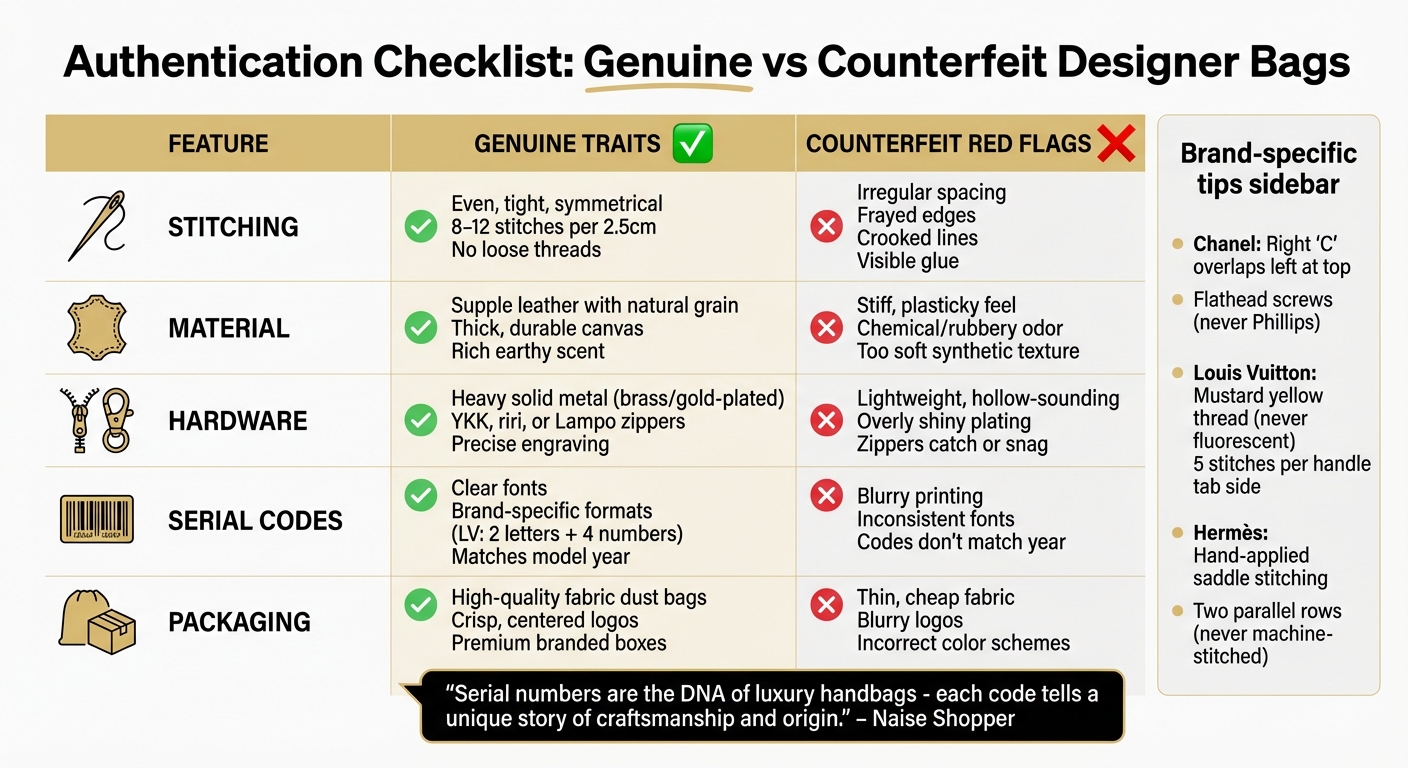
Authentic vs Counterfeit Designer Bag Authentication Checklist
Feature Comparison Table
After diving into our detailed guide on physical inspections, this checklist serves as your quick-reference tool for verifying authenticity. It condenses critical authentication points, so you can confidently assess items on the spot and calculate your potential profit.
| Feature | Genuine Traits | Counterfeit Red Flags | Verification Tip |
|---|---|---|---|
| Stitching | Even, tight, symmetrical; perfectly straight seams; no loose threads; 8–12 stitches per 2.5 cm. | Irregular spacing, frayed edges, crooked lines, or visible glue residue. | Count handle tab stitches - Louis Vuitton always has five per side. |
| Material | Supple leather with natural grain; thick, durable canvas; rich earthy scent. | Stiff, plasticky, or "too soft" synthetic feel; chemical or rubbery odour. | Press the leather - it should have slight give and not feel like plastic coating. |
| Hardware | Heavy, solid metal (brass/gold-plated); smooth zipper glide from YKK, riri, or Lampo; precise engraving. | Lightweight and hollow-sounding; overly yellow or shiny plating; zippers that catch or snag. | Tap the hardware to check density and look for chipping or peeling on metal surfaces. |
| Serial Codes | Clear fonts that adhere to brand-specific formats (e.g., LV date codes: 2 letters + 4 numbers). | Blurry printing, inconsistent font weights, or codes that don't match the model year. | Cross-reference the factory code (letters) with the "Made in" country stamp. |
| Packaging | High-quality fabric dust bags; crisp, centred logos; premium branded boxes. | Thin, cheap fabric; blurry or misprinted logos; incorrect colour schemes. | Check the dust bag's thickness and compare the clarity of the brand's font on all inclusions. |
This checklist highlights essential steps to spot counterfeits and safeguard your reputation. Some brand-specific details can add extra layers of verification: for example, Chanel's authentic logo has the right "C" overlapping the left "C" at the top, with backplates using flathead screws - not Phillips head. Louis Vuitton monogram bags feature yellow beeswax-dyed thread in a mustard shade, never fluorescent yellow. Hermès uses hand-applied saddle stitching with two parallel rows - machine stitching is an immediate red flag.
"Serial numbers are the DNA of luxury handbags - each code tells a unique story of craftsmanship and origin."
– Naise Shopper
Conclusion
For Dutch resellers, protecting both profits and reputation requires a robust, multi-layered approach to authentication. Relying solely on one method - whether it's inspecting stitching or checking documentation - leaves you exposed to advanced "super fakes." Just one counterfeit sale can lead to hefty financial losses and irreparable harm to your credibility.
"In luxury, trust matters as much as craftsmanship"
- Sign of the Times
Buyers are willing to pay premium prices - ranging from €47.000 to €122.000 for genuine Chanel bags or over €200.000 for Hermès Birkins - only when they are confident in the item's authenticity. Each verification step strengthens the next, ensuring your transactions align with the trust your business depends on.
Luxury brands are now integrating NFC microchips and QR codes to replace outdated date codes. By blending physical checks, professional authentication services, and advanced tools like VintiePlus, you can stay ahead of counterfeiters. VintiePlus offers 24/7 automated marketplace monitoring and custom filters, helping you spot genuine items before competitors while steering clear of suspicious listings - such as those priced 50% below market value.