
The vintage reselling market in the Netherlands is moving fast, and manual methods can’t keep up. Imagine spotting a Stone Island jacket on Vinted for €50,00, knowing it can resell for €200,00 - gone in seconds. Automated tools like VintiePlus change the game by scanning platforms like Vinted, Marktplaats, and Tweedehands 24/7, instantly purchasing underpriced items that match your criteria.
Here’s how it works:
- Automation scans for deals: Bots monitor listings non-stop, set to your preferences (brands, prices, sizes, etc.).
- Auto-buy features save time: Items are purchased within milliseconds, ensuring you don’t miss out.
- Dutch-specific settings: Tailored for local platforms, payment methods (iDEAL), and shipping options (PostNL, DHL).
- Success rates are high: VintiePlus users report a 98% success rate, buying over 500 items daily.
For Dutch resellers, this means focusing on scaling your business while automation handles sourcing. Whether flipping Gucci bags or Stone Island jackets, automation ensures speed and efficiency in a competitive market.
Key benefits:
- Save time with 24/7 monitoring and buying.
- Increase profits by targeting undervalued items.
- Tailor filters to match Dutch market preferences.
Automation isn’t just a tool - it’s how resellers stay ahead in a fast-paced second-hand market.
Finding Profitable Vintage Items
Profitability in vintage reselling comes down to smart selection. Successful resellers don’t just rely on instinct or aesthetics - they dig into research, verify authenticity, and calculate potential margins before making a purchase. Whether your focus is on designer handbags, collectible streetwear, or rare Pokémon cards, knowing the specific markers of value in each category can help you separate true gems from overpriced fakes.
How to Spot Undervalued Items
Start by researching brands that are in high demand. On platforms like Vinted and Marktplaats, names like Stone Island, Gucci, and Ralph Lauren consistently fetch strong resale prices. Use tools like the "Sold items" filter to get a realistic sense of what buyers are paying.
When it comes to designer goods, look for maker’s marks, serial codes, and hidden trademarks to confirm authenticity. Genuine vintage items often show wear in natural patterns - think frayed edges or faded areas in high-use spots - unlike the uniform look of artificially distressed pieces.
Material quality is another giveaway. Vintage items made with silk, cashmere, or solid woods like oak and walnut tend to feel more substantial compared to their modern, mass-produced counterparts. For furniture, check the underside for telltale signs of reproduction, like modern screws or power tool marks. Items with original tags or packaging also tend to command higher resale values.
Speed is crucial for snagging bargains. On platforms like Vinted, undervalued items often disappear within seconds. Professional resellers often rely on automated monitoring tools to stay ahead. As Sean Scherer from Kabinett and Kammer explains:
"The incentive of the forger is to try to fake the Regency credenza they can get $50,000 for."
Once you’ve found a potential deal, don’t skip the math - calculate its resale value to ensure the flip is worth the effort.
Calculating Profit and Key Metrics
After identifying undervalued items, it’s time to assess their profit potential. A general rule of thumb is to aim for a resale price that’s two to four times the original purchase cost. Many resellers aim for a 2× to 2.5× markup to keep sales volume steady. To calculate net profit, subtract your purchase price, packaging costs, and transaction fees from the final selling price.
Here are some examples from VintiePlus users:
- Gucci Mini Shopper: Bought for €125,00, resold for €350,00 (profit: €225,00).
- Stone Island Soft Shell-R Jacket: Bought for €50,00, resold for €200,00 (profit: €150,00).
- Ralph Lauren Shirt: Bought for €8,00, resold for €32,50 (profit: €24,50).
Automated tools like VintiePlus can help track these metrics and speed up decision-making by providing real-time pricing data. Platforms like Vinted, where sellers pay 0% commission (buyers cover a service fee of €0,70 plus 5% of the item price), allow you to retain most of your margins. However, don’t overlook additional costs like shipping and packaging. For high-ticket items, verifying serial codes and documenting authenticity can boost buyer confidence and justify premium prices.
Use tools like Google Trends to monitor price trends and demand spikes. To move inventory quickly, ensure items are either in "like new" condition or priced at least 30% below market value.
Value Indicators by Category
Each vintage category has unique markers that signal value. Understanding these can sharpen your buying instincts.
- Designer Handbags: Look for serial codes, authenticity markers, and premium leather. Stamps from brands like Chanel or Hermès and "buttery soft" leather are key indicators. Searches for Gucci on resale platforms have jumped 45%, while Louis Vuitton inquiries are up 24%. Authentic hardware and labels are critical for avoiding counterfeits.
- Collectible Streetwear: Brand popularity and current fashion trends are crucial. Items from Stone Island, Ralph Lauren, and Arte are particularly sought after. Original tags, detailed stitching, and embroidered logos often add value. Pieces from the 1990s with a true vintage feel are especially popular, aligning with Y2K and "old money" aesthetics.
- Pokémon Cards: Pay close attention to rarity symbols and condition. Features like holographic finishes, first edition stamps, and specific set markers (e.g., Shadowless Base Set) can significantly increase value. Grading services like PSA or Beckett are helpful for determining a card’s condition, with mint cards retaining full value while those in "good" condition may sell for 50–70% of their peak value.
| Category | Key Value Indicators | Average Sale Price |
|---|---|---|
| Designer Handbags | Serial codes, authenticity markers, quality leather | €100,00–€500,00+ |
| Hype Sneakers | Model (e.g., Jordan 4, NB 550), scarcity | €70,00–€200,00 |
| Streetwear | Brand recognition, original tags, logo type | €15,00–€200,00 |
| Iconic Denim | Brand (Levi's 501), wash, size | €30,00–€80,00 |
| Outdoor Jackets | Brand (North Face, Patagonia), seasonality | €60,00–€150,00 |
Timing is another factor that can make or break profitability. Buying off-season - like picking up heavy coats in summer - can help you maximize margins when demand spikes later. For instance, North Face puffers sell best in January, while white sneakers and floral dresses fly off shelves in April. Backpacks tend to peak in August and September. Knowing these seasonal trends can help you buy low and sell high consistently.
Setting Up VintiePlus for Automated Buying
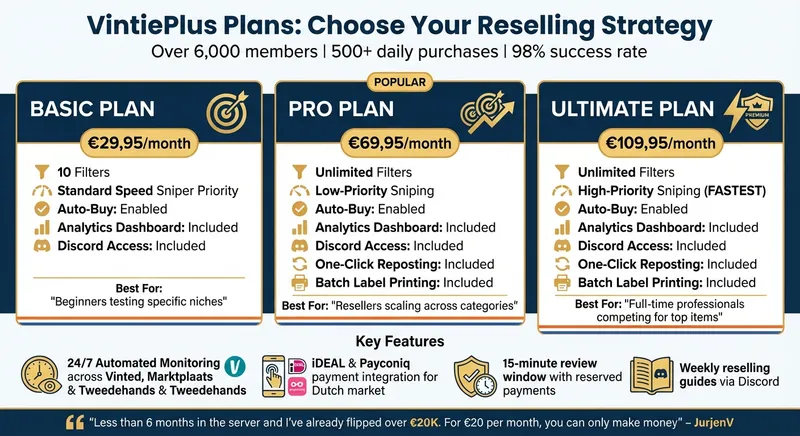
VintiePlus Pricing Plans Comparison for Dutch Vintage Resellers
Getting started with VintiePlus is straightforward, requiring just a few technical steps. This platform supports three major marketplaces - Vinted, Marktplaats, and Tweedehands - making it a go-to tool for Dutch resellers. With over 6,000 members and 500+ daily purchases, it's a trusted choice for many.
VintiePlus Core Features
Once you've identified profitable items, VintiePlus takes over to simplify your buying process. Acting as a round-the-clock monitoring system, it scans marketplaces continuously for items that match your criteria. The standout feature? Its Auto-Buy function, which snaps up undervalued items instantly - beating manual buyers to the punch. This is a game-changer, especially when sought-after vintage treasures tend to vanish quickly.
The platform's custom filter system allows you to fine-tune your search by specifying parameters like brands, price ranges (in euros), sizes, and item conditions. Basic plan users can create up to 10 filters, while Pro and Ultimate subscribers enjoy unlimited filters for broader searches. For those on Pro and Ultimate plans, an analytics dashboard provides insights into your purchase history, profit margins, and filter performance - key metrics for refining your buying strategy.
You’ll also gain access to weekly reselling guides via Discord. As user JurjenV shared:
"Less than 6 months in the server and I've already flipped over €20K. For €20 per month, you can only make money".
Another user, HavocMT, highlighted the effectiveness of the Auto-Buy tool:
"The autobuy tool works like magic since manual sniping almost never lands the deals!".
Configuration Steps
Setting up VintiePlus starts with retrieving your authentication tokens from Vinted. This is a one-time process that links your Vinted account to the platform. For this step, you'll need to use Firefox, as other browsers may not display the necessary data correctly.
- Log out of Vinted in Firefox.
- Press F12 to open the Inspect Tool and navigate to the Network tab.
- Filter for "oauth" and enable "Preserve log" to keep data visible during login.
- Log back into Vinted using your email credentials (third-party logins like Google won’t work).
- Locate the "oauth" request in the Network tab, then open the Response tab. Here, you’ll find two key strings: the Access Token and Refresh Token. Copy these and paste them into your VintiePlus profile, then click update to connect your account.
Next, set up your shipping preferences. Choose between automated Home Shipping or manual Pickup Points using the interactive map. For Dutch users, configuring iDEAL or Payconiq as your primary payment method ensures smooth local transactions.
Once that's done, head to the Monitor page and activate Auto-Buy. If you’re using PayPal or 3D Secure Payconiq, items will be reserved for 15 minutes, giving you time to manually confirm or cancel the purchase.
Settings for Dutch Resellers
After completing the initial setup, it’s time to customise your filters to align with the Dutch market. Tailoring your settings to local trends ensures quicker transactions and better results with preferred payment methods like iDEAL.
For Dutch resellers, focusing on profitable categories and brands such as Arte, Stone Island, and Parajumpers is a smart strategy. Set price caps in euros that match your profit goals. For instance, if Parajumper jackets typically resell for €150,00, consider setting your maximum purchase price between €60,00 and €75,00.
To maximise inventory opportunities, enable monitoring across Vinted, Marktplaats, and Tweedehands. Using Dutch-language keywords in your filters can help capture listings from local sellers who might undervalue their items due to limited market knowledge.
For those looking to compete for premium items, the high-priority sniper feature (available with the Ultimate plan at €109,95/month) ensures the fastest response times. Basic plan users (€29,95/month) benefit from standard Auto-Buy speed, while Pro plan subscribers (€69,95/month) enjoy unlimited filters with low-priority sniping - a great option for resellers looking to expand their reach.
| Plan | Monthly Price | Filter Limit | Sniper Priority | Best For |
|---|---|---|---|---|
| Basic | €29,95 | 10 Filters | Standard | Beginners testing specific niches |
| Pro | €69,95 | Unlimited | Low-Priority | Resellers scaling across categories |
| Ultimate | €109,95 | Unlimited | High-Priority | Full-time professionals competing for top items |
Use the analytics dashboard to track your filters’ performance. This will help you identify which brands and price ranges deliver the best margins, enabling you to fine-tune your strategy over time.
Improving Your Automated Workflows
Once you've set up automation, the real magic lies in fine-tuning your workflows. The leap from a basic automated system to one that's highly efficient often depends on how well you've adapted your successful manual strategies into precise automated filters and safeguards. Let’s break it down.
Converting Manual Sourcing to Automation
Think about the strategies you’ve used manually on Vinted. Maybe you’ve noticed that listings posted during off-peak hours or those from sellers with less-polished descriptions often offer better deals. These observations can be turned into actionable automated rules. For instance, if you frequently spot pricing outliers or minimally detailed listings, tweak your filters to include relevant brand names and descriptive Dutch keywords like "mooie jas" or "vintage trui" to better target local deals.
Timing plays a huge role here. Unlike manual browsing, VintiePlus scans marketplaces non-stop, at speeds no human could match. This constant monitoring ensures your filters capture early-morning uploads or weekend listings that manual buyers might overlook. With a 98% success rate for automated purchases, the platform shows how speed can directly translate into securing valuable inventory. By integrating these adjustments into your workflows, you can boost both precision and efficiency.
Workflow Components
A successful automated workflow is more than just setting up an auto-buy function. It starts with filter configuration - your choices for brands, price ranges (in euros), sizes, and conditions act as the first safeguard against irrelevant or risky purchases. Once your filters are in place, activate an auto-buy trigger that kicks in as soon as an item matches all your criteria. To add a layer of security, use reserved payment methods, which give you a 15-minute review window. This short pause lets you double-check authenticity markers before finalising the purchase.
When combined, elements like precise filters, auto-buy triggers, seller notifications, and one-click reposting create a smooth workflow that takes you from sourcing to selling effortlessly.
Managing Risk with Automation
After setting up your workflow, the next challenge is managing risk to keep your automation profitable. Set purchase price caps to ensure healthy margins. For example, if you plan to resell a vintage Gucci bag for €300, limit your automated purchase price to around €100. This leaves room for profit after accounting for Vinted’s buyer commission, which is typically €0.70 plus 5% of the item price.
Additionally, strict condition filters can help you avoid quality issues while maintaining profit margins. For higher-priced items, you might want to disable full auto-buy and instead rely on VintiePlus’s notification system. This allows you to manually confirm the purchase after a quick review, giving you an extra layer of control. The analytics dashboard is another valuable tool - it helps track the performance of your filters so you can refine them over time for even better results.
sbb-itb-d4aa959
Scaling Your Reselling Business
Ready to take your reselling venture to the next level? Scaling your business means boosting inventory, reaching broader markets, and turning occasional sales into steady income. But growth also comes with risks, so it’s essential to expand smartly while keeping control over operations. Here’s how you can do it.
Reducing Risks in Automated Buying
Automation can save time, but it comes with its own set of challenges - especially on platforms like Vinted, where automation is prohibited. Actions that appear too "robotic", like rapid listing updates or bulk messaging, can lead to account suspension. To avoid detection, spread out automated tasks throughout the day rather than executing hundreds of actions at once.
Financial risks are another factor. Automated buying uses your Vinted balance or linked payment methods immediately, which could lead to unintended purchases if filters aren’t set up correctly. To prevent this, configure filters with precision - focus on specifics like brand, size, and condition. For high-value items, such as a vintage Louis Vuitton bag priced at €250,00, it’s wise to disable full auto-buy. Instead, manually verify details like authenticity markers before completing the purchase. If your region supports PayPal or Payconiq, you can use the 15-minute reservation feature to double-check photos and descriptions before committing.
Additionally, keep an eye on the EU’s Safety Gate system, which flags dangerous or recalled products. This ensures you’re not accidentally buying or selling items that could pose risks.
Growth Strategies for Dutch Resellers
As your business grows, expanding across multiple platforms can help you reach more buyers. Tools like VintiePlus are particularly useful, as they support Vinted, Marktplaats (Netherlands), and Tweedehands (Belgium). Opting for higher-tier plans like Pro (€69,95/month) or Ultimate (€109,95/month) gives you access to features like "low-priority" and "high-priority" snipers. These tools help secure high-demand items - think vintage Nike sportswear or rare Pokémon cards - faster than manual methods.
Scaling also means managing higher volumes of inventory and sales. Features such as one-click reposting and batch label printing, available in Pro and Ultimate plans, reduce manual work significantly. Automated tools can further streamline operations by sending offers to users who favourite your items or dispatching welcome messages to new followers. These time-saving features allow you to engage with potential buyers efficiently, even as your customer base grows.
For long-term growth, use data analytics to refine your strategy. The VintiePlus dashboard can help you identify trends, such as undervalued niches or profitable categories. For example, if vintage Gucci bags bought for under €100,00 consistently resell for €300,00, it might be worth focusing more on that segment. Seasonal buying is another effective tactic - purchase winter coats during summer when prices are lower, then sell them in autumn when demand spikes. Cross-listing on platforms like eBay, Depop, and Vinted can also increase your sales velocity.
Compliance and Business Requirements
Once reselling becomes a regular activity, staying compliant with Dutch and EU regulations is crucial to protect your profits and business operations. Registering as a sole trader (Eenmanszaak) ensures you meet tax obligations and adhere to consumer protection laws. In the Netherlands, sellers are required to guarantee that second-hand items function properly for at least one year after the sale. If a defect arises within 12 months, the burden of proof lies with the seller to demonstrate that the issue wasn’t their fault.
Starting 13 December 2024, the EU’s General Product Safety Regulation (GPSR) will apply to all second-hand, repaired, and reconditioned products. As a "distributor", you’ll need to ensure items have proper identification (like batch or serial numbers), manufacturer details, and a designated "responsible person" within the EU. For example, selling clothing with cut-off labels or electronics without documentation may violate compliance rules. In Germany, proposed fines for non-compliance could reach up to €100.000,00.
If you’re sourcing vintage items from outside the EU, such as archaeological objects over 250 years old, you’ll need to use the electronic Import of Cultural Goods (ICG) system to submit licences or statements. For items older than 200 years with a customs value exceeding €18.000,00, an importer statement (self-certification) is required. Additionally, retain the EU Declaration of Conformity for applicable products for 10 years from the date they’re placed on the market.
Conclusion
Automated vintage buying is a game-changer for saving time and snagging exclusive deals in a competitive market. VintiePlus equips resellers in the Netherlands and across the EU with powerful tools to track platforms like Vinted, Marktplaats, and Tweedehands 24/7. This allows users to grab underpriced items faster than traditional methods while improving inventory management. With a community of over 6,000 members and more than 500 successful purchases daily, the platform has clearly made its mark.
The numbers speak for themselves: users achieve a 98% success rate, with over €649,074.00 worth of items purchased. Resellers like Boaz report covering their subscription costs after just 40–50 sales. Imagine buying a Stone Island jacket for €50.00 and reselling it for €200.00 or flipping a Gucci Mini Shopper purchased at €125.00 for €350.00 - automation turns these opportunities into consistent profits.
However, scaling up requires careful attention to risk management and legal compliance. To protect your profits and reputation, it’s crucial to use precise filters, manually verify high-value items, and adhere to Dutch and EU regulations.
VintiePlus isn’t just a tool - it’s a comprehensive ecosystem tailored to the Dutch and EU reselling market. With subscription plans and advanced features like high-priority sniping, the platform delivers returns that quickly justify the investment. Plus, the added benefits of analytics and a supportive Discord community make it easier to turn vintage reselling into a scalable business.
Whether you’re just starting out or looking to expand across multiple platforms, success lies in being strategic, automating wisely, and scaling intelligently. As the vintage market continues to grow - Vinted alone boasts 80 million users with a 20% annual growth rate - those who succeed will be the ones who embrace the right tools at the right time.